


Ελληνικό Αρχείο Τσε Γκεβάρα © Guevaristas
Η πρώτη και πληρέστερη ελληνική ιστοσελίδα για τον Ερνέστο Τσε Γκεβάρα.

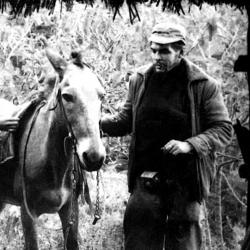
Φωτογραφίες από το αντάρτικο στην κουβανική ύπαιθρο την περίοδο 1956-1959.


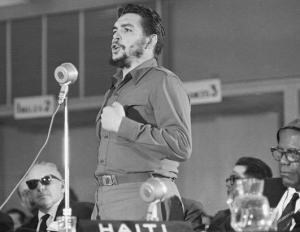 Η παρακάτω ομιλία εκφωνήθηκε από τον Ερνέστο Τσε Γκεβάρα κατά το δεύτερο Οικονομικό Συμπόσιο της Αφρο-Ασιατικής Αλληλεγγύης. Η Σύνοδος έλαβε χώρα στην πρωτεύουσα της Αλγερίας και μετείχαν αντιπρόσωποι 63 Αφρικανικών και Ασιατικών κυβερνήσεων όπως επίσης και 19 εθνικοαπελευθερωτικά Κινήματα απ’ όλον τον κόσμο. Η Κούβα προσκλήθηκε ως παρατηρητής της Συνόδου και ο Τσε μετείχε της προεδρικής επιτροπής αυτής.
Cuba is here at this conference to speak on behalf of the peoples of Latin America.As we have emphasized on other occasions, Cuba also speaks as an underdeveloped country as well as one that is building socialism.
It is not by accident that our delegation is permitted to give its opinion here, in the circle of the peoples of Asia and Africa.A common aspiration unites us in our march toward the future: the defeat of imperialism. A common past of struggle against the same enemy has united us along the road.
This is an assembly of peoples in struggle, and the struggle is developing on two equally important fronts that require all our efforts. The struggle against imperialism, for liberation from colonial or neocolonial shackles, which is being carried out by means of political weapons, arms, or a combination of the two, is not separate from the struggle against backwardness and poverty. Both are stages on the same road leading toward the creation of a new society of justice and plenty.
It is imperative to take political power and to get rid of the oppressor classes. But then the second stage of the struggle, which may be even more difficult than the first, must be faced.
Ever since monopoly capital took over the world, it has kept the greater part of humanity in poverty, dividing all the profits among the group of the most powerful countries. The standard of living in those countries is based on the extreme poverty of our countries. To raise the living standards of the underdeveloped nations, therefore, we must fight against imperialism. And each time a country is torn away from the imperialist tree, it is not only a partial battle won against the main enemy but it also contributes to the real weakening of that enemy, and is one more step toward the final victory. There are no borders in this struggle to the death. We cannot be indifferent to what happens anywhere in the world, because a victory by any country over imperialism is our victory, just as any country’s defeat is a defeat for all of us. The practice of proletarian internationalism is not only a duty for the peoples struggling for a better future, it is also an inescapable necessity.
If the imperialist enemy, the United States or any other, carries out its attack against the underdeveloped peoples and the socialist countries, elementary logic determines the need for an alliance between the underdeveloped peoples and the socialist countries. If there were no other uniting factor, the common enemy should be enough.
Of course, these alliances cannot be made spontaneously, without discussions, without birth pangs, which sometimes can be painful. We said that each time a country is liberated it is a defeat for the world imperialist system. But we must agree that the break is not achieved by the mere act of proclaiming independence or winning an armed victory in a revolution. It is achieved when imperialist economic domination over a people is brought to an end. Therefore, it is a matter of vital interest to the socialist countries for a real break to take place. And it is our international duty, a duty determined by our guiding ideology, to contribute our efforts to make this liberation as rapid and deep-going as possible.
A conclusion must be drawn from all this: the socialist countries must help pay for the development of countries now starting out on the road to liberation. We state it this way with no intention whatsoever of blackmail or dramatics, nor are we looking for an easy way to get closer to the Afro- Asian peoples; it is our profound conviction. Socialism cannot exist without a change in consciousness resulting in a new fraternal attitude toward humanity, both at an individual level, within the societies where socialism is being built or has been built, and on a world scale, with regard to all peoples suffering from imperialist oppression.
We believe the responsibility of aiding dependent countries must be approached in such a spirit. There should be no more talk about developing mutually beneficial trade based on prices forced on the backward countries by the law of value and the international relations of unequal exchange that result from the law of value.How can it be “mutually beneficial” to sell at world market prices the raw materials that cost the underdeveloped countries immeasurable sweat and suffering, and to buy at world market prices the machinery produced in today’s big automated factories?
If we establish that kind of relation between the two groups of nations, we must agree that the socialist countries are, in a certain way, accomplices of imperialist exploitation. It can be argued that the amount of exchange with the underdeveloped countries is an insignificant part of the foreign trade of the socialist countries. That is very true, but it does not eliminate the immoral character of that exchange.
The socialist countries have the moral duty to put an end to their tacit complicity with the exploiting countries of the West. The fact that the trade today is small means nothing. In 1959 Cuba only occasionally sold sugar to some socialist bloc countries, usually through English brokers or brokers of other nationalities. Today 80 percent of Cuba’s trade is with that area. All its vital supplies come from the socialist camp, and in fact it has joined that camp. We cannot say that this entrance into the socialist camp was brought about merely by the increase in trade. Nor was the increase in trade brought about by the destruction of the old structures and the adoption of the socialist form of development. Both sides of the question intersect and are interrelated.
We did not start out on the road that ends in communism foreseeing all steps as logically predetermined by an ideology advancing toward a fixed goal. The truths of socialism, plus the raw truths of imperialism, forged our people and showed them the path that we have now taken consciously. To advance toward their own complete liberation, the peoples of Asia and Africa must take the same path. They will follow it sooner or later, regardless of what modifying adjective their socialism may take today.
For us there is no valid definition of socialism other than the abolition of the exploitation of one human being by another. As long as this has not been achieved, if we think we are in the stage of building socialism but instead of ending exploitation the work of suppressing it comes to a halt — or worse, is reversed — then we cannot even speak of building socialism.We have to prepare conditions so that our brothers and sisters can directly and consciously take the path of the complete abolition of exploitation, but we cannot ask them to take that path if we ourselves are accomplices in that exploitation. If we were asked what methods are used to establish fair prices, we could not answer because we do not know the full scope of the practical problems involved. All we know is that, after political discussions, the Soviet Union and Cuba have signed agreements advantageous to us, by means of which we will sell five million tons of sugar at prices set above those of the so-called free world sugar market. The People’s Republic of China also pays those prices in buying from us.
This is only a beginning. The real task consists of setting prices that will permit development. A great shift in ideas will be involved in changing the order of international relations. Foreign trade should not determine policy, but should, on the contrary, be subordinated to a fraternal policy toward the peoples. Let us briefly analyze the problem of long-term credits for developing basic industries. Frequently we find that beneficiary countries attempt to establish an industrial base disproportionate to their present capacity. The products will not be consumed domestically and the country’s reserves will be risked in the undertaking.
Our thinking is as follows: The investments of the socialist states in their own territory come directly out of the state budget, and are recovered only by use of the products throughout the entire manufacturing process, down to the finished goods. We propose that some thought be given to the possibility of making these kinds of investments in the underdeveloped countries. In this way we could unleash an immense force, hidden in our continents, which have been exploited miserably but never aided in their development. We could begin a new stage of a real international division of labor, based not on the history of what has been done up to now but rather on the future history of what can be done.
The states in whose territories the new investments are to be made would have all the inherent rights of sovereign property over them with no payment or credit involved. But they would be obligated to supply agreed-upon quantities of products to the investor countries for a certain number of years at set prices.
The method for financing the local portion of expenses incurred by a country receiving investments of this kind also deserves study. The supply of marketable goods on long-term credits to the governments of underdeveloped countries could be one form of aid not requiring the contribution of freely convertible hard currency. Another difficult problem that must be solved is the mastering of technology. The shortage of technicians in underdeveloped countries is well known to us all. Educational institutions and teachers are lacking. Sometimes we lack a real understanding of our needs and have not made the decision to carry out a top-priority policy of technical, cultural and ideological development.
The socialist countries should supply the aid to organize institutions for technical education. They should insist on the great importance of this and should supply technical cadres to fill the present need. It is necessary to further emphasize this last point. The technicians who come to our countries must be exemplary. They are comrades who will face a strange environment, often one hostile to technology, with a different language and totally different customs. The technicians who take on this difficult task must be, first of all, communists in the most profound and noble sense of the word. With this single quality, plus a modicum of flexibility and organization, wonders can be achieved. We know this can be done. Fraternal countries have sent us a certain number of technicians who have done more for the development of our country than 10 institutes, and have contributed more to our friendship than 10 ambassadors or 100 diplomatic receptions.
If we could achieve the above-listed points — and if all the technology of the advanced countries could be placed within reach of the underdeveloped countries, unhampered by the present system of patents, which prevents the spread of inventions of different countries — we would progress a great deal in our common task. Imperialism has been defeated in many partial battles. But it remains a considerable force in the world. We cannot expect its final defeat save through effort and sacrifice on the part of us all.
The proposed set of measures, however, cannot be implemented unilaterally. The socialist countries should help pay for the development of the underdeveloped countries, we agree. But the underdeveloped countries must also steel their forces to embark resolutely on the road of building a new society — whatever name one gives it — where the machine, an instrument of labor, is no longer an instrument for the exploitation of one human being by another. Nor can the confidence of the socialist countries be expected by those who play at balancing between capitalism and socialism, trying to use each force as a counterweight in order to derive certain advantages from such competition. A new policy of absolute seriousness should govern the relations between the two groups of societies. It is worth emphasizing once again that the means of production should preferably be in the hands of the state, so that the marks of exploitation may gradually disappear. Furthermore, development cannot be left to complete improvisation. It is necessary to plan the construction of the new society. Planning is one of the laws of socialism, and without it, socialism would not exist. Without correct planning there can be no adequate guarantee that all the various sectors of a country’s economy will combine harmoniously to take the leaps forward that our epoch demands.
Planning cannot be left as an isolated problem of each of our small countries, distorted in their development, possessors of some raw materials or producers of some manufactured or semimanufactured goods, but lacking in most others.[25] From the outset, planning should take on a certain regional dimension in order to intermix the various national economies, and thus bring about integration on a basis that is truly of mutual benefit. We believe the road ahead is full of dangers, not dangers conjured up or foreseen in the distant future by some superior mind but palpable dangers deriving from the realities besetting us. The fight against colonialism has reached its final stages, but in the present era colonial status is only a consequence of imperialist domination. As long as imperialism exists it will, by definition, exert its domination over other countries. Today that domination is called neocolonialism.
Neocolonialism developed first in South America, throughout a whole continent, and today it begins to be felt with increasing intensity in Africa and Asia. Its forms of penetration and development have different characteristics. One is the brutal form we have seen in the Congo. Brute force, without any respect or concealment whatsoever, is its extreme weapon. There is another more subtle form: penetration into countries that win political independence, linking up with the nascent local bourgeoisies, development of a parasitic bourgeois class closely allied to the interests of the former colonizers. This development is based on a certain temporary rise in the people’s standard of living, because in a very backward country the simple step from feudal to capitalist relations marks a big advance, regardless of the dire consequences for the workers in the long run.
Neocolonialism has bared its claws in the Congo. That is not a sign of strength but of weakness. It had to resort to force, its extreme weapon, as an economic argument, which has generated very intense opposing reactions. But at the same time a much more subtle form of neocolonialism is being practiced in other countries of Africa and Asia. It is rapidly bringing about what some have called the South Americanization of these continents; that is, the development of a parasitic bourgeoisie that adds nothing to the national wealth of their countries but rather deposits its huge ill-gotten profits in capitalist banks abroad, and makes deals with foreign countries to reap more profits with absolute disregard for the welfare of the people. There are also other dangers, such as competition between fraternal countries, which are politically friendly and sometimes neighbors, as both try to develop the same investments simultaneously to produce for markets that often cannot absorb the increased volume. This competition has the disadvantage of wasting energies that could be used to achieve much greater economic coordination; furthermore, it gives the imperialist monopolies room to maneuver.
When it has been impossible to carry out a given investment project with the aid of the socialist camp, there have been occasions when the project has been accomplished by signing agreements with the capitalists. Such capitalist investments have the disadvantage not only of the terms of the loans but other, much more important disadvantages as well, such as the establishment of joint ventures with a dangerous neighbor. Since these investments in general parallel those made in other states, they tend to cause divisions between friendly countries by creating economic rivalries. Furthermore, they create the dangers of corruption flowing from the constant presence of capitalism, which is very skillful in conjuring up visions of advancement and well-being to fog the minds of many people. Some time later, prices drop in the market saturated by similar products. The affected countries are obliged to seek new loans, or to permit additional investments in order to compete. The final consequences of such a policy are the fall of the economy into the hands of the monopolies, and a slow but sure return to the past. As we see it, the only safe method for investments is direct participation by the state as the sole purchaser of the goods, limiting imperialist activity to contracts for supplies and not letting them set one foot inside our house. And here it is just and proper to take advantage of interimperialist contradictions in order to secure the least burdensome terms.
We have to watch out for “disinterested” economic, cultural and other aid that imperialism grants directly or through puppet states, which gets a better reception in some parts of the world.
If all of these dangers are not seen in time, some countries that began their task of national liberation with faith and enthusiasm may find themselves on the neocolonial road, as monopoly domination is subtly established step by step so that its effects are difficult to discern until they brutally make themselves felt.
There is a big job to be done. Immense problems confront our two worlds — that of the socialist countries and that called the Third World — problems directly concerning human beings and their welfare, and related to the struggle against the main force that bears the responsibility for our backwardness. In the face of these problems, all countries and peoples conscious of their duties, of the dangers involved in the situation, of the sacrifices required by development, must take concrete steps to cement our friendship in the two fields that can never be separated: the economic and the political. We should organize a great solid bloc that, in its turn, helps new countries to free themselves not only from the political power of imperialism but also from its economic power.
The question of liberation by armed struggle from an oppressor political power should be dealt with in accordance with the rules of proletarian internationalism. In a socialist country at war, it would be absurd to conceive of a factory manager demanding guaranteed payment before shipping to the front the tanks produced by his factory. It ought to seem no less absurd to inquire of a people fighting for liberation, or needing arms to defend its freedom, whether or not they can guarantee payment.
Arms cannot be commodities in our world. They must be delivered to the peoples asking for them to use against the common enemy, with no charge and in the quantities needed and available. That is the spirit in which the Soviet Union and the People’s Republic of China have offered us their military aid. We are socialists; we constitute a guarantee of the proper utilization of those arms. But we are not the only ones, and all of us should receive the same treatment. The reply to the ominous attacks by U.S. imperialism against Vietnam or the Congo should be to supply those sister countries with all the defense equipment they need, and to offer them our full solidarity without any conditions whatsoever.
In the economic field we must conquer the road to development with the most advanced technology possible. We cannot set out to follow the long ascending steps from feudalism to the nuclear and automated era. That would be a road of immense and largely useless sacrifice. We have to start from technology at its current level. We have to make the great technological leap forward that will reduce the current gap between the more developed countries and ourselves. Technology must be applied to the large factories and also to a properly developed agriculture. Above all, its foundation must be technological and ideological education, with a sufficient mass base and strength to sustain the research institutes and organizations that have to be created in each country, as well as the men and women who will use the existing technology and be capable of adapting themselves to the newly mastered technology.
These cadres must have a clear awareness of their duty to the society in which they live. There cannot be adequate technological education if it is not complemented by ideological education; without technological education, in most of our countries, there cannot be an adequate foundation for industrial development, which is what determines the development of a modern society, or the most basic consumer goods and adequate schooling. A good part of the national revenues must be spent on so-called unproductive investment in education. And priority must be given to the development of agricultural productivity. The latter has reached truly incredible levels in many capitalist countries, producing the senseless crisis of overproduction and a surplus of grain and other food products or industrial raw materials in the developed countries. While the rest of the world goes hungry, these countries have enough land and labor to produce several times over what is needed to feed the entire world. Agriculture must be considered a fundamental pillar of our development. Therefore, a fundamental aspect of our work should be changes in the agrarian structure, and adaptation to the new technological possibilities and to the new obligations of eliminating the exploitation of human beings.
Before making costly decisions that could cause irreparable damage, a careful survey of the national territory is needed. This is one of the preliminary steps in economic research and a basic prerequisite for correct planning. We warmly support Algeria’s proposal for institutionalizing our relations. We would just like to make some supplementary suggestions: First: in order for the union to be an instrument in the struggle against imperialism, the cooperation of Latin American countries and an alliance with the socialist countries is necessary.
Second: we should be vigilant in preserving the revolutionary character of the union, preventing the admission into it of governments or movements not identified with the general aspirations of the people, and creating mechanisms that would permit the separation from it of any government or popular movement diverging from the just road.
Third: we must advocate the establishment of new relations on an equal footing between our countries and the capitalist ones, creating a revolutionary jurisprudence to defend ourselves in case of conflict, and to give new meaning to the relations between ourselves and the rest of the world. We speak a revolutionary language and we fight honestly for the victory of that cause. But frequently we entangle ourselves in the nets of an international law created as the result of confrontations between the imperialist powers, and not by the free peoples, the just peoples, in the course of their struggles.
For example, our peoples suffer the painful pressure of foreign bases established on their territories, or they have to carry the heavy burden of massive foreign debts. The story of these throwbacks is well known to all of us. Puppet governments, governments weakened by long struggles for liberation or the operation of the laws of the capitalist market, have allowed treaties that threaten our internal stability and jeopardize our future. Now is the time to throw off the yoke, to force renegotiation of oppressive foreign debts, and to force the imperialists to abandon their bases of aggression. I would not want to conclude these remarks, this recitation of concepts you all know, without calling the attention of this gathering to the fact that Cuba is not the only Latin American country; it is simply the only one that has the opportunity of speaking before you today. Other peoples are shedding their blood to win the rights we have. When we send our greetings from here, and from all the conferences and the places where they may be held, to the heroic peoples of Vietnam, Laos, so-called Portuguese Guinea, South Africa, or Palestine — to all exploited countries fighting for their emancipation — we must simultaneously extend our voice of friendship, our hand and our encouragement, to our fraternal peoples in Venezuela, Guatemala and Colombia, who today, arms in hand, are resolutely saying “No!” to the imperialist enemy.
Few settings from which to make this declaration are as symbolic as Algiers, one of the most heroic capitals of freedom. May the magnificent Algerian people — schooled as few others in sufferings for independence, under the decisive leadership of its party, headed by our dear compañero Ahmed Ben Bella — serve as an inspiration to us in this fight without quarter against world imperialism.
(Πηγή: Διαδικτυακό Αρχείο Μαρξιστών – © 2005 Aleida March, Che Guevara Studies Center and Ocean Press. Reprinted with their permission. Not to be reproduced in any form without the written permission of Ocean Press)
Δύο κινέζοι δημοσιογράφοι, οι K’ung Mai και Ping An, πήραν συνέντευξη απ’ τον Τσε στο σπίτι του στις 18 Απριλίου 1959, ή όπως οι ίδιοι το έθεσαν «την 108η μέρα έπειτα απ’ τη νίκη της Επανάστασης». Το ραδιόφωνο του Πεκίνου και το Κινεζικό πρακτορείο ειδήσεων στο Λονδίνο έδωσαν σύντομες περιλήψεις της συνέντευξης, χωρίς παρ’ όλα αυτά να αναφερθεί σε καμία απ’ τις τρείς μεγάλες εφημερίδες του Πεκίνου.
Reporter: Will you please tell us how Cuba achieved her revolutionary victory?
Guevara: Certainly. Let us begin at the time I joined the 26th of July Movement in Mexico. Before the dangerous crossing on the Granma the views on society of the members of this organisation were very different. I remember, in a frank discussion within our family in Mexico, I suggested we ought to propose a revolutionary program to the Cuban people. I have never forgotten how one of the participants in the attack on the Moncada army camp responded at that time. He said to me: «Our action is very simple. What we want to do is to initiate a coup d ‘etat. Batista pulled off a coup and in only one morning took over the government. We must make another coup and expel him from power… Batista has made a hundred concessions to the Americans, and we will make one hundred and one.» At that time I argued with him, saying that we had to make a coup on the basis of principle and yet at the same time understand clearly what we would do after taking over the government. That was the thinking of a member of the first stage of the 26th of July Movement. Those who held the same view and did not change left our revolutionary movement later and adopted another path.
From that time on, the small organisation that later made the crossing on the Granma encountered repeated difficulties. Besides the never-ending suppression by the Mexican authorities, there was also a series of internal problems, like those people who were adventurous in the beginning but later used this pretext and that to break away from the military expedition. Finally at the time of the crossing on the Granma there remained only eighty-two men in the organisation. The adventurous thought of that time was the first and only catastrophe encountered within the organisation during the process of starting the uprising. We suffered from the blow. But we gathered together again in the Sierra Maestra. For many months the manner of our life in the mountains was most irregular. We climbed from one mountain peak to another, in a drought, without a drop of water. Merely to survive was extremely difficult.
The peasants who had to endure the persecution of Batista’s military units gradually began to change their attitude toward us. They fled to us for refuge to participate in our guerrilla units. In this way our rank and file changed from city people to peasants. At that same time, as the peasants began to participate in the armed struggle for freedom of rights and social justice, we put forth a correct slogan -land reform. This slogan mobilised the oppressed Cuban masses to come forward and fight to seize the land. From this time on the first great social plan was determined, and it later became the banner and primary spearhead of our movement.
It was at just this time that a tragedy occurred in Santiago de Cuba; our Comrade Frank Pa?s was killed. This produced a turning point in our revolutionary movement. The enraged people of Santiago on their own poured into the streets and called for the first politically oriented general strike. Even though the strike did not have a leader , it paralysed the whole of Oriente Province. The dictatorial government suppressed the incident. This movement, however, caused us to understand that working class participation in the struggle to achieve freedom was absolutely essential! We then began to carry out secret work among the workers, in preparation for another general strike, to help the Rebel Army seize the government.
The victorious and bold secret activities of the Rebel Army shook the whole country; all of the people were stirred up, leading to the general strike on April 9 last year. But the strike failed because of a lack of contact between the leaders and the working masses. Experience taught the leaders of the 26th of .July Movement a valuable truth: the revolution must not belong to this or that specific clique, it must be the undertaking of the whole body of the Cuban people. This conclusion inspired the members of the movement to work their hardest, both on the plains and in the mountains. At this time we began to educate our forces in revolutionary theory and doctrine. This all showed that the rebel movement had already grown and was even beginning to achieve political maturity….
Every person in the Rebel Army remembered his basic duties in the Sierra Maestra and other areas: to improve the status of the peasants, to participate in the struggle to seize land, and to build schools. Agrarian law was tried for the first time; using revolutionary methods we confiscated the extensive possessions of the officials of the dictatorial government and distributed to the peasants all of the state-held land in the area. At this time there rose up a peasant movement, closely connected to the land, with land reform as its banner….
To carry out thoroughly the law providing for the abolition of the latifundia system will be the concern of the peasant masses themselves. The present State Constitution provides for mandatory monetary compensation whenever land is taken away, and land reform under it will be both sluggish and difficult. Now after the victory of the revolution, the peasants who have achieved their freedom must rise up in collective action and democratically demand the abolition of the latifundia system and the carrying out of a true and extensive land reform.
Reporter: What problems does the Cuban Revolution now face, and what are its current responsibilities?
Guevara: The first difficulty is that our new actions must be engaged in on the old foundations. Cuba’s antipeople regime and army are already destroyed, but the dictatorial social system and economic foundations have not yet been abolished. Some of the old people are still working within the national structure. In order to protect the fruits of the revolutionary victory and to enable the unending development of the revolution we need to take another step forward in our work to rectify and strengthen the government. Second, what the new government took over was a rundown mess. When Batista fled he cleaned out the national treasury, leaving serious difficulties in the national finances…. Third, Cuba’s land system is one in which latifundistas hold large amounts of land, while at the same time many people are unemployed…. Fourth, there is still racial discrimination in our society which is not beneficial to efforts to achieve the internal unification of the people. Fifth, our house rents are the highest in the world; a family frequently has to pay over a third of its income for rent. To sum up, the reform of the foundations of the economy of the Cuban society is very difficult and will take a long time.
In establishing the order of society and in democratising the national life, the new government has adopted many positive measures. We have exerted great effort to restore the national economy. For example, the government has passed a law lowering rents by fifty percent. Yesterday a law regulating beaches was passed to cancel the privileges of a small number of people who occupy the land and the seashores….
Most important is the land reform law, which will soon be promulgated. Moreover. we will found a National Land Reform Institute. Our land reform here is not yet very penetrating; it is not as thorough as the one in China. Yet it must be considered the most progressive in Latin America….
Reporter: How will Cuba struggle against domestic and foreign reactionary enemies? What are the prospects of the revolution ?
Guevara: The Cuban Revolution is not a class revolution, but a liberation movement that has overthrown a dictatorial, tyrannical government. The people detested the American-supported Batista dictatorial government from the bottoms of their hearts and so rose up and overthrew it. The revolutionary government has received the broad support of all strata of people because its economic measures have taken care of the requirements of all and have gradually improved the livelihood of the people. The only enemies remaining in the country are the latifundistas and the reactionary bourgeoisie. They oppose the land reform that goes against their own interests. These internal reactionary forces may get in league with the developing provocation’s of the foreign reactionary forces and attack the revolutionary government.
The only foreign enemies who oppose the Cuban Revolution are the people who monopolise capital and who have representatives in the United States State Department. The victory and continuous development of the Cuban Revolution has caused these people to panic. They do not willingly accept defeat and are doing everything possible to maintain their control over the Cuban government and economy and to block the great influence of the Cuban Revolution on the people’s struggles in the other Latin American countries….
Our revolution has set an example for every other country in Latin America. The experience and lessons of our revolution have caused the mere talk of the coffee houses to be dispersed like smoke. We have proved that an uprising can begin even when there is only a small group of fearless men with a resolute will; that it is only necessary to gain the support of the people who can then compete with, and in the end defeat, the regular disciplined army of the government. It is also necessary to carry out a land reform. This is another experience that our Latin American brothers ought to absorb. On the economic front and in agricultural structure they are at the same stage as we are.
The present indications are very clear that they are now preparing to intervene in Cuba and destroy the Cuban Revolution. The evil foreign enemies have an old method. First they begin a political offensive, propagandising widely and saying that the Cuban people oppose Communism. These false democratic leaders say that the United States cannot allow a Communist country on its coastline. At the same time they intensify their economic attack and cause Cuba to fall into economic difficulties. Later they will look for a pretext to create some kind of dispute and then utilise certain international organisations they control to carry out intervention against the Cuban people. We do not have to fear an attack from some small neighbouring dictatorial country, but from a certain large country, using certain international organisations and a certain kind of pretext in order to intervene and undermine the Cuban Revolution….
[…]
(Πηγή: Διαδικτυακό Αρχείο Μαρξιστών)
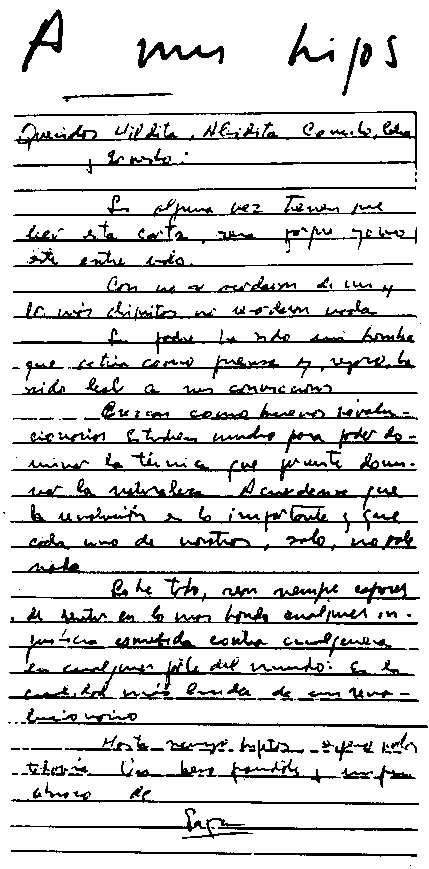
Γράμμα στα παιδιά, 1965.
Αγαπητοί Χιλντίτα, Αλεδίτα, Καμίλο, Σέλια και Ερνέστο:
Εάν διαβάζετε αυτό το γράμμα είναι επειδή δεν είμαι πλέον μαζί σας.
Κανονικά δεν θα με θυμάστε και οι μικρότεροι (από σας) δεν θα με γνωρίζετε καθόλου. Ο πατέρας σας ήταν ένας άνθρωπος που έδρασε με βάση τα πιστεύω του και ήταν σίγουρα πιστός στις αντιλήψεις του.
Μεγαλώστε ως καλοί επαναστάτες. Μελετήστε σκληρά ώστε να εντρυφύσετε στην τεχνολογία, η οποία μας επιτρέπει να δαμάσουμε τη φύση. Να θυμάστε ότι η επανάσταση είναι το σημαντικό – και ο καθένας από εμάς μόνος δεν αξίζει τίποτα.
Πάνω απ’ όλα, να είστε πάντα σε θέση να νιώσετε βαθιά οποιαδήποτε αδικία συμβαίνει εναντίον οποιουδήποτε, οπουδήποτε στον κόσμο. Αυτό είναι το πιο σπουδαίο γνώρισμα σε έναν επαναστάτη.
Γιά πάντα παιδιά μου. Ακόμη ελπίζω να σας ξαναδώ. Ένα μεγάλο φιλί και μιά μεγάλη αγκαλιά από το μπαμπά.
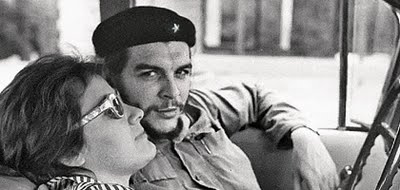
 Ο Τσε και η σύζυγος του Αλεϊδα Μαρτς στην Αβάνα. Φωτογραφία του Αλμπέρτο Κόρντα.
 Ελληνικό Αρχείο Τσε Γκεβάρα © Guevaristas