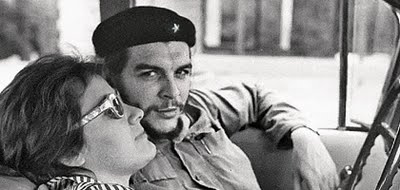
Δύο κινέζοι δημοσιογράφοι, οι K’ung Mai και Ping An, πήραν συνέντευξη απ’ τον Τσε στο σπίτι του στις 18 Απριλίου 1959, ή όπως οι ίδιοι το έθεσαν «την 108η μέρα έπειτα απ’ τη νίκη της Επανάστασης». Το ραδιόφωνο του Πεκίνου και το Κινεζικό πρακτορείο ειδήσεων στο Λονδίνο έδωσαν σύντομες περιλήψεις της συνέντευξης, χωρίς παρ’ όλα αυτά να αναφερθεί σε καμία απ’ τις τρείς μεγάλες εφημερίδες του Πεκίνου.
Reporter: Will you please tell us how Cuba achieved her revolutionary victory?
Guevara: Certainly. Let us begin at the time I joined the 26th of July Movement in Mexico. Before the dangerous crossing on the Granma the views on society of the members of this organisation were very different. I remember, in a frank discussion within our family in Mexico, I suggested we ought to propose a revolutionary program to the Cuban people. I have never forgotten how one of the participants in the attack on the Moncada army camp responded at that time. He said to me: «Our action is very simple. What we want to do is to initiate a coup d ‘etat. Batista pulled off a coup and in only one morning took over the government. We must make another coup and expel him from power… Batista has made a hundred concessions to the Americans, and we will make one hundred and one.» At that time I argued with him, saying that we had to make a coup on the basis of principle and yet at the same time understand clearly what we would do after taking over the government. That was the thinking of a member of the first stage of the 26th of July Movement. Those who held the same view and did not change left our revolutionary movement later and adopted another path.
From that time on, the small organisation that later made the crossing on the Granma encountered repeated difficulties. Besides the never-ending suppression by the Mexican authorities, there was also a series of internal problems, like those people who were adventurous in the beginning but later used this pretext and that to break away from the military expedition. Finally at the time of the crossing on the Granma there remained only eighty-two men in the organisation. The adventurous thought of that time was the first and only catastrophe encountered within the organisation during the process of starting the uprising. We suffered from the blow. But we gathered together again in the Sierra Maestra. For many months the manner of our life in the mountains was most irregular. We climbed from one mountain peak to another, in a drought, without a drop of water. Merely to survive was extremely difficult.
The peasants who had to endure the persecution of Batista’s military units gradually began to change their attitude toward us. They fled to us for refuge to participate in our guerrilla units. In this way our rank and file changed from city people to peasants. At that same time, as the peasants began to participate in the armed struggle for freedom of rights and social justice, we put forth a correct slogan -land reform. This slogan mobilised the oppressed Cuban masses to come forward and fight to seize the land. From this time on the first great social plan was determined, and it later became the banner and primary spearhead of our movement.
It was at just this time that a tragedy occurred in Santiago de Cuba; our Comrade Frank Pa?s was killed. This produced a turning point in our revolutionary movement. The enraged people of Santiago on their own poured into the streets and called for the first politically oriented general strike. Even though the strike did not have a leader , it paralysed the whole of Oriente Province. The dictatorial government suppressed the incident. This movement, however, caused us to understand that working class participation in the struggle to achieve freedom was absolutely essential! We then began to carry out secret work among the workers, in preparation for another general strike, to help the Rebel Army seize the government.
The victorious and bold secret activities of the Rebel Army shook the whole country; all of the people were stirred up, leading to the general strike on April 9 last year. But the strike failed because of a lack of contact between the leaders and the working masses. Experience taught the leaders of the 26th of .July Movement a valuable truth: the revolution must not belong to this or that specific clique, it must be the undertaking of the whole body of the Cuban people. This conclusion inspired the members of the movement to work their hardest, both on the plains and in the mountains. At this time we began to educate our forces in revolutionary theory and doctrine. This all showed that the rebel movement had already grown and was even beginning to achieve political maturity….
Every person in the Rebel Army remembered his basic duties in the Sierra Maestra and other areas: to improve the status of the peasants, to participate in the struggle to seize land, and to build schools. Agrarian law was tried for the first time; using revolutionary methods we confiscated the extensive possessions of the officials of the dictatorial government and distributed to the peasants all of the state-held land in the area. At this time there rose up a peasant movement, closely connected to the land, with land reform as its banner….
To carry out thoroughly the law providing for the abolition of the latifundia system will be the concern of the peasant masses themselves. The present State Constitution provides for mandatory monetary compensation whenever land is taken away, and land reform under it will be both sluggish and difficult. Now after the victory of the revolution, the peasants who have achieved their freedom must rise up in collective action and democratically demand the abolition of the latifundia system and the carrying out of a true and extensive land reform.
Reporter: What problems does the Cuban Revolution now face, and what are its current responsibilities?
Guevara: The first difficulty is that our new actions must be engaged in on the old foundations. Cuba’s antipeople regime and army are already destroyed, but the dictatorial social system and economic foundations have not yet been abolished. Some of the old people are still working within the national structure. In order to protect the fruits of the revolutionary victory and to enable the unending development of the revolution we need to take another step forward in our work to rectify and strengthen the government. Second, what the new government took over was a rundown mess. When Batista fled he cleaned out the national treasury, leaving serious difficulties in the national finances…. Third, Cuba’s land system is one in which latifundistas hold large amounts of land, while at the same time many people are unemployed…. Fourth, there is still racial discrimination in our society which is not beneficial to efforts to achieve the internal unification of the people. Fifth, our house rents are the highest in the world; a family frequently has to pay over a third of its income for rent. To sum up, the reform of the foundations of the economy of the Cuban society is very difficult and will take a long time.
In establishing the order of society and in democratising the national life, the new government has adopted many positive measures. We have exerted great effort to restore the national economy. For example, the government has passed a law lowering rents by fifty percent. Yesterday a law regulating beaches was passed to cancel the privileges of a small number of people who occupy the land and the seashores….
Most important is the land reform law, which will soon be promulgated. Moreover. we will found a National Land Reform Institute. Our land reform here is not yet very penetrating; it is not as thorough as the one in China. Yet it must be considered the most progressive in Latin America….
Reporter: How will Cuba struggle against domestic and foreign reactionary enemies? What are the prospects of the revolution ?
Guevara: The Cuban Revolution is not a class revolution, but a liberation movement that has overthrown a dictatorial, tyrannical government. The people detested the American-supported Batista dictatorial government from the bottoms of their hearts and so rose up and overthrew it. The revolutionary government has received the broad support of all strata of people because its economic measures have taken care of the requirements of all and have gradually improved the livelihood of the people. The only enemies remaining in the country are the latifundistas and the reactionary bourgeoisie. They oppose the land reform that goes against their own interests. These internal reactionary forces may get in league with the developing provocation’s of the foreign reactionary forces and attack the revolutionary government.
The only foreign enemies who oppose the Cuban Revolution are the people who monopolise capital and who have representatives in the United States State Department. The victory and continuous development of the Cuban Revolution has caused these people to panic. They do not willingly accept defeat and are doing everything possible to maintain their control over the Cuban government and economy and to block the great influence of the Cuban Revolution on the people’s struggles in the other Latin American countries….
Our revolution has set an example for every other country in Latin America. The experience and lessons of our revolution have caused the mere talk of the coffee houses to be dispersed like smoke. We have proved that an uprising can begin even when there is only a small group of fearless men with a resolute will; that it is only necessary to gain the support of the people who can then compete with, and in the end defeat, the regular disciplined army of the government. It is also necessary to carry out a land reform. This is another experience that our Latin American brothers ought to absorb. On the economic front and in agricultural structure they are at the same stage as we are.
The present indications are very clear that they are now preparing to intervene in Cuba and destroy the Cuban Revolution. The evil foreign enemies have an old method. First they begin a political offensive, propagandising widely and saying that the Cuban people oppose Communism. These false democratic leaders say that the United States cannot allow a Communist country on its coastline. At the same time they intensify their economic attack and cause Cuba to fall into economic difficulties. Later they will look for a pretext to create some kind of dispute and then utilise certain international organisations they control to carry out intervention against the Cuban people. We do not have to fear an attack from some small neighbouring dictatorial country, but from a certain large country, using certain international organisations and a certain kind of pretext in order to intervene and undermine the Cuban Revolution….
[…]
(Πηγή: Διαδικτυακό Αρχείο Μαρξιστών)