 9 October 2009.
By Alan Woods*.
Che Guevara was a dedicated revolutionary and Communist. He was also an internationalist and understood that to defend the Cuban revolution it was necessary to spread it to other parts of the world. He attempted this in Africa and Latin America. This was his strong side. His weak side was that he saw the revolution fundamentally as a peasant guerilla struggle and did not fully understand the central role of the working class in the socialist revolution.
The campaign against Che
The fortieth anniversary of the assassination of Che Guevara has been the signal for a noisy campaign against him. The attacks against Che do not all come from the right. There are constant attacks from anarchists, libertarians, and all kinds of «democrats». Particularly distasteful are the criticisms of Che by Regis Debray, that miserable renegade and coward, who played such a pernicious role in Che’s last campaign in Bolivia and later became a reformist and an adviser to Mitterand.
Other «intellectuals» like Jon Lee Anderson, who wrote a well-known book about Che, Jorge Castaneda and Octavio Paz have joined this chorus of scoundrels and renegades vying with each other to «demystify» Che – that is, to pour dirt on his memory. This disgraceful campaign of calumnies has been backed by many in the Latin American «left», which is just another indication of the degeneration of the «democratic» intelligentsia in the period of the senile decay of capitalism.
Writer Paul Berman informs us that the «modern-day cult of Che» obscures the work of dissidents and what he believes is a «tremendous social struggle» currently taking place in Cuba. There is indeed a tremendous social struggle taking place in Cuba. It is a struggle between revolution and counterrevolution: a struggle between those who wish to defend the gains of the Cuban Revolution and those who, under the false flag of «democracy» wish to drag Cuba towards capitalist slavery, as has already happened in Russia. In this struggle it is not possible to be neutral, and these «democratic intellectuals» have openly taken the side of the capitalist counterrevolution.
Another one of these scoundrels, author Christopher Hitchens, once considered himself a socialist and a supporter of the Cuban revolution, but now, like so many others of the middle class fair weather friends of Cuba has changed his mind. Of Che Guevara’s legacy he writes: «Che’s iconic status was assured because he failed. His story was one of defeat and isolation, and that’s why it is so seductive. Had he lived, the myth of Che would have long since died.»
No, my friend, Che Guevara is not dead but very much alive, and he will be remembered long after all this miserable tribe of bourgeois Pharisees has been forgotten. Yes, Che was defeated. But at least he had the courage to try to fight, and it is a thousand times better to try to fight and to fall honourably in battle for a just cause than to chatter and complain and whimper from the sidelines of history and to do precisely nothing.
The question of revolutionary violence
The main accusation against Che is that he was responsible for unnecessarily brutal repression. What are the facts? After the overthrow, Che Guevara was assigned the role of «supreme prosecutor», overseeing the trials and executions of hundreds of suspected war criminals from the previous regime. As commander of the La Cabana prison, he oversaw the trial and execution of former Batista regime officials and members of the «Bureau for the Repression of Communist Activities» (a unit of the secret police known by its Spanish acronym BRAC). This has provided the excuse for a stream of vicious attacks against him by the enemies of the Revolution. We have seen a stream of articles with titles referring to Che as a «butcher» and so on.
In his book on Che, Jon Lee Anderson writes:
«Throughout January, suspected war criminals were being captured and brought to La Cabana daily. For the most part, these were not the top henchmen of the ancien régime; most had escaped before the rebels assumed control of the city and halted outgoing air and sea traffic, or remained holed up in embassies. Most of those left behind were deputies, or rank and file chivatos and police torturers. The trials began at eight or nine in the evening, and, more often than not, a verdict was reached by two or three in the morning. Duque de Estrada, whose job it was to gather evidence, take testimonies, and prepare the trials, also sat with Che, the «supreme prosecutor,» on the appellate bench, where Che made the final decision on the men’s fate.» (Source: Anderson, Jon Lee. Che Guevara: A Revolutionary Life, New York: 1997, Grove Press, pp. 386-387.)
José Vilasuso, an attorney who worked under Guevara, has said that these were «lawless proceedings» where «the facts were judged without any consideration to general juridical principles». Vilasuso described a process where «[t]he statements of the investigating officer constituted irrefutable proof of wrongdoing» and where «[t]here were relatives of victims of the previous regime who were put in charge of judging the accused.»
Solon the Great, who wrote the Athenian Constitution and knew one or two things about laws, said the following: «the law is like a spider’s web: the small are caught and the great tear it up.» The law has never been higher than the class interests that lie behind it. The bourgeoisie hides behind the so-called impartiality of the law to disguise the dictatorship of the big banks and monopolies. When it no longer suits the ruling class, it sets aside these laws and exercises its dictatorship openly.
The people who were executed in La Cabana, were, as the above quotation says, notorious supporters of the Batista dictatorship that tortured and killed many people without trial, informers who spied on people and were responsible for their imprisonment, torture and death, and the torturers themselves. These were the people who were handed over to the revolutionary firing squads. And we are supposed to raise our hands in horror over this? Are we supposed to be shocked when the Revolution settles accounts with its enemies?
The same middle class Pharisees who whimper about these executions are those who support «peace and reconciliation» in places like Chile, Argentina and South Africa. They are the authors of the obscene farce of «truth commissions» where the murderers and torturers meet face to face with their victims, with widows and orphans, with people who suffered unspeakable tortures or years of imprisonment for their views. And at the end of this, they are supposed to be reconciled and «at peace». Yes, and how many others are «at peace» in unmarked graves or at the bottom of the River Plate with their hands chopped off?
This so-called peace and reconciliation is nothing but a cruel deception and the so-called truth commissions a cowardly evasion of the truth: that there can never be peace and reconciliation between the murderers and torturers and their victims, who cry for justice even from the grave. It is absolutely intolerable that today known murderers and torturers walk the streets of Santiago, Buenos Aires and Johannesburg, and their victims are forced to live with this knowledge. In Spain the reformists and Stalinists subscribed to the shameful fraud that they called the «Transition». The fascist butchers who were responsible for the deaths of over a million people were allowed to go unpunished as a result. This was taken by the reformists in Chile and elsewhere to be a good example to follow.
Was it a good thing that Pinochet was permitted to die peacefully in his bed of old age? Would it not have been better for this mass murderer to be tried by the families of his victims? A violation of the principles of legality, say the Pharisees! An act of true revolutionary justice, we reply! To preach love and reconciliation in the midst of the class struggle is a form of crime: for it is always the weak and defenceless who are expected to show love and forgiveness, while the rich and powerful always escape the consequences of their crimes.
Che Guevara was a humanitarian who had a deep love for the poor and oppressed, and consequently he had a profound hatred for the oppressors and exploiters. He wrote:
«Hatred is an element of struggle; relentless hatred of the enemy that impels us over and beyond the natural limitations of man and transforms us into effective, violent, selective, and cold killing machines. Our soldiers must be thus; a people without hatred cannot vanquish a brutal enemy.»
Harsh words? Yes, but the class struggle is harsh, and the consequences of defeat are deadly serious. Cuba is only 90 miles from the most powerful imperialist nation on earth. Not long after these events US imperialism organized an invasion with the help of those agents of Batista who Che did not manage to place before a firing squad.
Hypocrisy of imperialists
The attacks of the enemies of the Revolution are motivated by spite and hypocrisy. A Revolution has to defend itself against its enemies, both internal and external. A Revolution, which by its very nature overturns all the old laws, rules and regulations cannot be expected to operate on the basis of bourgeois legality. It has to invent new rules and a new legality and the only rule it knows is the one invented long ago by Cicero: salus populi suprema lex est (the salvation of the people is the supreme law). For revolutionaries the salvation of the revolution is the supreme law. The idea that a revolution must dance the minuet of bourgeois legality is just stupidity.
Throughout history there have been many risings of the oppressed underdogs against their masters. The annals of human history are full rich in defeated slave rebellions and similar tragedies. In every case we find that the slaves were defeated because they did not show sufficient determination and were too soft and trusting, whereas the ruling class is always prepared to employ the most brutal and bloody methods in order to maintain their class rule.
History is full of examples of the brutality of the ruling class. After the defeat of Spartacus, the Romans crucified thousands of slaves along the Via Apia. In June, 1848, general Cavaignac had promised pardon, and he massacred the workers. The bourgeois Thiers had sworn by the law, and he gave the army carte-blanche to slaughter. After the defeat of the Commune, the butchers of Versailles took a terrible revenge against the proletarians of Paris. Lissagaray (History of the Paris Commune of 1871) writes:
«The wholesale massacres lasted up to the first days of June, and the summary executions up to the middle of that month. For a long time mysterious dramas were enacted in the Bois de Boulogne. Never will the exact number of the victims of the Bloody Week be known. The chief of military justice admitted 17,000 shot, the municipal council of Paris paid the expenses of burial of 17,000 corpses; but a great number were killed out of Paris or burnt. There is no exaggeration in saying 20,000 at least. «Many battlefields have numbered more dead, but these at least had fallen in the fury of the combat. The century has not witnessed such a slaughtering after the battle; there is nothing to equal it in the history of our civil struggles. St. Bartholomew’s Day, June 1848, the 2nd December, would form but an episode of the massacres of May. Even the great executioners of Rome and modern times pale before the Duke of Magenta. The hecatombs of the Asiatic victors, the fetes of Dahomey alone could give some idea of this butchery of proletarians.»
There are many more recent examples. After the overthrow of the democratically elected Arbenz government, the rulers of Guatemala unleashed a bloody war of genocide against its own people with the aid of the CIA. Pinochet killed and tortured tens of thousands. In Argentina there was even greater slaughter under the Junta. In the case of Cuba, the American stooge Batista murdered and tortured countless oppositionists.
All this is a matter of historical record. The so-called democrats in the USA and the European Union pretend to be shocked at the revolutionary violence which the Cuban Revolution directed against its enemies, but the same people were prepared to turn a blind eye to the crimes of the counterrevolutionary despots who were the friends of US imperialism. As President Franklin D Roosevelt said about the Nicaraguan dictator Somoza: «He’s a son of a bitch, but he’s our son of a bitch.»
The Bay of Pigs
The bourgeois approach the question of violence from a practical and class point of view. The working class should do likewise. The idea that it is possible to defeat the class enemy by reading them lectures on morality is naïve and foolish. The real reason for the hypocritical cries of moral outrage against the Cuban (and Russian) Revolutions is that here at last the slaves fought back against the slave-owners, and they won.
In the beginning, Castro did not put forward a socialist perspective and did not nationalize anything. Che, on the other hand, insisted that the Cuban Revolution must be a socialist revolution. The Revolution soon entered into conflict with US imperialism, which attempted to sabotage its attempts to carry out an agrarian reform and other measures to improve the living standards of the masses. The big US companies tried to sabotage the Cuban economy. Castro responded by nationalizing all US property in Cuba. The Revolution had crossed the Rubicon. It had expropriated the landlords and capitalists and was now on collision course with Washington.
This was a complete confirmation of Trotsky’s theory of Permanent Revolution – a theory that Che was so interested in that he took a copy of this book with him on his final Bolivian expedition. Trotsky explains that in modern conditions the tasks of the bourgeois democratic revolution in colonial and ex-colonial countries cannot be carried out by the bourgeoisie but can only be realized by expropriating the landlords and capitalists and beginning the socialist transformation of society.
The imperialist «democrats» replied by organizing an invasion of Cuba. Cuban mercenaries were armed and trained by the CIA and set out to effect the violent overthrow of the revolutionary government. The Revolution defended itself, mobilizing and arming the workers and peasants. The imperialist forces were routed at the Bay of Pigs – the first time that imperialism had suffered a military defeat in Latin America. The Revolution was triumphant.
If the reactionaries had succeeded in regaining power, what would they have done? Would they have invited the Cuban workers and peasants to join them in a universal celebration of brotherly love and reconciliation? Would they have set up a truth commission and invited Che and Fidel to participate? They would have filled not one Cabana but a hundred with their victims. Only a blind man can fail to understand this. But there are none so blind as they who will not see.
Che and world revolution
The Cuban Revolution was in danger. How was it to be saved? Che Guevara had the right idea, and was moving in the right direction before his young life was brutally ended. He was radically opposed to bureaucracy, corruption and privilege, which are today the biggest threat to the Cuban Revolution and, if not corrected, will prepare the way for capitalist restoration. Above all, he understood that the only way to preserve the Cuban Revolution was to extend the socialist revolution to the rest of the world, beginning with Latin America.
His speeches against bureaucracy and his criticisms of the Soviet Union became more and more outspoken to the degree that the influence of the Soviet Union in Cuba grew. In general he had grown increasingly sceptical of the Soviet Union. He publicly accused Moscow of betraying the colonial revolution. In February 1965 Che made what turned out to be his last public appearance on the international stage when he delivered a speech to the Second Economic Seminar on Afro-Asian Solidarity in Algiers. In the course of his speech he stated:
«There are no frontiers in this struggle to the death. We cannot remain indifferent in the face of what occurs in any part of the world. A victory for any country against imperialism is our victory, just as any country’s defeat is our defeat.» He went on to say that, «The socialist countries have the moral duty of liquidating their tacit complicity with the exploiting countries of the West.»
This was a very explicit condemnation of the policy of peaceful co-existence pursued by Moscow. He considered that the withdrawal of Soviet missiles from Cuban territory without consulting Castro to be a betrayal. He enthusiastically supported the Vietnamese people in their war of liberation against US imperialism. He called upon the oppressed peoples of other countries to take up arms and create «100 Vietnams». Such talk horrified Khrushchev and the Moscow bureaucracy.
In his mind the idea slowly matured that the only way to save the Cuban Revolution was to spread the revolution on a world scale. This idea was fundamentally correct. The isolation of the Cuban Revolution was the greatest threat to its survival. Che was not a man to allow an idea to remain on paper. He decided to translate it into action. Che Guevara left Cuba in 1965 to participate in the revolutionary struggles in Africa. He first went to Congo-Kinshasa, although his whereabouts remained a closely held secret for the next two years.
Che wrote a letter in which he reaffirmed his solidarity with the Cuban Revolution but declared his intention to leave Cuba to fight abroad for the cause of the revolution. He stated that «Other nations of the world summon my modest efforts,» and that he had therefore decided to go and fight as a guerrilla «on new battlefields». In order not to embarrass the Cuban government and provide excuses to the imperialists to attack Cuba, he announced his resignation from all his positions in the government, in the Party, and in the Armed forces, and renounced his Cuban citizenship, which had been granted to him in 1959 in recognition of his efforts on behalf of the revolution.
«This is the history of a failure.»
At that time Africa was in a state of ferment. The French colonialists had been driven out of Algeria and the Belgian imperialists had been forced to leave the Congo. But the imperialists were waging a stubborn rearguard action in alliance with the Apartheid regime in South Africa and reactionary elements in different countries. At stake was Africa’s vast mineral wealth. It was also the chief battleground between the Soviet Union and the United States.
Che concluded that this was the beast place to fight. Ben Bella, who was president of Algeria, had recently held discussions with Guevara, and said: «The situation prevailing in Africa, which seemed to have enormous revolutionary potential, led Che to the conclusion that Africa was imperialism’s weak link. It was to Africa that he now decided to devote his efforts.»
In the recently independent Congo the Belgian and French imperialists sabotaged the left-wing government of Patrice Lumumba by creating chaos as a pretext for a military intervention. With the active collaboration of the CIA the reactionaries led by Mobutu murdered Lumumba and seized power in Leopoldville (Kinshasa). A guerrilla war led by Lumumba supporters commenced. The Cuban operation was to be carried out in support of the rebels under the command of Laurent-Désiré Kabila.
Astonishingly, the thirty-seven year old Guevara had no formal military training (his asthma had prevented him from being drafted into military service in Argentina) but he had the experiences of the Cuban revolution, and that was enough. In the same way, Trotsky had no formal military training when he formed the Red Army, yet the Red soldiers, armed by revolutionary fervour, defeated every foreign army thrown against them.
Napoleon pointed out long ago that in warfare morale is always the decisive factor. However, Che was swiftly disillusioned by his Congolese allies. He had little regard for the ability of Kabila. «Nothing leads me to believe he is the man of the hour,» he wrote. The Cuban and Russian revolutionaries were fighting for a cause they believed in. But in the Congo, the anti-imperialist struggle was mixed up with tribal divisions, personal ambition and corruption. That was shown by subsequent events. In May 1997, Laurent Kabila overthrew Mobuto and became President of the Democratic Republic of the Congo. In that position, which he held until his assassination in 2001, he behaved as a corrupt tyrant. He was succeeded in the presidency by his son, the equally corrupt Joseph Kabila.
The CIA and South African mercenaries were working with Mobutu’s forces to defeat the rebels. They soon realized that they were fighting a far more serious enemy, although originally they did not know that Che was present. However, the superior intelligence available to the CIA alerted the South Africans to his presence. Che’s Congo Diary speaks of the incompetence, stupidity, and infighting of the local Congolese forces. This was the main reason for the revolt’s failure. Without Cuban help it would have been defeated much earlier.
After seven months of frustrations, suffering from his asthma and crippling dysentery and disillusioned with his allies, Che left the Congo with the surviving members of his force of Afro-Cubans. Later, when writing of the Congo mission, he states bitterly: «This is the history of a failure.»
Bolivia
After the failure in Africa, Che decided to attempt to open s new revolutionary front in Latin America. He seems to have chosen Bolivia for its strategic position, bordering a number of important countries, including Argentina. He adopted the disguise of a Uruguayan businessman with thick glasses and a shaved head. This was so perfect that when he said his final goodbye to his little daughter she did not recognize him. However, the imperialists were not so easily fooled.
Che clearly made a mistake when he tried to organize a guerrilla war in Bolivia, a country with a powerful working class with great revolutionary traditions. He miscalculated in a number of areas. He expected to be confronted only by the poorly trained and equipped Bolivian army. But, as we have already pointed out, the imperialists had learned the lesson of Cuba and were prepared for him. Only eleven months after beginning the operation the guerrillas were routed and Che Guevara was dead. Only five men managed to escape from the trap that had been prepared for them by the Bolivian army and its US «advisers».
To read today Che Guevara’s Bolivian Diaries is a moving and tragic experience. The physical and mental sufferings of this small band of men are indescribable. Their final destiny is heartbreaking. He established his base in the jungles of the remote Ñancahuazú region. But building a guerrilla army under such conditions proved extremely difficult, as his Bolivian diary shows. But to start a revolution in the jungles of Bolivia, was a hopeless venture from the start. The total guerrilla force numbered only about fifty. They experienced great difficulty recruiting from the local populace, who did not even speak Spanish. The guerrillas had learned Quechua, but the local language was Tupí-Guaraní.
Despite everything, the guerrillas showed tremendous bravery and determination and scored a number of early successes against Bolivian regular soldiers in the Camiri mountains. However, in September, the Army managed to eliminate two guerrilla groups, killing one of the leaders. From this point on, they were fighting a battle that was lost in advance. Moreover, as the campaign dragged on, Che’s health deteriorated. He suffered from severe and debilitating bouts of asthma.
The Bolivian authorities were finally alerted about Guevara’s presence when photographs taken by the rebels fell into their hands after a clash with the Bolivian army in March 1967. It is said that after seeing them, President René Barrientos exclaimed that he wanted Guevara’s head on a pike in the centre of la Paz. Here we have an authentic expression of the humanitarian pacifism of the bourgeoisie – the same people who criticize revolutionaries for violence.
Despite the attempts to portray him as a bloodthirsty monster (what revolutionary leader has not been so portrayed?) Che was actually a very humanitarian person. In one very moving passage of his Bolivian Diaries he recalls a moment when he could have shot a young Bolivian soldier but found himself unable to pull the trigger.
This is hardly the conduct of a cruel and bloodthirsty man! Che personally gave medical treatment to wounded Bolivian soldiers whom the guerrillas took prisoner, and then let them go free. This humane behaviour contrasts to the brutal treatment he himself received when he fell into the hands of the Bolivian army. It is even said that, when captured, he offered to treat some Bolivian soldiers who had also been wounded in the fighting. The Bolivian officer in charge rejected his offer.
Stalinists betray
Che’s men faced innumerable obstacles – not only from the language and the weather (it was almost always raining) and the terrain. Under the Stalinist pro-Moscow leadership of Mario Monje the Bolivian Communist Party was bitterly hostile to Guevara and resented his presence in Bolivia. The Bolivian Stalinists refused to honour their commitments to the guerrillas. They argued that there were no conditions to launch a revolutionary offensive in Bolivia. Fidel Castro in his Introduction to Che’s Bolivian Diaries answered this very well:
«There will always be a proliferation of excuses, whatever the time and circumstance, not to fight – and that would mean that we could never obtain freedom. Che did not outlive his ideas, but he knew that with the loss of his life they would spread even wider. His pseudo-revolutionary critics, with their political cowardice and eternal failure to act, will certainly outlive the evidence of their own stupidity. It is worth noting, as the diary shows us, that Mario Monje, one of those ‘revolutionary’ specimens who are becoming so frequent in Latin America, took advantage of his title of secretary of the Communist Party of Bolivia to dispute Che’s right to the political and military leadership of the movement. And Monje had also announced his intention of giving up his position within the party. According to him, it was enough to have held the position, and that gave him the right to claim the leadership.
«Mario Monje, needless to say, had no experience in guerrilla warfare, nor had he ever been in combat. But the fact that he considered himself a Communist should have rid him of crude and superficial patriotism, as had the true patriots who had fought for Bolivia’s first independence.
«If this is their idea of the internationalist and anti-imperialist struggle on this continent, such ‘Communist leaders’ have not progressed as far as the aboriginal tribes who were vanquished by the European colonisers at the time of the conquest.
«This was the behaviour of the leader of the Communist Party of a country called Bolivia, whose historical capital is called Sucre, in honour of its first liberators, who were both Venezuelan. Monje had the opportunity to count on the co-operation of the political, organisational and military talent of a true and revolutionary giant, whose cause was not circumscribed to the narrow, artificial and even unjust boundaries of Bolivia. However, Monje did nothing but make claims for the leadership in a shameful, ridiculous and unwarranted manner.» (Ernesto Che Guevara, Bolivian Diary, «A Necessary Introduction» by Fidel Castro, pp. xxxi-xxxii.)
And Castro continues his blistering indictment of Monje and the leaders of the Bolivian C.P.:
«[…] But Monje, unhappy with the outcome, set out to sabotage the movement. While in La Paz, he intercepted the well-trained Communist militants who were about to join the guerrilla force. They were the kind of men who have all the necessary qualities to join the armed struggle, but whose progress is criminally frustrated by their incapable and manipulating leaders.» (Ernesto Che Guevara, Bolivian Diary, «A Necessary Introduction» by Fidel Castro, p. xxxiii.)
At the end of January, Che wrote in his Diary:
«Analysis of the month.
«As I expected, Monje’s attitude was evasive at first and then treacherous.
«The party is now up in arms against us, and I do not know how far they will go. But this will not stop us and maybe in the long run it will be to our advantage (I am almost certain of this). The most hones and militant people will be with us, even if they have to go through a crisis of conscience that may be quite serious.
«Moisés Guevara has so far responded well. We shall see how he and his people behave in the future.
«Tania left, but the Argentines have given no signs of life, and neither has she. Now begins the real guerrilla phase and we will test the troops. Time will tell what they are capable of and what are the prospects for the Bolivian revolution.
«Of all we had envisaged, the hardest task was the recruitment of Bolivian combatants.» (Ernesto Che Guevara, Bolivian Diary, p. 38.)
Those members of the Party who did join or support Che Guevara did so against the Party leadership’s wishes. Che’s Bolivian Diary shows how the problems with the Bolivian Communist Party resulted in the guerrillas having significantly smaller forces than originally anticipated. This dealt a mortal blow to the guerrilla’s chances of success.
Regis Debray
A lamentable role in all this was played by Regis Debray, a man who subsequently made a career out of exploiting his alleged relation with Che Guevara. It is frequently stated that he «fought with Che in Bolivia» and was a «comrade of Che.» This is completely untrue. Debray never did any fighting and in fact caused serious problems for the guerrillas. Che regarded this petty bourgeois intellectual with well-deserved contempt. His Diary contains frequent references to this unwelcome «travelling companion» and none of them is flattering.
Debray and the Argentine painter Ciro Bustos turned up in Che’s camp as revolutionary tourists and caused nothing but trouble. They were supposed to help to develop contacts with the outside world. In the end they got plenty of publicity for themselves at the cost of the guerrillas. The Diary shows that Che was suspicious of Debray from the start:
«The Frenchman emphasised rather too vehemently how useful he could be outside.» (Ernesto Che Guevara, Bolivian Diary, p. 69.)
Che’s suspicions were soon justified. Unable to tolerate the harsh conditions they pestered Che to allow them to leave. They were soon captured by the army and gave information that was invaluable in the pursuit of the rebels. Bustos betrayed the guerrillas and became a vulgar informant. He even drew portraits so that the army could recognize them. The trial of Regis Debray attracted the attention of the world’s media, but distracted attention from the guerrillas who were the ones really putting up a fight. This trial undoubtedly embarrassed the Bolivian government, but it also hardened their attitudes towards the guerrillas. It is possible that one of the reasons Barrientos decided to murder Guevara was to avoid a repetition of the media circus of this trial.
The final chapter
Barrientos ordered the Bolivian Army to hunt Guevara down. But in fact he was merely following the orders of his bosses in Washington, who had long ago put a price on the head of their most hated enemy. As soon as Washington discovered his location, CIA and other special forces were sent to Bolivia, where they took charge of the operation.
US advisors arrived on April 29 and instituted a 19-week counter-insurgency training programme for the Bolivian 2nd Ranger Battalion. The intensive course included training in weapons, individual combat, squad and platoon tactics, patrolling, and counter-insurgency. The Bolivian Army was trained and supplied by US advisors and Special Forces. These included a recently established elite battalion of Rangers with special training in jungle operations.
From late September the enemy dogged their footsteps. Bolivian Special Forces were notified of the location of Guevara’s guerrilla encampment by an informant. They encircled it on 8 October and Che was captured after a brief skirmish. As the Bolivian forces approached him, he is supposed to have called out: «Do not shoot! I am Che Guevara and worth more to you alive than dead.» By this means they try to portray him as a coward. This is just another of the calumnies with which the reactionaries attempt to blacken the memory of this man, who always showed great bravery and complete disregard for his personal safety.
Barrientos lost no time in ordering the execution of Che Guevara. He issued the order as soon as he was informed of the capture. He did not waste time in legal niceties. He did this with the full knowledge and consent of the «democrats» in Washington. None of these people could run the risk of a trial where Che Guevara could defend himself and, as he inevitably would, pass over to the counteroffensive, denouncing the social injustices that justified his fight. No! This voice had to be silenced once and for all.
In January 1919 in Berlin, the Junkers who captured Rosa Luxemburg and Karl Liebknecht also had no intention of allowing them to reach a court of law. They did not consult a law book before battering their brains out either. Che Guevara was taken to a dilapidated schoolhouse in the nearby village of La Higuera where he was held prisoner overnight. What thoughts must have gone through his mind on that last terrible night when he was alone, like a lamb among hungry wolves, alone and isolated from the world, from his family, friends and comrades, facing dawn and inevitable death!
Early the next afternoon Che Guevara was taken out of the schoolhouse. At 1.10pm on 9 October 1967 he was executed by Mario Teran, a sergeant in the Bolivian army. In an attempt to conceal the fact that he had been shot in cold blood, he received multiple shots to the legs, so as to simulate combat wounds. Before this he said to his executioner: «I know you are here to kill me. Shoot, coward, you are only going to kill a man.» This is the voice of the real Che Guevara, not that of a coward pleading for his life.
The dead body was lashed to the landing skids of a helicopter and flown to neighbouring Vallegrande where it was placed in a laundry tub in the local hospital and put on display for the gentlemen of the press who took photographs. In a macabre act of desecration a military doctor surgically amputated his hands, Bolivian army officers transferred Guevara’s cadaver to an undisclosed location.
The man who headed the hunt for Guevara was Felix Rodriguez, a CIA agent, who had infiltrated Cuba to prepare for an anti-Castro uprising to coincide with the Bay of Pigs invasion. It was Rodriguez who informed his masters in Washington and Virginia of Che’s death. Like a common thief he removed Che’s Rolex watch and other personal items that he used to show to reporters while bragging of his exploits. Felix Rodriguez’s name will enter the annals of history branded with infamy. But the memory of the man he cruelly murdered will forever live as a champion of the poor and oppressed, a fighter, a revolutionary hero and a martyr for the cause of world socialism.
The Question of Guerrilla War
As with any other person, Che had his strong side and his weak side. He undoubtedly made a mistake when he attempted to present the Cuban model of guerrilla war as a tactic with a general application. Marxists have always conceived the peasant war as an auxiliary of the workers in the struggle for power. That position was first developed by Marx during the German revolution of 1848, when he argued that the German revolution could only triumph as a second edition of the Peasants’ War. That is to say, the movement of the workers in the towns would have to draw behind it the peasant masses.
It is not correct to argue that this position is only for developed capitalist countries. Before the Russian revolution the industrial working class represented no more than 10 per cent of the population. Yet Lenin and the Bolsheviks always argued that the working class had to place itself at the head of the nation and lead the peasants and other oppressed layers behind them. The proletariat played the leading role in the Russian revolution, drawing behind itself the multi-millioned mass of poor peasants – the natural ally of the proletariat.
The only class able to lead a successful socialist revolution is the working class. This is not for sentimental reasons but because of the place it occupies in society and the collective character of its role in production. No reference or hint at the possibility that the peasantry can bring about a socialist revolution can be found in the writings of Marx, Engels, Lenin and Trotsky. The reason for that is the extreme heterogeneity of the peasantry as a class. It is divided into many layers, from the landless labourers (who are really rural proletarians) to the rich peasants who employ other peasants as wage labourers. They do not have a common interest and therefore cannot play an independent role in society. Historically they have supported different classes or groups in the cities.
By its very nature, guerrilla warfare is the classical weapon of the peasantry, and not the working class. It is suited for conditions of armed struggle in inaccessible rural areas – mountains, jungle, etc. – where the difficulty of the terrain makes it complicated to deploy regular troops and where the support of the rural masses provides the necessary logistic support and cover for the guerrillas to operate.
In the course of a revolution in a backward country with a sizeable peasant population, guerrilla warfare can act as a useful auxiliary for the revolutionary struggle of the workers in the towns. But it would never have occurred to Lenin to put forward the idea of guerrillaism as a substitute for the conscious movement of the working class. Guerrilla tactics, from a Marxist standpoint, are only permissible as a subordinate and auxiliary part of the socialist revolution.
This was precisely Lenin’s position in 1905. It had nothing in common with the kind of individual terrorist tactics pursued by the Narodnaya Volya and their heirs, the Social Revolutionary Party, still less the insane tactics of the modern terrorists and «urban guerrilla» organisations which are the very antithesis of a genuine Leninist policy. Lenin insisted that armed struggle must be part of the revolutionary mass movement, and specified the conditions in which it was permissible:
«1) the sentiments of the masses be taken into account; 2) the conditions of the working class movement in the given locality be reckoned with, and 3) care be taken that the forces of the proletariat should not be frittered away.» And he also made it clear that, far from being a panacea, guerrilla war was only one possible method of struggle permissible only «at a time when the mass movement has actually reached the point of an uprising».
The danger of degeneration inherent in such activity becomes an absolute certainty the moment the guerrilla groups are isolated from the mass movement. In the period following 1906, when the workers’ movement was in decline and the revolutionaries were reeling from a series of body blows, the guerrilla organizations increasingly displayed signs that they were ceasing to be useful auxiliary organs of the revolutionary party, and becoming transformed into groups of adventurers, or even worse. Even while defending the possibility of guerrilla tactics as a kind of rearguard action against reaction at a moment when he still expected the revolutionary movement to revive, Lenin warned against «anarchism, Blanquism, the old terrorism, the acts of individuals isolated from the masses, which demoralize the workers, repel wide strata of the population, disorganize the movement and injure the revolution,» and added that «examples in support of this appraisal can easily be found in the events reported every day in the newspapers».
In the period 1905-06, the revolutionary movement included an element of «guerrilla warfare», with partisan detachments, armed expropriation, and other forms of armed struggle. But the fighting squads were always closely linked to the workers’ organizations. Thus, the Moscow military committee included not just RSDLP members, but also SRs, trade unionists (printers) and students. As we have seen, partisan groups were used for the purpose of defence against pogromists and the Black Hundred gangs. They also helped to protect meetings against police raids, where the presence of armed workers’ detachments was frequently an important factor in preventing violence.
Other tasks included the capture of arms, the assassination of spies and police agents and also bank raids for funds. The initiative for the setting up of such guerrilla groups was frequently taken by the workers themselves. The Bolsheviks strove to gain the leadership of these groups, to give them an organized and disciplined form and provide them with a clear plan of action. There were, of course, serious risks entailed here. All kinds of adventurist, declassed and shady elements could get mixed up in these groups, which, once isolated from the movement of the masses, tended to degenerate along criminal lines to the point where they would become indistinguishable from mere groups of bandits.
In addition to this, they were also wide open to penetration by provocateurs. As a rule it is far easier for the agents of the state to infiltrate militaristic and terrorist organizations than genuine revolutionary parties, especially where they are composed of educated cadres bound together by strong ideological ties, although even the latter are not immune to penetration. Lenin was well aware of the dangers of degeneration posed by the existence of the armed groups. Strict discipline and firm control by party organizations and experienced revolutionary cadres partially guarded against such tendencies. But the only real control was that of the revolutionary mass movement.
As long as the guerrilla units acted as auxiliaries to the mass movement (that is, in the course of the revolutionary upswing) they played a useful and progressive role. But, wherever the guerrilla groups were separated from the mass revolutionary movement, they inevitably tended to degenerate. For this reason, Lenin considered it completely inadmissible to prolong their existence, once it was clearly established that the revolutionary movement was in irreversible decline. Once this stage was reached, he immediately called for the dissolution of all the guerrilla groups.
Guerrilla warfare
Che wrote a number of articles and books on the theory and practice of guerrilla warfare. The experience of the overthrow of the Arbenz government made a lasting impression on him. He concluded that the ruling class must be overthrown by an armed insurrection, and that assumption was quite correct. All history shows that no ruling class has ever surrendered its power and privileges without a fight. No devil has ever cut off its own claws. Marxists are not pacifists. The masses must be prepared to fight and to use whatever force is necessary to disarm the ruling class. In the words of Marx, force is the midwife of history.
His well-known book Guerrilla Warfare takes the Cuban model of revolution as a model that is applicable in other countries. In this model a small group (foco) of guerrillas carries out the armed insurrection without the need for broad organizations to organize the masses. This was a serious mistake, as subsequent events tragically demonstrated. The Cuban Revolution took the imperialists by surprise. They did not expect the guerrillas to succeed so easily. Even when they did, the US ruling class was divided on how to react. One wing urged an aggressive policy, but another was in favour of a cautious attitude.
The imperialists made a mistake. But they also study and learn from experience. After the experience of the Cuban Revolution the imperialists could no longer be taken by surprise. They studied the theory of guerrilla warfare, including the writings of Che Guevara. And they were ready and waiting. As soon as the first guerrilla foco was formed, they intervened to crush it. They did not give the guerrillas time to establish a base in the rural population. This is what happened in the case of Bolivia. It sealed the fate of Che and his comrades – and many others later on.
It is one of the greatest tragedies of revolutionary history that a whole generation of courageous young people in Latin America and elsewhere lost their lives as a result of a futile attempt to copy a tactic that had succeeded in Cuba because of a peculiar concatenation of circumstances but which could not be artificially transplanted to other counties with different conditions.
Guerrilla war makes some sense in a backward, predominantly agricultural society like China before 1949. But it makes no sense at all in countries like Chile or Argentina where the peasantry is a minority and the decisive majority lives in towns and cities. Even in tsarist Russia, as we have seen, Lenin insisted that the leading role in the revolution must be played by the proletariat and that guerrilla warfare must be seen as an auxiliary to the revolutionary movement of the masses and above all of the working class.
In Argentina, Uruguay, Mexico, Venezuela and other countries, the attempt to mechanically imitate the methods of the guerrillas in Cuba all led to bloody defeats. Particularly negative was the idea of so-called «urban guerrillaism», which is only the old idea of individual terrorism under a new guise. Those who advocated this disastrous tactic thought that they had invented something entirely new. In fact they were only repeating the mistakes of the old Russian terrorists of the Narodnaya Volya, against which Lenin conducted an implacable struggle.
In every case these tactics ended in a bloody defeat and savage reaction. The movement lost thousands of young cadres who could have played an important role in developing a mass revolutionary movement in the factories, workers’ districts and villages. This was a very serious mistake that must be rectified if the socialist revolution is to succeed. It is the negative side of Che’s legacy that is seized upon by ultra-lefts who are incapable of understanding the real positive legacy of this great revolutionary and only repeat his mistakes. This is the worst injustice to Che’s memory that one can imagine.
The real message of Che Guevara that we must treasure and learn from is his internationalism: the correct idea that the socialist revolution is not an isolated national act but part of a chain that can only be complete with the victory of socialism on a world scale. The present revolutionary movement in Latin America proves that he was right.
Che Guevara’s internationalism
The Cuban revolution from the beginning was inspired by revolutionary internationalism. This was personified by Che Guevara, who was an outstanding leader of the Cuban revolution. Che was born an Argentinean and fought in the front line of the Cuban revolution. But in reality he was a true internationalist and a citizen of the world. Like Bolivar he had the perspective of a Latin American revolution.
After his tragic death there have been many attempts to turn Che Guevara into a harmless icon, a face on a tee-shirt. He is presented by the bourgeois as a well-meaning romantic, a utopian idealist. This is unworthy of the memory of a great revolutionist! Che Guevara was not a hopeless dreamer but a revolutionary realist. It was not an accident that Che attempted to extend the revolution to other countries, not just in Latin America but also in Africa. He understood very well that, in the last analysis, the future of the Cuban revolution would be determined by this.
From the very beginning the destiny of the Cuban revolution has been tied to events on a world scale. How could it be otherwise when the revolution was threatened at birth by the most powerful imperialist state on earth? The Cuban revolution – like the Russian revolution – had a tremendous international impact, especially in Latin America and the Caribbean. That remains the case even today. Che tried to light a spark that would set the whole continent ablaze. Maybe he made a mistake in how he went about it, but nobody can question his intentions and his fundamental idea was correct: that the only way to save the Cuban revolution was to spread it to Latin America.
Che helped organize revolutionary expeditions overseas, all of which failed. The first attempt was made in Panama; another in the Dominican Republic took place as early as 1959. Unfortunately, some erroneous conclusions were drawn from the Cuban experience. The attempt to export the model of guerrilla war and focos led to one terrible defeat after another. There were several reasons for this. Firstly, as we have already seen, the Cuban insurgency had taken US imperialism by surprise. But they soon learned the lessons and every time a «foco» appeared, they crushed it immediately before it could spread.
A more important fact was that the majority of the population in Latin America now lives in towns and cities. Guerrilla war is a typical method of struggle of the peasantry. Therefore, while guerrilla war can play an important role as an auxiliary, it cannot play the main role. That is reserved for the working class in the towns. And tactics must be adapted accordingly.
This is shown by the experience of Venezuela, where the attempt to organize a guerrilla movement was a complete failure. The Venezuelan revolution is unfolding as an essentially urban revolution, based on the masses in the towns and cities and supported by the peasantry. The Bolivarian Movement of Hugo Chávez has used the parliamentary struggle very effectively to mobilize the masses. And it has been the movement of the masses that has defeated the counterrevolution on three occasions.
The destiny of the Cuban revolution is now organically bound up with that of the Venezuelan Revolution. They will determine each other. If the Venezuelan revolution is defeated, the Cuban revolution will be in the greatest danger. Every effort must be made to prevent this. But here we must learn from history. The Venezuelan revolution has accomplished miracles, but it is not yet finished.
Like the Cuban revolution, the Venezuelan revolution has begun as a national-democratic revolution. In the early stages of the he programme advocated by Hugo Chávez was the programme of advanced bourgeois democracy. But experience has shown that the oligarchy and imperialism are the mortal enemies of democracy. They will stop at nothing to destroy the revolution. Therefore, to attempt to limit the Bolivarian Revolution to the bourgeois democratic tasks – that is, to halt the Revolution – would be to prepare the way for the inevitable downfall of the Revolution.
Why is US imperialism so determined to destroy the Cuban and Venezuelan revolutions? It is because of the effect they are having on a continental scale. The imperialists are terrified that Cuba and Venezuela will act as focal points. Therefore, they are determined to liquidate them.
The idea of Che was to open up twenty Vietnams in Latin America. That was not a bad idea, but it was not possible at that time, partly because the conditions had not ripened sufficiently, but mainly because of the false model of guerrilla war that was followed. But now things are different. The crisis of capitalism has had devastating effects in Latin America, and this has had revolutionary consequences. The conditions for revolution are maturing everywhere. In fact, at the present time there is not a single stable capitalist regime from Tierra del Fuego to the Rio Grande. With correct leadership, there is no reason why successful proletarian revolutions should not occur in one or several Latin American countries in the next period. What is needed is not nationalism and blocs with the reactionary bourgeoisie, but a revolutionary socialist programme and revolutionary proletarian internationalism.
(Ο Alan Woods είναι Τροτσκιστής πολιτικός επιστήμων. Είναι ηγετικό στέλεχος της International Marxist Tendency και πολιτικός συντάκτης της ιστοσελίδας “In Defence of Marxism”.)
Οι απόψεις που εκφράζονται στο άρθρο δεν υιοθετούνται απ’ το Ελληνικό Αρχείο Τσε Γκεβάρα.

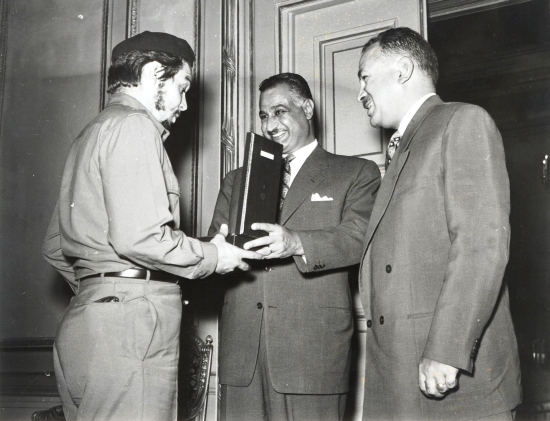 Ο Τσε βραβεύεται από τον πρόεδρο της Αιγύπτου Γκαμάλ Αμπντέλ Νάσερ, ενώπιον του αντιπροέδρου της κυβέρνησης Χουσεϊν Αλ-Χαφί, στο Κάϊρο, Ιούνιος 1959 (Αρχεία Υπουργείου Εξωτερικών Κούβας).
 Συνάντηση με τον πρόεδρο Νάσερ και μέλη της αιγυπτιακής κυβέρνησης στο Κάϊρο (Αρχεία Υπουργείου Εξωτερικών Κούβας).
 Με τον πρόεδρο Νάσερ.
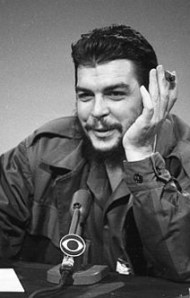 Του Ερνέστο Γκεβάρα.
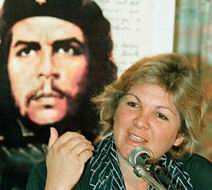
 Συνέντευξη στο Δημήτρη Καραγιάννη.
 – Εχετε μελετήσει σίγουρα τα έργα του πατέρα σας, τη σκέψη του για την ανάπτυξη της προσωπικότητας. Πιστεύετε ότι οι ιδέες του βρίσκουν εφαρμογή στην Κούβα;
 Ελληνικό Αρχείο Τσε Γκεβάρα © Guevaristas