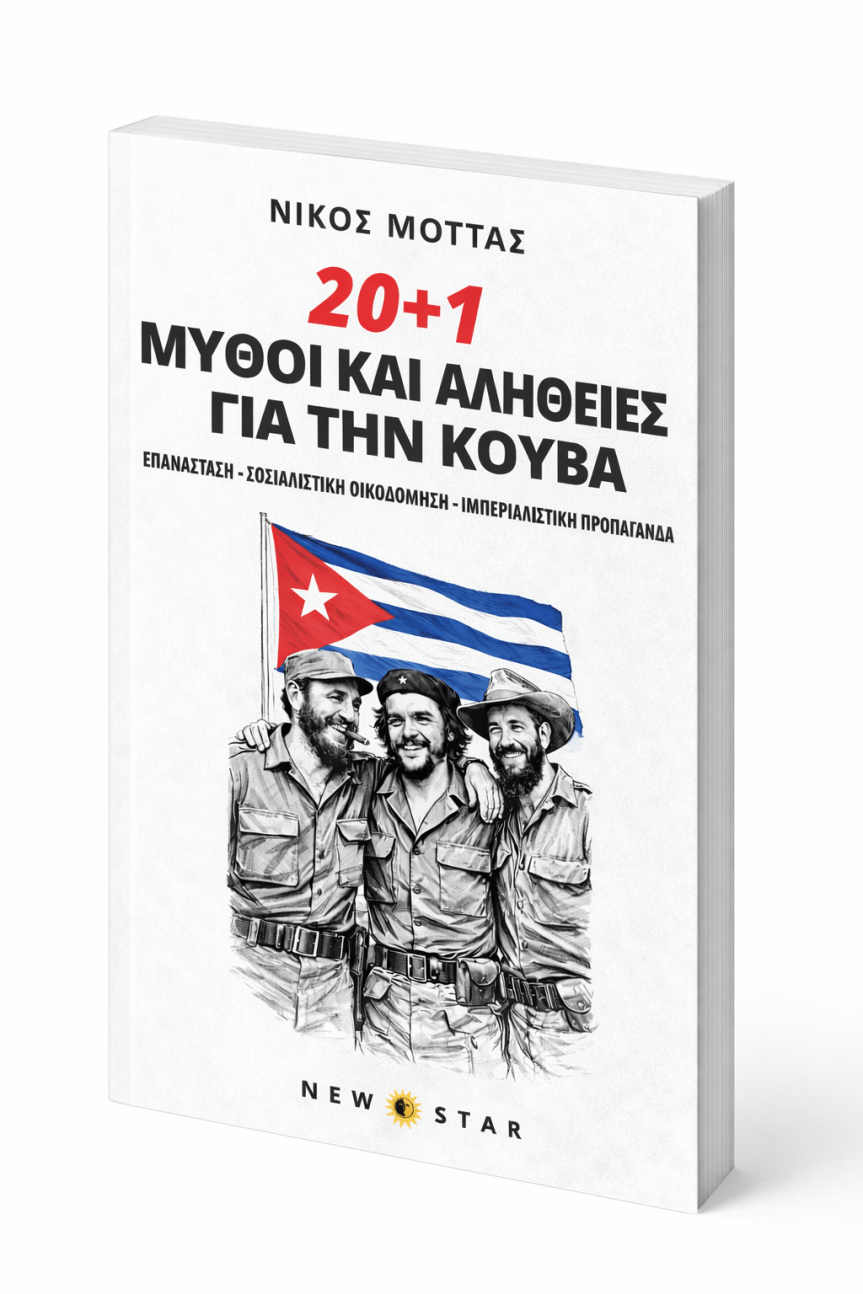
20+1 MITOS Y VERDADES SOBRE CUBA – El nuevo libro de Nikos Mottas se publicó en Grecia

NIKOS MOTTAS
20+1 MITOS Y VERDADES SOBRE CUBA
REVOLUCIÓN – CONSTRUCCIÓN SOCIALISTA – PROPAGANDA IMPERIALISTA

El nuevo libro de Nikos Mottas, titulado “20+1 MITOS Y VERDADES SOBRE CUBA”, ha sido publicado en el idioma griego por Ediciones New Star.

Una isla que resistió el asedio imperialista más prolongado de los siglos XX y XXI. Un pueblo que eligió vivir con dignidad, a pesar de la pobreza, los bloqueos y las amenazas. Un experimento social que —con todas sus contradicciones— no se limitó a cuestionar gobiernos o regímenes, sino el propio sistema de dominación capitalista.

Este libro intenta arrojar luz sobre aspectos cruciales de la Revolución Cubana, del proceso de construcción socialista, así como de la implacable propaganda que la acompaña hasta nuestros días. Con profundidad histórica, coherencia teórica y realismo político, examina los dilemas, las victorias y las derrotas de un ejemplo histórico único.

Cuba no es un vestigio de otra época, sino una prueba de que siguen existiendo caminos alternativos de desarrollo y organización social. Cien años después del nacimiento de Fidel Castro, la llama de la revolución continúa ardiendo. No como un “mausoleo de ideas superadas”, como pretende presentarlo el discurso ideológico dominante del capitalismo, sino como un recordatorio vivo de que el socialismo-comunismo sigue siendo más necesario y actual que nunca.

Nikos Mottas es politólogo, autor y periodista. Entre otras publicaciones, es autor del libro «Che Guevara, Embajador de la Revolución» (2021).

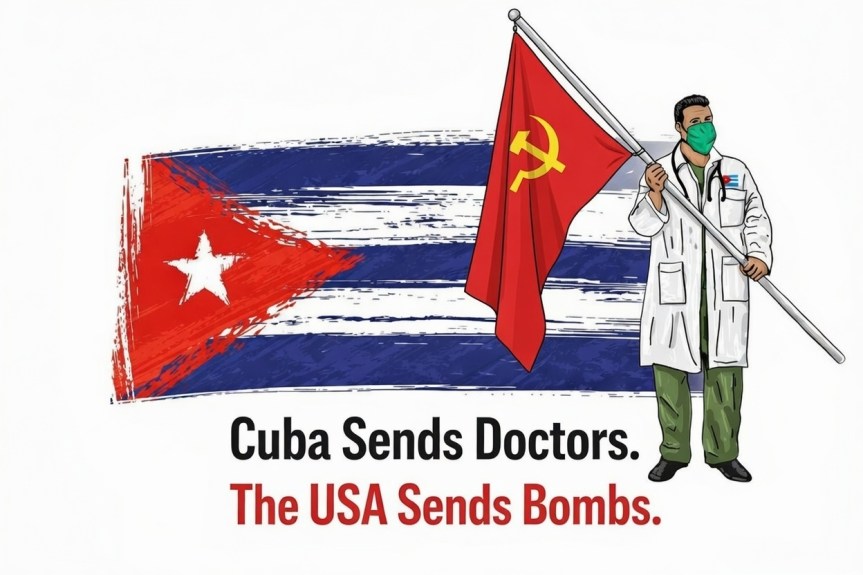
Nikos Mottas: «Cuba Sends Doctors. The USA Sends Bombs»

By Nikos Mottas

There are moments when history reduces itself to a single, unavoidable contrast. Today is one of them. As renewed threats and economic aggression once again emanate from Washington under Donald Trump, an old truth regains its sharpness:

Cuba sends doctors. The United States sends bombs.

This is not a slogan invented for effect. It is a reflection of two opposing social systems, two different priorities, two irreconcilable visions of what a society should produce—and for whom.

For more than sixty years, socialist Cuba has lived under blockade, sanctions, financial isolation, and constant political hostility from the United States. The goal of that pressure has never been hidden. From the early days after 1959, Washington’s strategy aimed at economic suffocation: restrict trade, choke access to credit, create scarcity, and force the population to turn against its own revolutionary project.

It did not work.

Instead of collapsing, the island reorganized itself. Instead of militarizing its society, it invested in education and public health. When much of the pre-revolutionary medical elite left the country expecting the Revolution to fall, Cuba made a historic decision: it would form a new generation of doctors drawn from workers and peasants. Healthcare would not depend on wealth. It would be universal, preventive, and public.

Under the leadership of Fidel Castro, scarce resources were directed not toward stock exchanges or private insurance conglomerates, but toward polyclinics, vaccination programs, and medical schools. In a poor country under siege, the Revolution chose to multiply doctors.

That choice transformed Cuba internally. Life expectancy rose. Infant mortality dropped to levels comparable with developed nations. Entire rural areas that had been abandoned under the old order received consistent medical care for the first time. Health ceased to be a commodity and became a social guarantee.

But Cuba did not stop at its own borders.

Time and again, when disaster struck elsewhere, Cuban medical brigades were there. After earthquakes in Latin America, hurricanes in the Caribbean, epidemics in Africa, and pandemics that paralyzed wealthy nations, Cuban doctors boarded planes carrying not weapons but stethoscopes. In the midst of Ebola’s devastation in West Africa, it was Cuban medical personnel who arrived in significant numbers when many powerful countries hesitated. During the COVID-19 crisis, Cuban brigades assisted overwhelmed healthcare systems abroad while the island simultaneously developed its own vaccines despite the blockade.

This is not charity diplomacy. It flows from a different organizing principle. A planned economy, even one with limited material wealth, can prioritize the defense of life because it is not governed by private profit.

Now look at the other side of the contrast.

The US commands the largest military budget in history. Its defense spending surpasses that of entire regions combined. It maintains hundreds of overseas bases and has been involved—directly or indirectly—in wars, invasions, regime-change operations, sanctions campaigns, and covert interventions across continents. From Southeast Asia to the Middle East, from Latin America to Eastern Europe, its foreign policy has consistently relied on military leverage and economic coercion.

At home, millions of Americans struggle with medical debt. Entire communities face inadequate healthcare access. Life-saving medication can be priced beyond reach. Yet there is no comparable hesitation when funding new weapons systems, expanding military alliances, or modernizing nuclear arsenals.

This contrast is not about national character. It is about structure.

Capitalism in its imperial stage concentrates wealth, protects corporate power, and projects military force to secure economic interests. Socialist construction—however constrained by massive external pressure—attempts to allocate resources according to collective need.

For more than six decades, the US blockade has attempted to make daily life in Cuba unbearable. It restricts access to medical equipment, fuel, spare parts, financial transactions, and international trade. It punishes third countries that attempt normal economic relations with the island. Every shortage is then cynically cited as proof that socialism “fails,” while the external chokehold is treated as invisible.

And yet, despite all this, Cuba continues to graduate doctors in remarkable numbers. It continues to dispatch medical brigades abroad. It continues to treat healthcare not as a luxury but as a right.

That reality is politically dangerous.

Washington is unsettled not by Cuban strength, but by Cuban example. A small Caribbean nation, ninety miles from Florida, demonstrating that education can be free, that healthcare can be universal, that solidarity can cross borders without corporate contracts—this stands as a quiet but persistent rebuke to the dominant model.

The difference can be expressed simply:

One system invests in aircraft carriers; the other invests in pediatricians

One system refines sanctions; the other refines vaccination campaigns.

One system speaks of “freedom” while tightening economic sieges; the other sends medical teams to communities that cannot pay.

Cuba is not a utopia. No society operating under permanent external pressure can be free of contradictions or difficulties. But its priorities are unmistakable. When faced with scarcity, it chooses to educate. When confronted with crisis, it chooses to heal. When attacked economically, it responds by training more doctors.

That moral orientation matters.

Cuba, a small island just ninety miles from Florida, keeps demonstrating that another world is possible — not through declarations and speeches, but through doctors, classrooms, and solidarity. And that living example is what the empire will never forgive.

* Nikos Mottas is the Editor-in-Chief of In Defense of Communism.  

Source: idcommunism.com

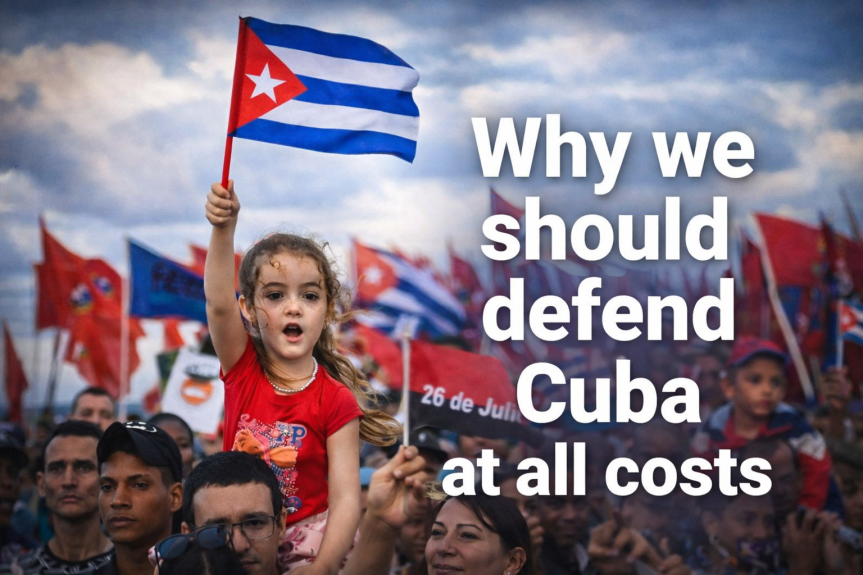
Nikos Mottas: Why we should defend Cuba at all costs

By Nikos Mottas

The recent escalation of vicious threats and coercive measures against Cuba by the Trump administration marks a new phase in a policy that is neither accidental nor episodic. The tightening of sanctions, the targeting of fuel supplies, the intensification of financial restrictions, and the open rhetoric of intimidation together constitute a deliberate sharpening of economic warfare against the Cuban people. 

This is not a diplomatic disagreement, nor a tactical adjustment dictated by momentary calculations. It is the continuation, under contemporary conditions, of a long-standing imperialist strategy whose objective has remained unchanged for more than six decades: to suffocate socialist Cuba and force its political capitulation.

What is unfolding today must be understood within the broader context of a generalized imperialist offensive, taking shape in conditions of deepening capitalist crisis. Economic coercion, sanctions regimes, and extraterritorial measures have become normalized instruments of class power on a global scale. In this framework, Cuba is not an isolated target but a strategic one. The attack on Cuba functions simultaneously as punishment and warning: punishment for a people that dared to break relations of dependency and expropriate capital, and warning to all others of the consequences of attempting a similar rupture.

To grasp why Cuba must be defended at all costs, it is necessary to move beyond moral appeals or abstract expressions of solidarity. The issue at stake is not sympathy, nor the defense of a distant cause. It is a question of class power, historical development, and the balance of forces between imperialism and the international working class.

Lenin’s analysis of imperialism remains indispensable precisely because it dispels illusions. Imperialism is not the product of particularly aggressive governments or misguided leaders; it is the necessary form assumed by capitalism at a certain stage of its development, when monopoly and finance capital dominate economic life and require political and military enforcement. Within this framework, the existence of a socialist state is intolerable not because of its rhetoric, but because of its material practice. Cuba did not merely replace one political leadership with another in 1959. It dismantled relations of dependency, expropriated foreign capital, and asserted social ownership over the decisive sectors of the economy. In doing so, it interrupted the mechanisms through which imperialism extracts value, disciplines labor, and reproduces its dominance.

The response was immediate and systematic. The blockade, sabotage, terrorist attacks, diplomatic isolation, and ideological warfare were not improvised reactions. They were the predictable instruments of a system that cannot coexist with alternatives. Imperialism does not tolerate exceptions; it seeks to erase them.

The blockade against Cuba has always functioned as a permanent counterrevolutionary mechanism. Its logic has never been military conquest, but social erosion. By restricting access to energy, medicine, spare parts, technology, credit, and trade, imperialism aims to disrupt the reproduction of socialist social relations themselves. This is why the targets are not abstract indicators, but concrete conditions of everyday life. Shortages are weaponized. Infrastructure is strained. Transport, production, and distribution are deliberately obstructed. Time, exhaustion, and uncertainty are transformed into political tools. The expectation is not that socialism will be overthrown through direct force, but that it will collapse under the cumulative pressure of material hardship.

Fidel Castro repeatedly warned that imperialism would attempt to defeat the revolution not only through open aggression, but through attrition. Yet he also emphasized that resistance under such conditions reshapes consciousness. Hardship, when interpreted correctly, does not automatically produce resignation or defeatism. It can also produce clarity. In this sense, Cuba’s endurance under siege is not passive survival; it is an ongoing ideological struggle conducted in conditions deliberately made hostile.

Cuba’s social achievements are often presented as isolated successes or statistical anomalies. This approach obscures their political content. Universal healthcare, free education, scientific development, cultural access, and social security are not neutral outcomes. They are the direct result of social ownership, central planning, and the exercise of working-class power. Under capitalism, even in its most developed forms, such guarantees remain subordinate to profitability. Under socialism, they become organizing principles. Cuba’s experience demonstrates, in practice rather than theory, that production organized for social use rather than private accumulation is not a utopian aspiration, but a viable historical alternative.

Che Guevara’s insistence on the moral and conscious dimensions of socialist construction is central to understanding this process. His emphasis on collective responsibility, social motivation, and the transformation of human relations was not ethical embellishment. It reflected a materialist understanding that socialism is not merely a rearrangement of property forms, but a struggle to overcome the social logic inherited from capitalism itself.

Cuba’s internationalist orientation emerged from this same clarity. It was not an optional moral stance, but the product of sober political assessment. As Lenin repeatedly warned, the existence of a socialist state in isolation, surrounded by an imperialist world system, inevitably entails immense pressure and heavy costs. International solidarity, therefore, is not generosity; it is a condition of survival. Cuba’s support for anti-colonial struggles, its internationalist missions, and its medical brigades were undertaken not in conditions of abundance, but of scarcity. They were acts of political realism, rooted in the understanding that fragmentation is imperialism’s most effective weapon and that solidarity, even when costly, strengthens resistance.

This is precisely why Cuba has been targeted so relentlessly. Internationalism undermines imperialism’s strategy of isolation. It exposes the global character of exploitation and reinforces the subjective capacity of oppressed peoples to resist. The attack on Cuba is therefore not only an attack on a specific country, but an attack on the principle of internationalism itself.

The defense of Cuba concerns the international working class directly. The message conveyed by imperialist aggression is unmistakable: any attempt to abolish capitalist property relations will be punished relentlessly. The objective is not only to defeat Cuba materially, but to present its defeat—if achieved—as historical proof that socialism is impossible. Such an outcome would have consequences far beyond the Caribbean. It would deepen defeatism, embolden reactionary forces, and reinforce the ideological hegemony of capital at a moment when capitalism itself is entering a period of intensified instability.

At this point, the historical significance of Cuba must be addressed without evasions. The counterrevolutionary overturns of 1989–1991 and the dissolution of the Soviet Union marked a profound setback in the global balance of class forces. They did not signify the “end of socialism,” but they did dramatically narrow the terrain of socialist construction. In the decades that followed, the international working class has confronted a world in which socialist transformation has been abandoned, distorted, or openly reversed in most places.

It is precisely within this historical rupture that Cuba’s role acquires exceptional weight. Despite its small size, despite suffocating imperialist pressure, and despite undeniable contradictions and difficulties, Cuba remains the only living example of a country that continues to attempt socialist construction on the basis of social ownership, planning, and working-class power, rather than market dominance and capitalist accumulation. This fact is not a moral judgment; it is an objective political reality.

Attempts to obscure this reality through false equivalences serve no emancipatory purpose. Capitalist restoration masked by socialist terminology, or systems dominated by market relations and capital accumulation, cannot substitute for socialist construction. Nor can forms of state survival that do not place the transformation of social relations at their core. Whatever their differences, such cases do not alter the historical truth that Cuba stands alone today as a reference point for socialism as a living project, not as a museum piece or rhetorical legacy.

For this reason, the defense of Cuba is not simply an act of solidarity with a besieged people. It is an act of strategic responsibility toward the international working class. To allow Cuba to be crushed, isolated, or forced into capitulation would not merely represent the defeat of one country. It would be used to seal the narrative that socialism belongs irrevocably to the past—that history has closed that chapter for good.

To defend Cuba is to reject that narrative in practice. It is to affirm that socialism is not a closed chapter of history, but a necessity born of capitalism’s own contradictions, contradictions that are deepening rather than receding. It is to defend the historical possibility that working people can still organize society on different foundations, even under conditions of extreme pressure.

For this reason, solidarity with Cuba cannot be episodic, symbolic, or rhetorical. It must be organized, political, and confrontational. It must challenge the legitimacy of the blockade, expose the criminal character of economic warfare, and mobilize working-class forces against imperialist aggression. For communist and workers’ parties, this is not a matter of preference. It is a test of internationalism. In conditions of imperialist assault, neutrality is not an intermediate position. Silence aligns objectively with the aggressor.

Capitalism today is marked by deep and sharpening structural contradictions: chronic economic instability, the permanent resort to militarization and war, increasingly authoritarian forms of governance, ecological devastation, and the systematic dismantling of social and labor rights. These phenomena are not accidental distortions of an otherwise functional system. They are the mature expression of capitalism’s historical limits. In this phase, the ruling classes are not merely managing crises; they are attempting to reorganize society in a way that permanently suppresses the possibility of systemic challenge.

Under these conditions, every living alternative becomes intolerable. Every historical experience that contradicts the narrative of capitalist inevitability must be erased, neutralized, or transformed into a harmless relic. It is in this sense that Cuba’s continued existence as a socialist project acquires decisive significance. Not because it claims perfection, but because it persists as a concrete negation of capitalist logic.

To understand this significance fully, one must confront directly the historical rupture produced by the counterrevolutionary overturns of 1989–1991 and the dissolution of the Soviet Union. That defeat did not mark the “end of socialism,” as bourgeois ideology endlessly proclaims. It marked a profound setback in the global balance of class forces, one whose consequences are still being felt. Since then, socialist construction has either been abandoned, reversed, or fundamentally distorted in most parts of the world.

In this post-counterrevolutionary landscape, Cuba occupies an objectively unique position. Despite its small size, despite relentless imperialist pressure, despite material scarcity and internal contradictions, Cuba remains the only country that continues to pursue socialist construction on the basis of social ownership, planning, and the primacy of working-class power over market relations and capital accumulation. This is not a matter of sentiment or loyalty; it is a material fact.

Attempts to blur this reality through false equivalences do not serve the working class. Capitalist restoration cloaked in socialist language, systems governed by the law of value and capital accumulation, or forms of state survival that do not place the transformation of social relations at their core cannot be treated as substitutes for socialist construction. Whatever their differences, such cases do not alter the central historical truth: Cuba stands today as the sole living reference point for socialism as a practical, ongoing process, not as a commemorative symbol of the past.

For this reason, the defense of Cuba transcends the boundaries of solidarity with a besieged nation. It becomes a question of strategic responsibility toward the international working class itself. To allow Cuba to be crushed, isolated, or forced into capitulation would not merely signify the defeat of one country. It would be mobilized ideologically to seal the argument that socialism belongs irreversibly to history, that the working class has no future beyond the management of capitalism’s crises.

To defend Cuba is to reject that argument in practice. It is to affirm that socialism is not a closed chapter of history, but a necessity born of capitalism’s own contradictions—contradictions that are intensifying rather than dissolving. It is to defend the historical possibility that working people can still organize society on different foundations, even under conditions of extreme pressure and hostility.

For this reason, solidarity with Cuba cannot be episodic, symbolic, or rhetorical. It must be organized, political, and confrontational. It must challenge the legitimacy of the blockade, expose the criminal character of economic warfare, and mobilize working-class forces against imperialist aggression. For communist and workers’ parties, this is not a question of preference or tone. It is a test of internationalism itself. In conditions of imperialist assault, neutrality is not an intermediate position; silence aligns objectively with the aggressor.

There is no comfortable middle ground. Either imperialism succeeds in suffocating socialist Cuba, or the international working class asserts its capacity to resist, to learn from historical defeats, and to re-enter history as an active force. Fidel Castro warned that revolutions are not destroyed only by external force, but by the erosion of solidarity and historical confidence. The defense of Cuba today is therefore a test—not of Cuba alone, but of the international workers’ movement as a whole.

Defending socialist Cuba is not a matter of sentiment, but a concrete historical task of the international working class — a task that must be carried out at all costs. 

* Nikos Mottas is the Editor-in-Chief of In Defense of Communism.  

Source: idcommunism.com

Nikos Mottas’ book on Che Guevara presented in Veria, Greece

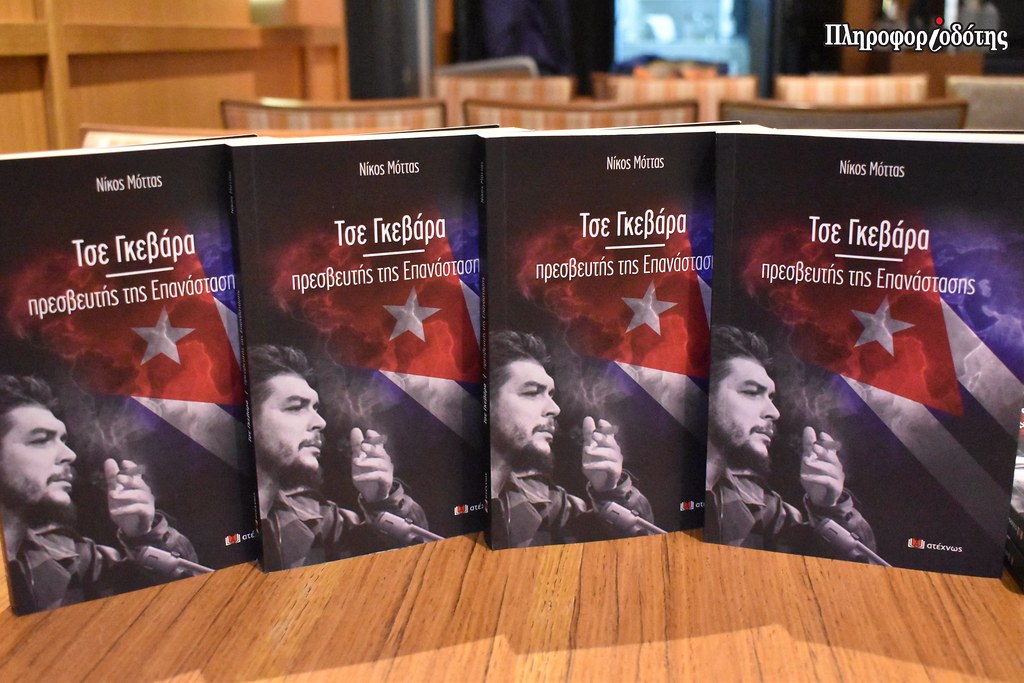
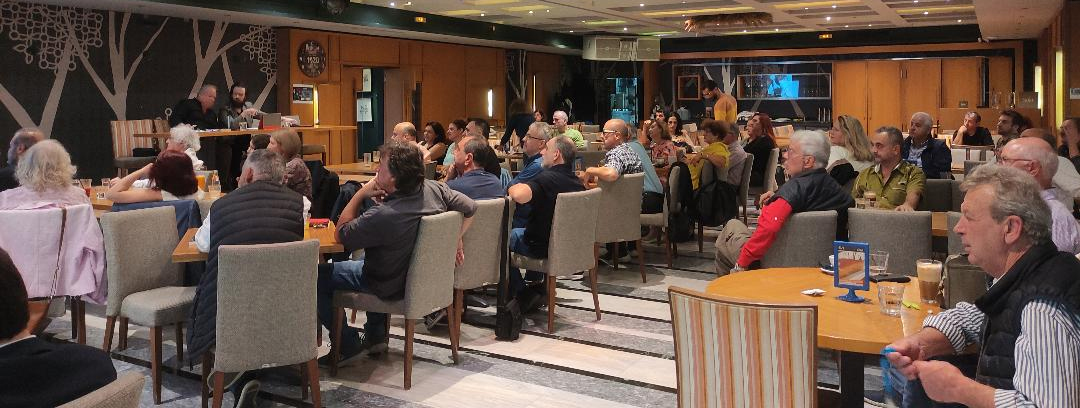
VERIA, GREECE – The presentation of Nikos Mottas’ book “Che Guevara, Ambassador of the Revolution” (2021, Atexnos Publishing) was held with particular success of Sunday 30 September in the northern Greek city of Veria.

The event was attended by numerous friends of Cuba, people from the local administration, representatives of associations and unions from the region of Imathia and others who expressed their solidarity towards the people of Cuba.

Nikos Mottas (right) with journalist Alekos Chatzikostas.

The speakers included Alekos Chatzikostas, journalist and author, as well as the book’s author Nikos Mottas. A special message addressed to the author by Dr. Aleida Guevara, daughter of Ernesto, was also read.

A short documentary titled “PAX CUBANA”, directed by Dimitris Tachmatzidis, was also presented during the event. Among others, the video included scenes from the visit of the Ambassador and Counsellor of the Republic of Cuba, Zelmys Maria Dominguez Cortina and Jose Oriol Marerro Martinez respectively, in northern Greece, including the archaelogical site of Vergina, back in September 2021.

Cuba honors the 89th anniversary of Che Guevara’s birth

CHE MAUSOLEO.jpgSANTA CLARA.– The presence of Comandante Ernesto Che Guevara in this city will be remembered with a series of activities this June 14, on the occasion of the 89th anniversary of his birth.

In the early morning, 39 children and young people from two local schools named after the guerrilla leader will carry out the traditional exchange of floral wreaths at the Memorial where his remains and those of his fellow comrades in arms in Bolivia rest, explained Yoel Padrón, head of the Young Communist League’s (UJC) Ideological Department in Villa Clara.

This ceremony will be followed by a march of the people of Santa Clara from Antonio Maceo Park, led by young workers from factories founded by the Heroic Guerrilla in this city.

The morning will also see 89 young people presented with their UJC membership cards, while 172 small children from different educational centers in Santa Clara will be initiated as pioneers and receive their neck scarves.

On Saturday, June 10, 200 young people was scheduled to climb the Loma del Capiro, where they would hold a meeting with combatants who fought alongside the emblematic revolutionary and guerrilla leader.

In Sancti Spíritus thousands of residents took to the cane fields and other agricultural centers.

On June 11th, in another province of Cuba, in Sancti Spíritus, thousands of residents took to the cane fields and other agricultural centers of El Meso, La Sierpe and Cabaiguán, in a massive, productive mobilization to honor Che, the main promoter of voluntary work in the country following the Revolution of 1959.

Mercy Rodríguez Crespo, secretary general of the Cuban Workers Federation in the province, told Granma that in addition to commemorating the upcoming 50th anniversary of Che’s death in Bolivia, also being celebrated are the anniversary of General Antonio Maceo’s birth; National Rebellion Day, July 26; and the World Festival of Youth to be held in October in the Russian city of Sochi.

José Ramón Monteagudo Ruiz, Central Committee member and first Party secretary in Sancti Spíritus, led the work at the El Meso basic unit of cooperative production which supplies the Uruguay sugar mill, in one the areas hit hard by drought, where a special effort is needed to plant cane for next year’s harvest.

Evaluating the impact of the mobilization, Elvis González Vasallo, director of the sugar enterprise in Sancti Spíritus, described as significant the work done in cane fields in several municipalities, with the exception of Yaguajay, where the focus was on vegetable farms.

The mobilization was convoked by the Party, with other organizations participating, and included work at cattle ranches, mills and industrial sites, as well as clean-up efforts in the cities of Sancti Spíritus and Trinidad.

Source: Periodico Granma.

Nikos Mottas: Thank You Compañero Fidel Castro!

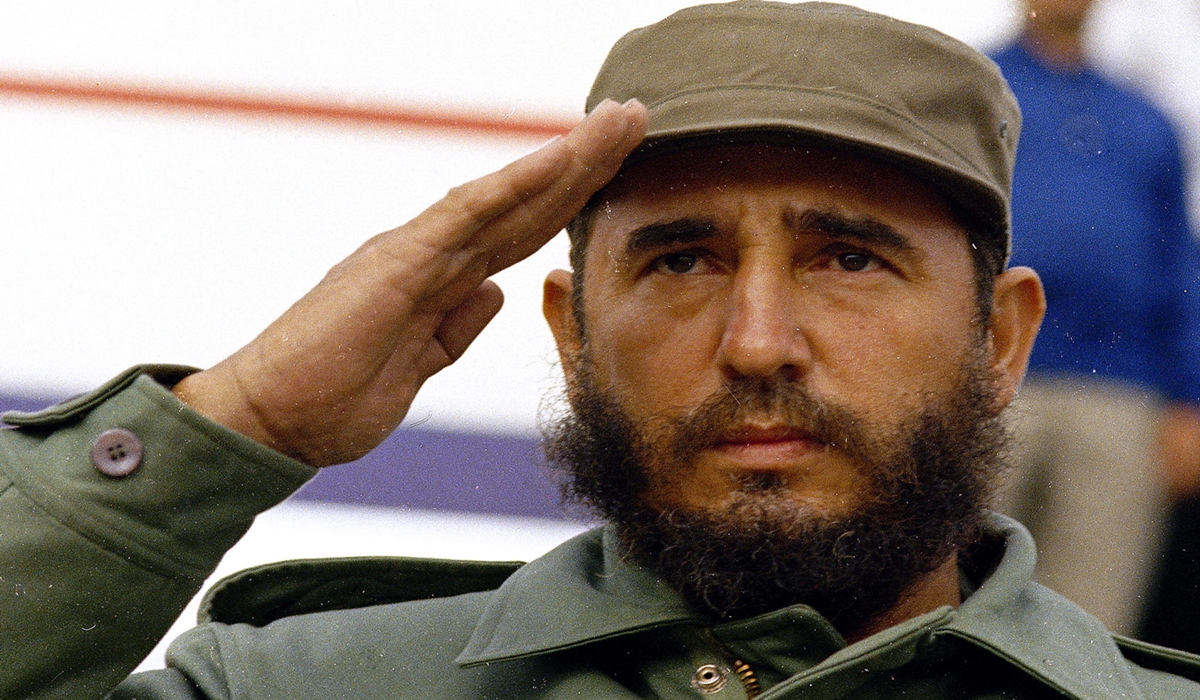
fidel-castro-ruz-great-revolutionaryBy Nikos Mottas / In Defense of Communism.

«Rights are to be taken, 

not requested; seized, 

not begged for»

– Jose Marti.

After 25th November 2016 humanity is poorer. The international working class, the people who fiught for a better world, those who believe in a society without exploitation of man by man, are poorer. Along with the proud people of Cuba, the international communist movement mourns the biological death of one of the greatest, the most emblematic revolutionaries of contemporary History. The heart of the leader of the Cuban Revolution, Comandante Fidel Castro stopped beating, marking the biological end of a life of 90 years full of struggles and sacrifices for the ideals of Socialism-Communism, for a Cuba where the people will be the masters of their destiny.

The death of Fidel, as well as the biological deaths of other extraordinary revolutionaries and communists like Lenin, Stalin, Che, Ho Chi Minch, consists a motive for the evaluation of their revolutionary work and legacy. A work and a legacy which are key factors in the formation of the class conciousness of the working class.

Fidel approached Marxism-Leninism in practice. He was a communist in actions, not words.Comandante Fidel identified himself with revolutionary practice which is dialectically inter-connected with the Marxist revolutionary theory. Along with his comrades and the Cuban people he accomplished an extraordinary achievement- the first Socialist revolution in the history of the American continent. Comrade Castro and the Cuban Revolution proved that Imperialism is not undefeated and that the only real superpower is the people who resist, the people who fight against capitalist barbarity and open the road to socialist perspective.

Various imperialists, apologists of Capitalism, fascists and anticommunists are trying these days to vilify Fidel and his legacy. They have already failed. Because History- the only unmistakable judge- has absolved him. Fidel has been irreversibly and ultimately absolved by History. The achievements of the Cuban Revolution consist a solid proof of that.

Today, 57 years after the 1959 Revolution, the achievements of socialist construction in Cuba’s public sectors including Health, Education and Housing is much higher than in many capitalist countries in Latin America. The literacy rate is almost 98%, education is accessible to all citizens without exceptions while the Cuban national health system (free for all) is justifiably regarded one of the best in the world. Some indicative data speak by themselves:

  • In 2007, the average life expectancy rate in Cuba was 78.26 years, having increasing trend. For the same year, the rate in the US was 77.99 years. (World Bank).
  • In 2010, infant mortality rate in the island was 4.7 for ever 1000 births, less than any country in the whole continent, including the US.
  • During the last years, 1,390,000 patients from 32 countries had their vision improved or fully restored in 59 ophalmology centers operating under the support of the Cuban and Venezuelan governments.
  • The centralized, state control of economy has let Cuba to constantly develop the national health system, even after the collapse of the Soviet Union and the hardening of the US economic blockade. From 1990 to 2003, the number of doctors in Cuba increased by 76%, of dentists by 46% and nurses by 16%. During the same period, the population coverage of the social institution of «family doctor» was increased by 52.2%, touching a rate of 99.2% in 2003.
  • In November 2008, Cuba had more than 70,000 doctors. From them, approximately 17,600 were sent to 75 different countries in order to offer their services there. In 27 countries (including African countries such as Ghana, Botswana, Namimbia etc.) Cuba has supplied medical personnel which offers high quality services. In Timor Leste, for example, it is estimated that between 2003 and 2008, the Cuban medical mission saved 11,400 people contributing significantly to the fall of birth mortality rate.
  • The high solidarity feeling among Cuban people is undoubted. The first Cuban medical team was sent in 1960 to the then devastated by an earthquake Chile. From 1960 to 1980 the Cuban government immediately sent medical aid to 16 countries which had been facing natural disasters or conflicts. On August 2005, after the disastrous hurricane Katrina in the United States, the Castro government volunteered to sent a team of doctors to the state of Louisianna. The proposal was turned down by the Bush administration. During the same year, on October 2005, Cuba sent the largest number of specialized medical personnel (2,500 men and women) to Pakistan, shortly after the earthquake. Moreover, the Cuban government offered 1,000 scholarships to Pakistani students from poor families who desired to study medicine.

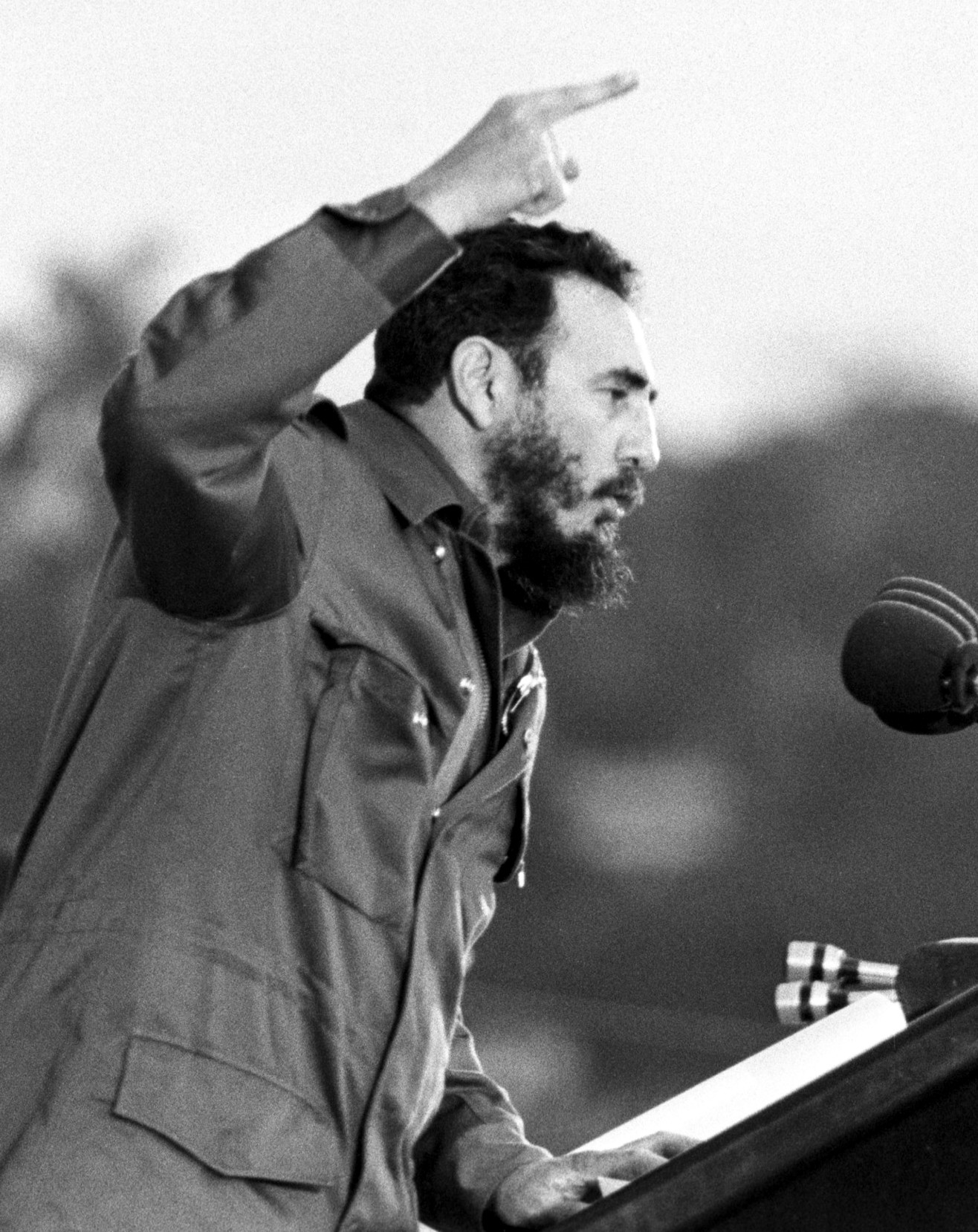
fidel-castro-speech-1Furthermore…

  • The 99.8% of Cubans over the age of 15 know how to read and write (UNESCO). That consists the highest rate of literacy in Latin America and one of the highest internationally.

  • During 2010, one million young Cubans were graduated from the country’s universities.

  • The role of woman in society is upgraded. Fourty-three percent (43%) of the seats at the country’s parliament are held by females, while 65% of the labor force in technical sectors are women.

  • Despite the relatively small size of the country (11 million), Cuba is a significant power in sports. For example, in the Pan-American Games of 2011 held in Mexico, the country was terminated second with 58 golden medals.

On the above we should add the fact that any citizen, indifferently of sex, race or ethnicity, can find a job, without facing the terrible situation of unemployment that bedevils many «developed» capitalist countries of the West.

The socialist construction in Cuba is not perfect- there are existing problems which constantly changing and the Revolution faces new challenges. However, we should ask ourselves: Under what conditions does Cuba and Cuban people try to live and develop the socialist system for more than four decades? The answer is clear

Since the triumph of the 1959 Revolution and until today, Imperialism- more specifically the U.S. imperialism- has not stopped to undermine the socialist construction in this small but proud island. The inhuman embargo (economic blockade) that has been imposed by the US government is an example of a multi-dimensional war that Imperialism has declared to Cuba. It is estimated that, in economic terms, 8 hours of economic blockade equals with 140 school buildings’ renovations. Three days of blockade equals with 100 tones of pharmaceutical material.

The war of Imperialism against the Castro government and the Cuban people became more relentless after the counter-revolutionary events of 1989-1991 in the Soviet Union and Eastern Europe. However, Cuba‘s Socialism managed not only to stay firm, but also to progress under especially adverse circumstances. That consists the unambiguous and undoubted vindication of Fidel Castro.

Every communist, every Marxist-Leninist, every honest fighter against capitalist exploitation and Imperialism, in every corner of the world, owes a massive “Gracias” to Comandante Fidel.

Thank You companero Fidel Castro! Thank you for your dedication to the ideals of Socialism-Communism. Thank you for all the unforgettable heroes who fought by your side- for Che, for Camilo, for Celia, for Raul and many others! Thank you for the proletarian internationalism which you and Cuba honoured in the best possible way! Thank you for your solidarity to the people of the world. Thank you for your extraordinary speeches which will continue to inspire a spirit of disobedience and rebellion against Imperialism. Thank you for the Revolution and the bread of the Cuban people who loved you like a father.

Thank You, Compañero Fidel, most of all, for the hope for a better world! Hasta La Victoria, Siempre Comandante!

28.11.2016.
 
*Nikos Mottas is the Editor-in-Chief of In Defense of Communism, a PhD candidate in Political Science, International Relations and Political History. 
fidel2bkentriki

Revolution Guided by Feelings of Great Love: Learning from Che Guevara

By Mitchel Cohen*.

Che Guevara was not overly concerned about elections as a means for transforming a capitalist or authoritarian state. But he was extremely concerned about finances, and how to fund the revolution. There is a piece in the film, «Ernesto Che Guevara: The Bolivian Diary,» which is eerie in that it shows Che as part of a Cuban delegation in Moscow begging for funds for Cuba. In the film, the 34-year old Che Guevara is barely able to bite his tongue and check his scathing sarcasm for the Russian bureaucrats, in order to gain funding from them.

Che hated the Cuban revolution’s reliance on the Soviet Union, and went on to devise other means for obtaining funds and dispersing them. As the only one among the victorious guerrilla leadership in the Cuban revolution who had actually studied the works of Karl Marx, Che despised the bureaucrats and party hacks in the USSR as well as in Cuba.

I.F. Stone revealed that how, as early as 1961, at a conference in Punte del Este, Uruguay, Che Guevara — born in Argentina and a student of medicine there — was huddled in discussion with some new leftists from New York. A couple of Argentine Communist Party apparatchiks passed. Che couldn’t help shouting out: «Hey, why are you here, to start the counter-revolution?»

Like many in the emerging new left around the world, Che had first-hand experience with party apparatchiks and hated their attempts to impose their bureaucracy on indigenous revolutionary movements.

Indeed, contrary to the conceptions of many in the U.S. today, the revolution in Cuba was made independent of, and at times in opposition to, the Cuban Communist Party. It was only several years after the revolution succeeded in taking state power that an uneasy working relationship was established leading to a merger of the revolutionary forces and the Party — a merger that provided no end of problems for Che, and for the Cuban revolution itself.

We can learn something for our situation in the US today by examining Che’s approach in Latin America.

One such problem: Cuba’s increasing dependence upon the Soviet Union (in some ways similar to radical organizations’ increasing dependence on Foundation grants and other hoop-providing jumpsters). In its desperation for currency to buy needed items, the government — after strenuous debate — decided to forego diversification of Cuba’s agriculture in order to expand its main cash-crop, sugar, which it exchanged for Soviet oil, using some and reselling the rest on the world market. Despite Che’s (and others) warnings, Cuba gradually lost the capability to feed its own people — a problem that reached devastating proportions with the collapse of the Soviet Union in 1991.

Similar crises had beset the Soviet Union and other avowedly socialist countries when they pursued industrial models of development and tried to pay for it by producing for and competing in the world market. Che’s response: Don’t produce for the world market. Reject cost/benefit analysis as the measure for what gets produced. A truly new society, Che believed, must aspire to and implement immediately, in the here and now, what its people dream for the future. And to get there, REAL communist revolutions must reject «efficiency» and nurture communalistic attempts to create a more humane society instead.

Che’s contempt for the officials of Marxdom (while considering himself a marxist) and bureaucrats of every stripe broke with the numbing mechanistic economics that Marxism had become. With Che and the new left inspired by him, «Revolution» was placed back on the historical agenda.

Che’s internationalism and identification with the poor and downtrodden every-where, his refusal to recognize the sanctity of national boundaries in the fight against U.S. imperialism, inspired new radical movements throughout the world. Che called upon radicals to transform OURSELVES into new, socialist human beings BEFORE the revolution, if we were to have any hope of actually achieving one worth living in. His call to begin living meaningfully NOW reverberated through an entire generation, reaching as much towards Sartre’s existentialism as the latter stretched towards Marx. Through action, through wringing the immediacy of revolution from the neck of every oppression, of every moment, and by putting one’s ideals immediately into practice, Che hammered the leading philosophical currents of the day into a tidal wave of revolt.

For Che, Marx’s maxim: «From each according to their ability to each according to their needs,» was not simply a long-range slogan but an urgent practical necessity to be implemented at once. The harrowing constraints of developing a small country (or radio station!!!!) along socialist lines, particularly in the context of continued attacks by U.S. imperialism (including a blockade, an invasion, a threatened nuclear war, and ongoing economic and ideological harrassment), on the other hand, militated against Che’s vision and boxed-in the revolutionary society into choosing from equally unpalatable alternatives.

In a sense, many of our organizations face similar «alternatives» today.

It was amid such contradictory pressures that Che tried to set a different standard for Cuba, and for humanity in general. As Minister of Finance, he managed to distribute the millions of dollars obtained from the USSR to artists, and to desperately poor farmers who in the U.S. would have been considered, shall we say, «poor risks.»

The Russian bureaucrats, like any capitalist banker, were furious with Che’s «Take what you need, don’t worry about paying it back» attitude. They leaned on Fidel to control Che and to regulate the «proper» dispersal of funds, just as twenty years later under Brezhnev, and apparently having learned nothing, the Soviet state leaned on Poland to pay back its inflated debt to the western banks, causing cutbacks and hardship and leading to the working class response: the formation of Solidarnosc. Indeed, the Soviet Union at that time was the best friend Chase Manhattan ever had! And in so doing it paid the ultimate price.

In 1959, the guerrillas, headed by Fidel Castro, swept into Havana having defeated the military dictatorship of Fulgencio Batista. Although the U.S. government armed and funded Batista, the CIA had its agents in Fidel’s guerrilla army as well.

One lieutenant in the guerilla army, Frank Fiorini, was actually one of several operatives of the Central Intelligence Agency there. Fiorini would surface a few years later as a planner of the Bay of Pigs invasion of Cuba, two years after that as one of three «hobos» arrested in Dallas a few moments after President Kennedy was assassinated and immediately released (one of the other «hobos» was none other than CIA-operative E. Howard Hunt), and again as one of the culprits involved with the dozens of CIA assassination attempts on the life of Fidel Castro.

Fiorini became quite famous again in 1973 as one of the burglars at the Democratic Party Headquarters at a hotel known as the Watergate, under the name Frank Sturgis. Indeed, it was precisely when the Watergate hearings were on the verge of raising serious questions about the Bay of Pigs and U.S. covert operations in Cuba that, suddenly, the existence of secret White House tapes was «unexpectedly» revealed. From that moment on, all we heard was what did Nixon know and when did he know it, and the potentially explosive investigation on the verge of revealing the secret history of illegal CIA interventions in Cuba, the murder of John F. Kennedy and attempted assassinations of Fidel were effectively sidetracked.

And yet it was under the constant threat of warfare by the U.S. — overt as well as the ongoing covert operations — that the Cuban revolution, especially under the instigation of Che, took some of its boldest steps in introducing «socialism of a new type.»

Contrast that with the erstwhile «communist» states, as they sacrificed whatever visionary socialist features they had in order to lure capitalist investment, so that they could compete on the world market. As head of the Cuban national bank, Che going against the tide, as always — made Cuba’s new banknotes famous by signing them simply «Che.» The first question Che asked of his subordinates when he took over the bank was «Where has Cuba deposited its gold reserves and dollars?» When he was told, «In Fort Knox,» he immediately began converting Cuba’s gold reserves into non-U.S. currencies which were exported to Canadian or Swiss banks. (1)

Che’s concern was not so much with developing «solvent» banking institutions in Cuba, but with two things: fighting U.S. imperialism, in this instance by removing the revolution’s gold from the clutches of the United States government (which could all too easily invent an excuse to confiscate it, as it later did with other Cuban holdings. Che was prescient in understanding that this would happen); and, of equal importance, finding ways to foster and fund the creation of a new socialist human being without relying upon capitalist mechanisms, which he understood would end up undermining the best of efforts. Che best put forth his outlook, which came to be that of the new left internationally as well, in a speech, «On Revolutionary Medicine»:

«Except for Haiti and Santo Domingo, I have visited, to some extent, all the other Latin American countries. Because of the circumstances in which I traveled, first as a student and later as a doctor, I came into close contact with poverty, hunger, and disease; with the inability to treat a child because of lack of money; with the stupefication provoked by continual hunger and punishment, to the point that a father can accept the loss of a son as an unimportant accident, as occurs often in the downtrodden classes of our American homeland. And I began to realize that there were things that were almost as important to me as becoming a famous scientist or making a significant contribution to medical science: I wanted to help those people.

«How does one actually carry out a work of social welfare? How does one unite individual endeavor with the needs of society?

«For this task of organization, as for all revolutionary tasks, fundamentally it is the individual who is needed. The revolution does not, as some claim, standardize the collective will and the collective initiative. On the contrary, it liberates one’s individual talent. What the revolution does is orient that talent. And our task now is to orient the creative abilities of all medical professionals toward the tasks of social medicine.

«The life of a single human being is worth a million times more than all the property of the richest man on earth. … Far more important than a good remuneration is the pride of serving one’s neighbor. Much more definitive and much more lasting than all the gold that one can accumulate is the gratitude of a people.

«We must begin to erase our old concepts. We should not go to the people and say, `Here we are. We come to give you the charity of our presence, to teach you our science, to show you your errors, your lack of culture, your ignorance of elementary things.’ We should go instead with an inquiring mind and a humble spirit to learn at that great source of wisdom that is the people.

«Later we will realize many times how mistaken we were in concepts that were so familiar they became part of us and were an automatic part of our thinking. Often we need to change our concepts, not only the general concepts, the social or philosophical ones, but also sometimes our medical concepts.

«We shall see that diseases need not always be treated as they are in big-city hospitals. We shall see that the doctor has to be a farmer also and plant new foods and sow, by example, the desire to consume new foods, to diversify the nutritional structure which is so limited, so poor.

«If we plan to redistribute the wealth of those who have too much in order to give it to those who have nothing; if we intend to make creative work a daily, dynamic source of all our happiness, then we have goals towards which to work.» (2)

Che’s love for the people took him first to the Congo and then to Bolivia, where he organized a band of guerrillas to serve, he hoped, as a catalyst in inspiring revolution. Che once again had to battle Official Marxdom: He struggled with the head of the Bolivian Communist Party for leadership of the guerrillas. The question: «Who should set policy for the guerrillas, Che and the guerrillas themselves or the head of the Bolivian Communist Party?» The guerrillas voted for Che perhaps the only election Che was ever involved in. NOT anybody was allowed to vote, not those who happened to live in the area, for example, but only people who were actively engaged in the struggle. Once Che won that election against the Communist Party attaché — an election that was not only about the individuals but a plebiscite on completely different revolutionary strategies — the Communist Party abandoned the guerrilla movement.

Would we view Che’s decision today as the correct one if the Bolivian CP had not been so heavy-handed, irresponsible and doctrinaire? (On the other hand, can there be a vanguard party that does not act in such a manner?) The question still haunts: To whom is the guerrilla responsible? Who sets the framework?

Such questions are not any easier to resolve. In Vietnam, for example, contary to Che’s guerrilla army, the National Liberation Front’s military took their policy from the party’s political bureau, not the other way around.

This was not the case with Che in Bolivia. The relationship of organization to mass-movement is a problem that has always plagued radical movements when they get to a certain stage. To whom is the affinity group, for example, responsible? Or, for that matter, the artist? The radio network?

On the one hand, decentralization is attractive, allowing for the greatest small-group autonomy, individual freedom and creativity. (One’s individual radio show, perhaps. One’s need for a paying job to support the family.) On the other hand, the larger movement must not only be able to coordinate the activities of many local groups but frame the actions of smaller groups who purport to be part of the same movement within a larger collective strategy, thus in some sense limiting their autonomy.

In Bolivia, failure by the guerrillas to be part of a many-pronged social movement led to their demise. Indeed, Che in his last days was rueful and frustrated at the lack of working class uprising in the mines, which he had hoped to incite. (The Communist Party was powerful among mine workers in Bolvia.) An uprising would have enabled the guerrillas to have had much greater impact. Eventually, the miners did overcome the CP reticence and did go on strike, but it was too little, too late. The guerrillas were depleted, Che wished for just 100 more guerrilla troops; that rather small number (he believed) would have made the difference.

These are serious and complicated questions that apply to our social movements today. Resolving such matters is not helped by demagoguery or grand-standing. It COULD BE helped by a transformation at the station itself, into one that consciously tries to develop a revolutionary culture and sees itself as such, and not simply a «job». Tricky stuff. Not easily reconciled. The world or at least OUR world depends upon whether we are able to resolve (or at least live with) the contradictions implied therein.

In Bolivia in the Summer of 1967, the guerrillas were picked off one by one. Without additional revolutionary forces Che and the others were forced to deal with the reality that, at least in Bolivia at that moment, their strategy for catalyzing a mass-based revolutionary uprising has failed. With the U.S. government under the presidency of the Democrat, Lyndon Johnson, sending military «advisers» and arms to the Bolivian junta, it became only a matter of time, a few months, before the struggle was defeated and the guerrillas wiped out.

A true picture of Che is not that of the flamboyant posters, nor the hagiography of both Hollywood and Stalinism, but of a man dedicated to the poor internationally, trying with a small band of guerrillas to spark a revolutionary uprising of peasants and workers to create a better life for themselves, and meeting frustration after frustration, with only some small successes apart from the tremendous victory of the Cuban revolution itself.

In America, we portray heroes as all-knowing exceptions to the rule, thereby reinforcing our dependence upon the myth of the heroic individual and maintaining the impotence of the multitude. In our culture, we are taught that change takes place not through mass-action but through a single moralistic or righteous figure (think of how Dr. King or Malcolm X is portrayed today) who is able to make the system respond positively to the importance of his or her argument.

We should hold no such illusions. The Bolivian peasants who are still alive and living in the areas in which Che and his guerrilla band were operating were clearly touched by the brush of history. In the film «Ernesto Che Guevara: The Bolivian Diary,» the filmmakers found that many of them were still alive, and interviewed them. They movingly recounted that one world-historic experience of their lives, their encounter with Che. Some remembered his kindness towards them. One peasant woman was an apolitical young teenager in 1967 and had risked her life to bring Che food and look after him in his last hours. Now around 50 years old, she remembers Che’s kindness towards her, and how this profoundly affected her life. Although no one in the film says it in so many words, clearly Che was something of a Christ figure to them, even to those who betrayed him or fired on him. It’s quite a comment on our present condition that human touches that were once quite ordinary seem, in today’s world, exceptional.

As Che put it, in his most famous quote: «At the risk of seeming ridiculous, let me say that a true revolutionary is guided by great feelings of love.»

But back in the Autumn of 1967, Che was thrown increasingly into doubt. He began to question his strategy of the «foco» for Bolivia, which in Cuba had worked so effectively. The guerrillas were faced with the failure of the peasants to join the revolt, contrary to the guerrillas’ expectations. This had a huge demoralizing effect on the guerrilla army, as well as upon Che’s state of mind.

Che was captured, tortured and murdered in Bolivia under the direction of the CIA on October 9, 1967. Thirty-six years have passed. Still Che is remembered, not as some ancient and barely remembered patriarch, but as one who exemplifying the spirit of the times. He inspired so many ordinary people to commit themselves to their vision of a different world, even in the face of bureaucratic intransigence and the enormous power of US imperialism, against all odds.

That such a vision seems extraordinary today, that acting out of one’s love for humanity is almost inconceivable in the US today only makes yesterday’s commonplace behavior seem beyond comprehension. And yet, people act in such ways ALL THE TIME. We just don’t see it, or report it. It’s what makes us human in an era of robots. It’s what enabled the new Bolivian revolution to actually win state power, much to the chagrin of the US government. That, too, is part of Che’s legacy.

And, hopefully, its what inspires us to continue «risking ridicule,» regardless of where it comes from, to make our radical efforts today successful. For many of us, it’s not only the end result that matters, it’s the way we live, living a meaningful life.

Notes:

1. John Gerassi, «Venceremos! The Speeches and Writings of Che Guevara,» Introduction, Simon and Schuster, p. 14.

2. ibid. This is an edited and abbreviated extract from a 1960 speech by Che Guevara, «On Revolutionary Medicine.» The entire speech can be found in the Gerassi book, pp 112-119.

* Mitchel Cohen is co-editor of «Green Politix,» the national newspaper of the Greens/Green Party USA. Article published on COUNTERPUNCH, January 3-5 2004.