Contra el burocratismo

Cuba Socialista, February 1963. Courtesy by Biblioteca de Textos Marxistas.

Nuestra Revolución fue, en esencia, el producto de un movimiento guerrillero que inició la lucha armada contra la tiranía y la cristalizó en la toma del poder. Los primeros pasos como Estado Revolucionario, así como toda la primitiva época de nuestra gestión en el gobierno, estaban fuertemente teñidos de los elementos fundamentales de la táctica guerrillera como forma de administración estatal. El «guerrillerismo» repetía la experiencia de la lucha armada de las sierras y los campos de Cuba en las distintas organizaciones administrativas y de masas, y se traducía en que solamente las grandes consignas revolucionarias eran seguidas (y muchas veces interpretadas en distintas maneras) por los organismos de la administración y de la sociedad en general. La forma de resolver los problemas concretos estaba sujeta al libre arbitrio de cada uno de los dirigentes.

Por ocupar todo el complejo aparato de la sociedad, los campos de acción de las «guerrillas administrativas» chocaban entre sí, produciéndose continuos roces, órdenes y contraórdenes, distintas interpretaciones de las leyes, que llegaban, en algunos casos, a la réplica contra las mismas por parte de organismos que establecían sus propios dictados en forma de decretos, haciendo caso omiso del aparato central de dirección. Después de un año de dolorosas experiencias llegamos a la conclusión de que era imprescindible modificar totalmente nuestro estilo de trabajo y volver a organizar el aparato estatal de un modo racional, utilizando las técnicas de la planificación conocidas en los hermanos países socialistas.

Como contra medida, se empezaron a organizar los fuertes aparatos burocráticos que caracterizan esta primera época de construcción de nuestro Estado socialista, pero el bandazo fue demasiado grande y toda una serie de organismos, entre los que se incluye el Ministerio de Industrias, iniciaron una política de centralización operativa, frenando exageradamente la iniciativa de los administradores. Este concepto centralizador se explica por la escasez de cuadros medios y el espíritu anárquico anterior, lo que obligaba a un celo enorme en las exigencias de cumplimiento de las directivas. Paralelamente, la falta de aparatos de control adecuados hacía difícil la correcta localización a tiempo de las fallas administrativas, lo que amparaba el uso de la «libreta». De esta manera, los cuadros más conscientes y los más tímidos frenaban sus impulsos para atemperarlos a la marcha del lento engranaje de la administración, mientras otros campeaban todavía por sus respetos, sin sentirse obligados a acatar autoridad alguna, obligando a nuevas medidas de control que paralizaran su actividad. Así comienza a padecer nuestra Revolución el mal llamado burocratismo.

El burocratismo, evidentemente, no nace con la sociedad socialista ni es un componente obligado de ella. La burocracia estatal existía en la época de los regímenes burgueses con su cortejo de prebendas y de lacayismo, ya que a la sombra del presupuesto medraba un gran número de aprovechados que constituían la «corte» del político de turno. En una sociedad capitalista, donde todo el aparato del Estado está puesto al servicio de la burguesía, su importancia como órgano dirigente es muy pequeña y lo fundamental resulta hacerlo lo suficientemente permeable como para permitir el tránsito de los aprovechados y lo suficientemente hermético como para apresar en sus mallas al pueblo.

Dado el peso de los «pecados originales» yacentes en los antiguos aparatos administrativos y las situaciones creadas con posterioridad al triunfo de la Revolución, el mal del burocratismo comenzó a desarrollarse con fuerza. Si fuéramos a buscar sus raíces en el momento actual, agregaríamos a causas viejas nuevas motivaciones, encontrando tres razones fundamentales. Una de ellas es la falta de motor interno. Con esto queremos decir, la falta de interés del individuo por rendir su servicio al Estado y por superar una situación dada. Se basa en una falta de conciencia revolucionaria o, en todo caso, en el conformismo frente a lo que anda mal.

Se puede establecer una relación directa y obvia entre la falta de motor interno y la falta de interés por resolver los problemas. En este caso, ya sea que esta falla del motor ideológico se produzca por una carencia absoluta de convicción o por cierta dosis de desesperación frente a problemas repetidos que no se pueden resolver, el individuo, o grupo de individuos, se refugian en el burocratismo, llenan papeles, salvan su responsabilidad y establecen la defensa escrita para seguir vegetando o para defenderse de la irresponsabilidad de otros.

Otra causa es la falta de organización. Al pretender destruir el «guerrillerismo» sin tener la suficiente experiencia administrativa, se producen disloques, cuellos de botellas, que frenan innecesariamente el flujo de las informaciones de las bases y de las instrucciones u órdenes emanadas de los aparatos centrales. A veces éstas, o aquellas, toman rumbos extraviados y, otras, se traducen en indicaciones mal vertidas, disparatadas, que contribuyen más a la distorsión.

La falta de organización tiene como característica fundamental la falla en los métodos para encarar una situación dada. Ejemplos podemos ver en los Ministerios, cuando se quiere resolver problemas a otros niveles que el adecuado o cuando éstos se tratan por vías falsas y se pierden en el laberinto de los papeles. El burocratismo es la cadena del tipo de funcionario que quiere resolver de cualquier manera sus problemas, chocando una y otra vez contra el orden establecido, sin dar con la solución. Es frecuente observar cómo la única salida encontrada por un buen número de funcionarios es el solicitar más personal para realizar una tarea cuya fácil solución sólo exige un poco de lógica, creando nuevas causas para el papeleo innecesario.

No debemos nunca olvidar, para hacer una sana autocrítica, que la dirección económica de la Revolución es la responsable de la mayoría de los males burocráticos: los aparatos estatales no se desarrollaron mediante un plan único y con sus relaciones bien estudiadas, dejando amplio margen a la especulación sobre los métodos administrativos. El aparato central de la economía, la Junta Central de Planificación, no cumplió su tarea de conducción y no la podía cumplir, pues no tenía la autoridad suficiente sobre los organismos, estaba incapacitada para dar órdenes precisas en base a un sistema único y con el adecuado control y le faltaba imprescindible auxilio de un plan perspectivo. La centralización excesiva sin una organización perfecta frenó la acción espontánea sin el sustituto de la orden correcta y a tiempo. Un cúmulo de decisiones menores limitó la visión de los grandes problemas y la solución de todos ellos se estancó, sin orden ni concierto. Las decisiones de última hora, a la carrera y sin análisis, fueron la característica de nuestro trabajo.

La tercera causa, muy importante, es la falta de conocimientos técnicos suficientemente desarrollados como para poder tomar decisiones justas y en poco tiempo. Al no poder hacerlo, deben reunirse muchas experiencias de pequeño valor y tratar de extraer de allí una conclusión. Las discusiones suelen volverse interminables, sin que ninguno de los expositores tenga la autoridad suficiente como para imponer su criterio. Después de una, dos, unas cuantas reuniones, el problema sigue vigente hasta que se resuelva por sí solo o hay que tomar una resolución cualquiera, por mala que sea.

La falta casi total de conocimientos, suplida como dijimos antes por una larga serie de reuniones, configura el «reunionismo», que se traduce fundamentalmente en falta de perspectiva para resolver los problemas. En estos casos, el burocratismo, es decir, el freno de los papeles y de las indecisiones al desarrollo de la sociedad, es el destino de los organismos afectados.

Estas tres causas fundamentales influyen, una a una o en distintas conjugaciones, en menor o mayor proporción, en toda la vida institucional del país, y ha llegado el momento de romper con sus malignas influencias. Hay que tomar medidas concretas para agilizar los aparatos estatales, de tal manera que se establezca un rígido control central que permita tener en las manos de la dirección las claves de la economía y libere al máximo la iniciativa, desarrollando sobre bases lógicas las relaciones de las fuerzas productivas.

Si conocemos las causas y los efectos del burocratismo, podemos analizar exactamente las posibilidades de corregir el mal. De todas las causas fundamentales, podemos considerar a la organización como nuestro problema central y encararla con todo el rigor necesario. Para ello debemos modificar nuestro estilo de trabajo; jerarquizar los problemas adjudicando a cada organismo y cada nivel de decisión su tarea; establecer las relaciones concretas entre cada uno de ellos y los demás, desde el centro de decisión económica hasta la última unidad administrativa y las relaciones entre sus distintos componentes, horizontalmente, hasta formar el conjunto de las relaciones de la economía. Esa es la tarea más asequible a nuestras fuerzas actualmente, y nos permitirá, como ventaja adicional encaminar hacia otros frentes a una gran cantidad de empleados innecesarios, que no trabajan, realizan funciones mínimas o duplican las de otros sin resultado alguno.

Simultáneamente, debemos desarrollar con empeño un trabajo político para liquidar las faltas de motivaciones internas, es decir, la falta de claridad política, que se traduce en una falta de ejecutividad. Los caminos son: la educación continuada mediante la explicación concreta de las tareas, mediante la inculcación del interés a los empleados administrativos por su trabajo concreto, mediante el ejemplo de los trabajadores de vanguardia, por una parte, y las medidas drásticas de eliminar al parásito, ya sea el que esconde en su actitud una enemistad profunda hacia la sociedad socialista o al que está irremediablemente reñido con el trabajo.

Por último, debemos corregir la inferioridad que significa la falta de conocimientos. Hemos iniciado la gigantesca tarea de transformar la sociedad de una punta a la otra en medio de la agresión imperialista, de un bloqueo cada vez más fuerte, de un cambio completo en nuestra tecnología, de agudas escaseces de materias primas y artículos alimenticios y de una fuga en masa de los pocos técnicos calificados que tenemos. En esas condiciones debemos plantearnos un trabajo muy serio y muy perseverante con las masas, para suplir los vacíos que dejan los traidores y las necesidades de fuerza de trabajo calificada que se producen por el ritmo veloz impuesto a nuestro desarrollo. De allí que la capacitación ocupe un lugar preferente en todos los planes del Gobierno Revolucionario.

La capacitación de los trabajadores activos se inicia en los centros de trabajo al primer nivel educacional: la eliminación de algunos restos de analfabetismo que quedan en los lugares más apartados, los cursos de seguimiento, después, los de superación obrera para aquellos que hayan alcanzado tercer grado, los cursos de Mínimo Técnico para los obreros de más alto nivel, los de extensión para ser subingenieros a los obreros calificados, los cursos universitarios para todo tipo de profesional y, también, los administrativos. La intención del Gobierno Revolucionario es convertir nuestro país en una gran escuela, donde el estudio y el éxito de los estudios sean uno de los factores fundamentales para el mejoramiento de la condición del individuo, tanto económicamente como en su ubicación moral dentro de la sociedad, de acuerdo con sus calidades.

Si nosotros logramos desentrañar, bajo la maraña de los papeles, las intrincada relaciones entre los organismos y entre secciones de organismos, la duplicación de funciones y los frecuentes «baches» en que caen nuestras instituciones, encontramos las raíces del problema y elaboramos normas de organización, primero elementales, más completas luego, damos la batalla frontal a los displicentes, a los confusos y a los vagos, reeducamos y educamos a esta masa, la incorporamos a la Revolución y eliminamos lo desechable y al mismo tiempo, continuamos sin desmayar, cualesquiera que sean los inconvenientes confrontados, una gran tarea de educación a todos los niveles, estaremos en condiciones de liquidar en poco tiempo el burocratismo.

La experiencia de la última movilización es la que nos ha motivado a tener discusiones en el Ministerio de Industrias para analizar el fenómeno de que, en medio de ella, cuando todo el país ponía en tensión sus fuerzas para resistir el embate enemigo, la producción industrial no caía, el ausentismo desaparecía, los problemas se resolvían con una insospechada velocidad. Analizando esto, llegamos a la conclusión de que convergieron varios factores que destruyeron las causas fundamentales del burocratismo; había un gran impulso patriótico y nacional de resistir al imperialismo que abarcó a la inmensa mayoría del pueblo de Cuba, y cada trabajador, a su nivel, se convirtió en un soldado de la economía dispuesto a resolver cualquier problema.

El motor ideológico se lograba de esta manera por el estímulo de la agresión extranjera. Las normas organizativas se reducían a señalar estrictamente lo que no se podía hacer y el problema fundamental que debiera resolverse; mantener la producción por sobre todas las cosas, mantener determinadas producciones con mayor énfasis aún, y desligar a las empresas, fábricas y organismos de todo el resto de las funciones aleatorias, pero necesarias en un proceso social normal.

La responsabilidad especial que tenía cada individuo lo obligaba a tomar decisiones rápidas; estábamos frente a una situación de emergencia nacional, y había que tomarlas fueran acertadas o equivocadas; había que tomarlas, y rápido; así se hizo en muchos casos. No hemos efectuado el balance de la movilización todavía, y, evidentemente, ese balance en términos financieros no puede ser positivo, pero sí lo fue en términos de movilización ideológica, en la profundización de la conciencia de las masas. ¿Cuál es la enseñanza? Que debemos hacer carne en nuestros trabajos.

Ernesto Guevara

Compaсero: The Life and Death of Che Guevara

Newsweek, July 21, 1997, p.22-23.

By Jorge G. Castañeda.

On the night of october 7 the 17 men broke out along the bottom of the Yuro or Churo gorge. A potato farmer across the stream distinguished a band of bearded, emaciated ghosts carrying guns and rucksacks. He had no doubt; it had to be the guerrillas. He dispatched his son to the military command post of Captain Gary Prado Salmon, just a few miles away. This soldier’s soldier immediately set up a textbook ambush, with men stationed at the entrance and exit of the ravine, and his command post on the high ground. Che’s last battle was about to begin.

Guevara had also issued his combat instructions, though he was not absolutely certain that the army had discovered the presence of his group. He split up his platoon into several small squads, each ordered to explore the narrow creeks ahead of them, to determine if there was a way out of the ravine. As the sun rose, [guerrillas] Benigno and Pacho realized that there were already dozens of soldiers on the high ground above them. Che had two choices: withdrow toward the back of the ravine and hope the soldiers had not bottled it up, or remain quiet until nightfall, trusting that the army would not detect his detachment. He chose the latter option and placed his men in a defensive perimeter, in case the troops did discover them. Around 1:30 on October 8, the vanguard position, at the mouth of the ravine, was hit by army fire; the different rebel positions were isolated from each other. Soon, two jets and a helicopter overflew the area, but did not bomb or strafe the hills. Che’s squad, made up of seven guerrillas, attempted to withdraw into the ravine; it would not be able to sustain he army’s fire for long. Minutes later, Guevara’s M-I carbine was shot out of his hands and rendered useless; soon he was hit in the calf, a flesh wound that nonetheless made it difficult for him to walk. Willi, or Simуn Cuba, dragged him along a small ridge, his machine gun in one hand, the other propping up his commandante as best he could. Three soldiers from Prado’s platoon saw them approaching, waited for them to climb a tiny cliff, and when they showed themselves, shouted out: «Drop your weapons and raise your hands.» Che could not shoot back; his pistol had no clip and his carbine was disabled. Willi held his fire, either because he could not shoot with one hand or because prudence indicated that as the wisest course. According to some accounts, Che then spoke up: «Don’t shoot, I am Che Guevara and I am worth more to you alive than dead»; other versions, tainted by Bolivian military spin, attribute a different statement to the defeated Argentine: «I am Che Guevara and I have failed.» Another, more plausible story is that it was Willi who threw down his rifle and raised his voice when the two soldiers, nervous and exhausted, took aim and seemed indecisive about what to do: «S—, this is Commander Guevara and he deserves respect.»

Captain Gary Prado was immediately advised of Che’s capture and scrambled down the ravine as the shooting continued below. He made two or three quick checks of Guevara’s identity, requisitioned his knapsack, and excitedly radioed Eighth Division headquarters: Che had been taken. A long procession formed, as Prado marched him off to La Higuera, two kilometers away. Behind them followed the other prisoners, mules carrying the bodies of the fallen rebels, the wounded soldiers, and soon, hundreds of onlookers. Guevara was thrown into a mud-floored room in the local schoolhouse; Willi was locked up next door.

Through the night the troops celebrated their success, while the Bolivia High Command in La Paz deliberated about what to do with its legendary captive. Che was in minor pain, and obviously depressed, but from available accounts, did not seem ready to die, though he must have contemplated this prospect. If he did exclaim, «I am worth more to you alive than dead,» he probably thought so. He may have concluded that the Bolivian government would prefer to try him and brandish his capture as a symbol of victory against foreign aggression, rather than execute him. But things did not turn out that way.

At night and in the early dawn, Gary Prado and army officer Andres Selich attempted fruitlessly to interrogate Guevara. Next morning, around 6:30, a helicopter flew in from Vallegrande with three passengers: Major Niсo de Guzmбn, the pilot; Colonel Joaquin Zenteno, the head of the Eighth Division; and Felix Rodriguez, the ClA’s Cuban-American radio man, sent along both out of deference for U.S. support—as Rodrнguez explains it—and to ensure proper identification of Che. Rodrнguez also was instructed to question Che and photograph his notebooks and the other seized documents.

The army had a monumental problem on its hands. There was no death penalty in Bolivia, and virtually no high-security prison where Guevara could serve a long sentence, The very thought of a trial sent shudders down the spines of President Barrientos, Armed Forces Commander General Ovando and the Armed Forces Chief of Staff, Juan Jose Torres. If the country and the government had been subjected to unending international pressure and condemnation for judging Regis Debray — a French writer and Cuban envoy captured by the Bolivians after he justify Guevara’s camp—what kind of outcry and campaign would erupt in favor of Che Guevara, the famous and heroic guerrilla commander? Che in jail, anywhere in Bolivia, would represent an enormous temptation for commandos from Cuba either to seek to free him or to force an exchange for hostages taken elsewhere. Handing Che over to the Americans, and having them fly him out to Panama for debriefing, was equally unacceptable. The nationalist tradition of the military would not allow it; moreover, the government would thereby confirm everything the Cubans and others had been claiming: the counterinsurgency effort was nothing more than a disguised form of Yankee interventionism. Every available testimony and account suggests that deliberately and unanimously, the Bolivian authorities decided that Che Guevara should be put to death as soon as possible.

The order went out from La Paz at midmorning; it was received in La Higuera, where Zenteno commissioned a squad of soldiers to carry it out. After a picture-taking session, the soldiers drew lots, and it fell to Lieutenant Mario Teran to finish off the disheveled, limp, depressed, but still defiant man lying on the floor of the school at La Higuera. After several false starts, a few hard swigs of scotch, and Che’s invocation to carry on, Teran fired half a dozen shots into Guevara’s torso; one of them pierced his heart and killed him instantly. His last words, according to Colonel Arnaldo Saucedo Parada, head of intelligence of the Eighth Division and the man responsible for delivering the official report on Che’s final moments, were: «I knew you were going to shoot me; I should never have been taken alive. Tell Fidel that this failure does not mean the end of the revolution, that it will triumph elsewhere. Tell Aleida [Che’s wife] to forget this, remarry and be happy, and keep the children studying. Ask the soldiers to aim well.» His body was lashed onto the landing skids of Zenteno’s helicopter and flown off to Vallegrande; there, after being washed and cleaned, it was put on display in the laundry room of the hospital of Our Lady of Malta, where this story began.

Reprinted by permission of Alfred A. Knopfin New York and Bloomsbury Publishing Plc. for the United Kingdom. Copyright © 1997 by Jorge G. Castaneda. A Spanish edition is already in print in parts of Latin America.

Speech at the U.N. Conference on Trade and Development

Η παρακάτω ομιλία εκφωνήθηκε από τον Ερνέστο Τσε Γκεβάρα στο πλαίσιο της Συνόδου Εμπορίου και Ανάπτυξης του Ο.Η.Ε. (UN Conference on Trade and Development) στη Γενεύη, στις 25 Μαρτίου 1964.

«The delegation of Cuba, an island nation situated at the mouth of the Gulf of Mexico in the Caribbean Sea, is addressing you. It addresses you under the protection of its rights, on many grounds, to come to this forum and proclaim the truth about itself. It addresses you first of all, as a country that is building socialism; as a country belonging to the group of Latin American nations, even though decisions contrary to law have temporarily severed it from the regional organization, owing to the pressure exerted and the action taken by the United States of America. Its geographical position indicates it is an underdeveloped country that addresses you, one which has borne the scars of colonialist and imperial exploitation and which knows from bitter experience the subjection of its markets and its entire economy, or what amounts to the same thing, the subjection of its entire governmental machinery to a foreign power. Cuba also addresses you as a country under attack.

All these features have given our country a prominent place in the news throughout the world, in spite of its small size, its limited economic importance, and its meager population.

At this conference, Cuba will express its views from the various stand-points which reflect its special situation in the world, but it will base its analysis on its most important and positive attribute: that of a country which is building socialism. As an underdeveloped Latin American country, it will support the main demands of its fraternal countries, and as a country under attack it will denounce from the very outset all the machinations set in train by the coercive apparatus of that imperial power, the United States of America.

We preface our statement with these words of explanation because our country considers it imperative to define accurately the scope of the conference, its meaning, and its possible importance.

We come to this meeting seventeen years after the Havana Conference, where the intention was to create a world order that suited the competitive interests of the imperialist powers. Although Cuba was the site of that Conference, our revolutionary government does not consider itself bound in the slightest by the role then played by a government subordinated to imperialist interests, nor by the content or scope of the so-called Havana Charter.

At that conference, and at the previous meeting at Bretton Woods, a group of international bodies were set up whose activities have been harmful to the interests of the dependent countries of the contemporary world. And even though the United States of America did not ratify the Havana Charter because it considered it too «daring», the various international credit and financial bodies and the General Agreement on Tariffs and Trade which were the tangible outcome of those two meetings, have proved to be effective weapons for defending its interests, and what is more, weapons for attacking our countries.

These are subjects which we must deal with at length later on.

Today the conference agenda is broader and more realistic because it includes, among others, three of the crucial problems facing the modern world: the relations between the camp of the socialist countries and that of the developed capitalist countries; the relations between the underdeveloped countries and the developed capitalist powers; and the great problem of development for the dependent world.

The participants at this new meeting far outnumber those who met at Havana in 1947. Nevertheless, we cannot say with complete accuracy that this is the forum of the peoples of the world. The result of the strange legal interpretations which certain powers still use with impunity is that countries of great importance in the world are missing from this meeting: for example the People’s Republic of China, the sole lawful representative of the most populous nation on earth, whose seats are occupied by a delegation which falsely claims to represent that nation, and which, to add to the anomaly, even enjoys the right of veto in the United Nations.

It should also be noted that delegations representing the Democratic Republic of Korea and the Democratic Republic of Vietnam, the genuine governments of those nations, are absent, while representatives of the governments of the southern parts of both those divided states are present; and to add to the absurdity of the situation, while the German Democratic Republic is unjustly excluded, the Federal Republic of Germany is attending this conference and is given a Vice Presidency. And while the socialist republics I mentioned are not represented here, the government of the Union of South Africa, which violates the Charter of the United Nations by the inhuman and fascist policy of apartheid embodied in its national laws, and which defies the United Nations by refusing to transmit information on the territories which it holds in trust, makes bold to occupy a seat in this hall.

Because of these anomalies the conference cannot be defined as the forum of the world’s peoples. It is our duty to point this out and draw it to the attention of the participants, because so long as this situation persists, and justice remains the tool of a few powerful interests, legal interpretations will continue to be made to suit the convenience of the oppressor powers and it will be difficult to relax the prevailing tension: a situation which entails real dangers for mankind. We also stress these facts in order to call attention to the responsibilities incumbent upon us and to the consequences that may result from the decisions taken here. A single moment of weakness, wavering, or compromise may discredit us in the eyes of history, just as we, the member states of the United Nations, are in a sense accomplices and bear on our hands the blood of Patrice Lumumba, Prime Minister of the Congolese, who was wretchedly murdered at a time when United Nations troops were presumably ‘guaranteeing the stability’ of his regime. What is worse, those troops had been expressly requested by the martyr, Patrice Lumumba.

Events of such gravity, or other similar events, or those which have negative implications for international relations and which jeopardize our prestige as sovereign nations, must not be allowed to happen at this conference.

We live in a world that is deeply and antagonistically divided into groupings of nations very dissimilar in economic, social, and political outlook. In this world of contradictions, the one existing between the socialist countries and the developed capitalist countries is spoken of as the fundamental contradiction of our time. The fact that the cold war, conceived by the warmongering West, has shown itself lacking in practical effectiveness and in political realism is one of the factors that have led to the convening of this conference. But while that is the most important contradiction, it is nevertheless not the only one; there is also the contradiction between the developed capitalist countries and the world’s underdeveloped nations; and at this Conference on Trade and Development, the contradictions existing between these groups of nations are also of fundamental importance. In addition there is the inherent contradiction between the various developed capitalist countries, which struggle unceasingly among themselves to divide up the world and to gain a firm hold on its markets so that they may enjoy an extensive development based, unfortunately, on the hunger and exploitation of the dependent world.

These contradictions are important; they reflect the realities of the world today, and they give rise to the danger of new conflagrations, which, in the atomic age, could spread throughout the world.

If at this egalitarian conference, where all nations can express, through their votes the hopes of their peoples, a solution satisfactory to the majority can be reached, a unique step will have been taken in the history of the world. However, there are many forces at work to prevent this from happening. The responsibility for the decisions to be taken devolves upon the representatives of the underdeveloped peoples. If all the peoples who live under precarious economic conditions, and who depend on foreign powers for some vital aspects of their economy and for their economic and social structure, are capable of resisting the temptations, offered coldly although in the heat of the moment, and impose a new type of relationship here, mankind will have taken a step forward.

If, on the other hand, the groups of underdeveloped countries, lured by the siren song of the vested interests of the developed powers which exploit their backwardness, contend futilely among themselves for the crumbs from the tables of the world’s mighty, and break the ranks of numerically superior forces; or if they are not capable of insisting on clear agreements, free from escape clauses open to capricious interpretations; of if they rest content with agreements that can simply be violated at will by the mighty, our efforts will have been to no avail, and the long deliberations at this conference will result in nothing more than innocuous files in which the international bureaucracy will zealously guard the tons of printed paper and kilometers of magnetic tape recording the opinions expressed by the participants. And the world will remain as it is.

Such is the nature of this conference. It will have to deal not only with the problems involved in the domination of markets and the deterioration in the terms of trade but also with the main reason for this state of world affairs: the subordination of the national economies of the dependent countries to other more developed countries, which, through investment, hold sway over the main sectors of their economies.

It must be clearly understood, and we say it in all frankness, that the only way to solve the problems now besetting mankind is to eliminate completely the exploitation of dependent countries by developed capitalist countries, with all the consequences that this implies. We have come here fully aware that what is involved is a discussion between the representatives of countries which have put an end to the exploitation of man by man, of countries which maintain such exploitation as their working philosophy, and of the majority group of the exploited countries. We must begin our discussion by acknowledging the truth of the above statements.

Even when our convictions are so firm that no arguments can change them, we are ready to join in constructive debate in a setting of peaceful coexistence between countries with different political, economic, and social systems. The difficulty lies in making sure that we all know how much we can hope to get without having to take it by force, and where to yield a privilege before it is inevitably wrung from us by force. The conference has to proceed along this difficult, narrow road; if we stray, we shall find ourselves on barren ground.

We announced at the beginning of this statement that Cuba would speak here also as a country under attack. The latest developments, which have made our country the target of imperialist wrath and the object of every conceivable kind of repression and violation of international law, from before the time of Playa Giron till now, are known to all. It was no accident that Cuba was the main scene of one of the incidents that have most gravely endangered world peace, as a result of legitimate action taken by Cuba in exercise of its right to adopt the principles of its own people.

Acts of aggression by the United States against Cuba began virtually as soon as the Revolution had been won. In the first stage they took the form of direct attacks on Cuban centers of production.

Later, these acts took the form of measures aimed at paralyzing the Cuban economy; about the middle of 1960 an attempt was made to deprive Cuba of the fuel needed to operate her industries, transport, and power stations. Under pressure from the Department of State, the independent United States oil companies refused to sell petroleum to Cuba or to provide Cuba with tankers to ship it in. Shortly afterward efforts were made to deprive Cuba of the foreign exchange needed for its external trade; a cut of 700,000 short tons in the Cuban sugar quota in the United States was made by President Eisenhower on July 6, 1960, and the quota was abolished altogether on March 31, 1961, a few days after the announcement of the Alliance for Progress and a few days before Playa Giron. In an endeavor to paralyze Cuban industry by cutting off its supplies of raw materials and spare machine parts, the United States Department of Commerce issued on October 19, 1960, an order prohibiting the shipment of many products to our island. This ban on trade with Cuba was progressively intensified until on February 3, 1962, the late President Kennedy placed an embargo on all United States trade with Cuba.

After all these acts of aggression had failed, the United States went on to subject our country to economic blockade with the object of stopping trade between other countries and our own. Firstly, on January 24, 1962, the United States Treasury Department announced a ban on the importation into the United States of any article made wholly or partly from products of Cuban origin, even if it was manufactured in another country. A further step, equivalent to setting up a virtual economic blockade, was taken on February 6, 1963, when the White House issued a communique announcing that goods bought with United States Government funds would not be shipped in vessels flying the flag of foreign countries which had traded with Cuba after January 1, of that year. This was the beginning of the blacklist, which now includes over 150 ships belonging to countries that have not yielded to the illegal United States blockade. A further measure to obstruct Cuba’s trade was taken on July 8, 1963, when the United States Treasury Department froze all Cuban property in United States territory and prohibited the transfer of dollars to or from Cuba, together with other kinds of dollar transaction carried out through third countries. Obsessed with the desire to attack us, the United States specifically excluded our country from the supposed benefits of the Trade Expansion Act. Acts of aggression have continued during the current year. On February 18, 1964, the United States announced the suspension of its aid to the United Kingdom, France, and Yugoslavia, because these countries were still trading with Cuba. Secretary of State Dean Rusk said that, «there could be no improvement in relations with Communist China while that country incited and supported acts of aggression in Southeast Asia, or in relations with Cuba while it represented a threat to the Western Hemisphere.» That threat, he went on, could be ended to Washington’s satisfaction only with the overthrow of the Castro regime by the Cuban people. They regarded that regime as temporary.

Cuba summons the delegation of the United States Government to say whether the actions foreshadowed by the Secretary’s statement and others like it, and the incidents we have described are or are not at odds with coexistence in the world today, and whether, in the opinion of that delegation, the successive acts of economic aggression committed against our island and against other countries which trade with us are legitimate. I ask whether that attitude is or is not at odds with the principle of the organization that brings us together — that of practicing tolerance between states — and with the obligation laid by that organization upon countries that have ratified its Charter to settle their disputes by peaceful means. I ask whether that attitude is or is not at odds with the spirit of this meeting in favor of abandoning all forms of discrimination and removing the barriers between countries with different social systems and at different stages of development. And I ask this conference to pass judgement on the explanation, if the United States delegation ventures to make one. We, for our part, maintain the only position we have ever taken in the matter: We are ready to join in discussions provided that no prior conditions are imposed.

The period that has elapsed since the Havana Charter was signed has been marked by events of undeniable importance in the field of trade and economic development. In the first place we have to note the expansion of the socialist camp and the collapse of the colonial system. Many countries, covering an area of more than thirty million square kilometres and with one-third of the world’s population, have chosen as their system of development the construction of the communist society, and as their working philosophy, Marxism-Leninism. Others, without directly embracing the Marxist-Leninist philosophy, have stated their intention of laying the foundations on which to build socialism. Europe, Asia, and now Africa and America, are continents shaken by the new ideas abroad in the world.

The countries in the socialist camp have developed uninterruptedly at rates of growth much faster than those of the capitalist countries in spite of having started out, as a general rule, from fairly low levels of development and of having had to withstand wars to the death and rigorous blockades.

In contrast with the surging growth of the countries in the socialist camp and the development taking place, albeit much more slowly, in the majority of the capitalist countries, is the unquestionable fact that a large proportion of the so-called underdeveloped countries are in total stagnation, and that in some of them the rate of economic growth is lower than that of population increase.

These characteristics are not fortuitous; they correspond strictly to the nature of the developed capitalist system in full expansion, which transfers to the dependent countries the most abusive and barefaced forms of exploitation.

Since the end of the last century this aggressive expansionist trend has been manifested in countless attacks on various countries on the more underdeveloped continents. Today, however, it mainly takes the form of control exercised by the developed powers over the production of and trade in raw materials in the dependent countries. In general it is shown by the dependence of a given country on a single primary commodity, which sells only in a specific market in quantities restricted to the needs of that market.

The inflow of capital from the developed countries is the prerequisite for the establishment of economic dependence. This inflow takes various forms: loans granted on onerous terms; investments that place a given country in the power of the investors; almost total technological subordination of the dependent country to the developed country; control of a country’s foreign trade by the big international monopolies; and in extreme cases, the use of force as an economic weapon in support of the other forms of exploitation.

Sometimes this inflow takes very subtle forms, such as the use of international financial credit and other types of organizations. The International Monetary Fund, the International Bank for Reconstruction and Development, GATT 2 and on the American continent, the Inter-American Development Bank are examples of international organizations placed at the service of the great capitalist colonialist powers essentially at the service of United States imperialism. These organizations make their way into domestic economic policy, foreign trade policy, and domestic and external financial relations of all kinds.

The International Monetary Fund is the watchdog of the dollar in the capitalist camp; the International Bank for Reconstruction and Development is the instrument for the infiltration of United States capital into the underdeveloped world, and the Inter American Development Bank performs the same sorry function on the American continent. All these organizations are governed by rules and principles which are represented as safeguards of equity and reciprocity in international economic relations, whereas in reality they are merely hocus-pocus masking the subtlest kinds of instruments for the perpetuation of backwardness and exploitation. The International Monetary Fund, which is supposed to watch over the stability of exchange rates and the liberalization of international payments, merely denies the underdeveloped countries even the slightest means of defense against the competition of invading foreign monopolies.

While launching so-called austerity programs and opposing the forms of payment necessary for the expansion of trade between countries faced with a balance of payments crisis and suffering from severe discriminatory measures in international trade, it strives desperately to save the dollar from its precarious situation, without going to the heart of the structural problems which afflict the international monetary system and which impede a more rapid expansion of world trade.

GATT, for its part, by establishing equal treatment and reciprocal concessions between developed and underdeveloped countries, helps to maintain the status quo and serves the interests of the former group of countries, and its machinery fails to provide the necessary means for the elimination of agricultural protectionism, subsidies, tariffs, and other obstacles to the expansion of exports from the dependent countries. Even more, it now has its so-called «Programme of Action,» and by a rather suspicious coincidence, the «Kennedy Round» is just about to begin.

In order to strengthen imperialist domination, the establishment of preferential areas has been adopted as a means of exploitation and neocolonial control. We can speak in full knowledge of this, for we ourselves have suffered the effects of preferential Cuban-United States agreements which shackled our trade and placed it at the disposal of the United States monopolies.

There is no better way to show what those preferences meant for Cuba than to quote the views of Sumner Welles, the United States Ambassador, on the Reciprocal Trade Agreement which was negotiated in 1933 and signed in 1934: «…the Cuban Government in turn would grant us a practical monopoly of the Cuban market for American imports, the sole reservation being that in view of the fact that Great Britain was Cuba’s chief customer for that portion of sugar exports which did not go to the United States, the Cuban Government would desire to concede certain advantages to a limited category of imports from Great Britain.

«…Finally, the negotiation at this time of a reciprocal trade agreement with Cuba, along the lines above indicated, will not only revive Cuba but will give us practical control of a market we have been steadily losing for the past ten years, not only for our manufactured products but for our agricultural exports as well, notably in such categories as wheat, animal fats, meat products, rice, and potatoes» [telegram from Ambassador Welles to the Secretary of State of the United States, sent on May 13, 1933 at 6 PM. and reproduced on pages 289 and 290 of Volume V (1933) of the official publication Foreign Relations of the United States]. The results of the so-called Reciprocal Trade Agreement confirmed the view of Ambassador Welles.

Cuba had to vend its main product, sugar, all over the world in order to obtain foreign currency with which to achieve a balance of payments with the United States, and the special tariffs which were imposed prevented producers in European countries, as well as our own national producers, from competing with those of the United States.

It is necessary only to quote a few figures to prove that it was Cuba’s function to seek foreign currency all over the world for the United States. During the period 1948 to ‘957, Cuba had a persistent debit balance of trade with the United States, totaling 382.7 million pesos, whereas its trade balance with the rest of the world was consistently favorable, totaling 1,274.6 million pesos. The balance of payments for the period 1948-1958 tells the story even more eloquently: Cuba had a positive balance of 543.9 million pesos in its trade with countries other than the United States, but lost this to its rich neighbor with which it had a negative balance of 952.1 million pesos, with the result that its foreign currency reserves were reduced by 408.2 million pesos.

The so-called Alliance for Progress is another clear demonstration of the fraudulent methods used by the United States to maintain false hopes among nations, while exploitation grows more acute.

When Fidel Castro, our Prime Minister, indicated at Buenos Aires in 1959, that a minimum of 3 billion dollars a year of additional external income was needed to finance a rate of development which would really reduce the enormous gap separating Latin America from the developed countries, many thought that the figure was exaggerated. At Punta del Este, however, 2 billion dollars a year was promised. Today it is recognized that merely to offset the loss caused by the deterioration in the terms of trade in 1961 (the last year for which figures are available), 30 per cent a year more than the hypothetical amount promised will be required. The paradoxical situation now is that, while the loans are either not forthcoming or are made for projects which contribute little or nothing to the industrial development of the region, increased amounts of foreign currency are being transferred to the industrialized countries. This means that the wealth created by the labor of peoples who live for the most part in conditions of backwardness, hunger, and poverty is enjoyed in United States imperialist circles. In 1961, for instance, according to ECLA figures, there was an outflow of 1.735 billion dollars from Latin America, in the form of interest on foreign investments and similar payments, and of 1.456 billion dollars in payments on foreign short-term and long-term loans. If we add to this the indirect loss of purchasing power of exports (or deterioration in the terms of trade), which amounted to 2.66 billion dollars in 1961, and 400 million dollars for the flight of capital, we arrive at a total of 6.2 billion dollars, or more than three «Alliances for Progress» a year. Thus, assuming that the situation has not deteriorated further in 1964, the Latin American countries participating in the Alliance for Progress will lose directly or indirectly, during the three months of this conference, almost 1.6 billion dollars of the wealth created by the labor of their peoples. On the other hand, of the 2 billion dollars pledged for the entire year, barely half can be expected, on an optimistic estimate, to be forthcoming.

Latin America’s experience of the real results of this type of «aid,» which is represented as the surest and most effective means of increasing external income, better than the direct method-that of increasing the volume and value of exports, and modifying their structure-has been a lamentable one. For this very reason it may serve as a lesson for other regions and for the underdeveloped world in general. At present that region is virtually at a standstill so far as growth is concerned; it is also afflicted by inflation and unemployment, is caught up in the vicious circle of foreign indebtedness, and is racked with tensions which are sometimes discharged by armed conflict.

Cuba has drawn attention to these facts as they emerged, and has predicted the outcome, specifying that it rejected any implication in it other than that emanation from its example and its moral support; and events have proved it to be right. The Second Declaration of Havana is proving its historical validity.

These phenomena, which we have analyzed in relation to Latin America, but which are valid for the whole of the dependent world, have the effect of enabling the developed powers to maintain trade conditions that lead to a deterioration in the terms of trade between the dependent countries and the developed countries.

This aspect — one of the more obvious ones, which the capitalist propaganda machinery has been unable to conceal — is another of the factors that have led to the convening of this conference.

The deterioration in the terms of trade is quite simple in its practical effect: the underdeveloped countries must export raw materials and primary commodities in order to import the same amount of industrial goods. The problem is particularly serious in the case of the machinery and equipment which are essential to agricultural and industrial development.

We submit a short tabulation, indicating, in physical terms, the amount of primary commodities needed to import a thirty to thirty-nine horsepower tractor in the years 1955 and 1962. These figures are given merely to illustrate the problem we are considering. Obviously, there are some primary commodities for which prices have not fallen and may indeed have risen somewhat during the same period, and there may be some machinery and equipment which have not risen in relative cost as substantially as that in our example. What we give here is the general trend.

We have taken several representative countries as producers of the raw materials or primary commodities mentioned. This does not mean, however, that they are the only producers of the item or that they produce nothing else.

Many underdeveloped countries, on analyzing their troubles, arrive at what seems a logical conclusion. They say that the deterioration in the terms of trade is an objective fact and the underlying cause of most of their problems and is attributable to the fall in the prices of the raw materials which they export and the rise in the prices of manufactures which they import — I refer here to world market prices. They also say, however, that if they trade with the socialist countries at the prices prevailing in those markets, the latter countries benefit from the existing state of affairs because they are generally exporters of manufactures and importers of raw materials. In all honesty, we have to recognize that this is the case, but we must also recognize that the socialist countries did not cause the present situation — they absorb barely 10 per cent of the underdeveloped countries’ primary commodity exports to the rest of the world — and that, for historical reasons, they have been compelled to trade under the conditions prevailing in the world market, which is the outcome of imperialist domination over the internal economy and external markets of the dependent countries. This is not the basis on which the socialist countries organize their long-term trade with the underdeveloped countries. There are many examples to bear this out, including, in particular, Cuba. When our social structure changed and our relations with the socialist camp attained a new level of mutual trust, we did not cease to be underdeveloped, but we established a new type of relationship with the countries in that camp. The most striking example of this new relationship are the sugar price agreements we have concluded with the Soviet Union, under which that fraternal country has undertaken to purchase increasing amounts of our main product at fair and stable prices, which have already been agreed up to the year 1970.

Furthermore, we must not forget that there are underdeveloped countries in a variety of circumstances and that they maintain a variety of policies toward the socialist camp. There are some, like Cuba, which have chosen the path of socialism; there are some which are developing in a more or less capitalist manner and are beginning to produce manufactures for export; there are some which have neocolonial ties; there are some which have a virtually feudal structure; and there are others which, unfortunately, do not participate in conferences of this type because the developed countries have not granted the independence to which their people aspire. Such is the case of British Guiana, Puerto Rico, and other countries in Latin America, Africa, and Asia. Except in the first of these groups, foreign capital has made its way into these countries in one way or another, and the demands that are today being directed to the Socialist countries should be placed on the correct footing of negotiation. In some cases this means negotiation between underdeveloped and developed country; almost always, however, it means negotiation between one country subject to discrimination and another in the same situation. On many occasions these same countries demand unilateral preferential treatment from all the developed countries without exception: i.e., including in this category the socialist countries. They place all kinds of obstacles in the way of direct trading with these states. There is a danger that they may seek to trade through national subsidiaries of the imperialist powers-thus giving the latter the chance of spectacular profits – by claiming that a given country is underdeveloped and therefore entitled to unilateral preferences.

If we do not want to wreck this conference, we must abide strictly by principles. We who speak for underdeveloped countries must stress the right on our side; in our case, as a socialist country, we can also speak of the discrimination that is practiced against us, not only by some developed capitalist countries but also by underdeveloped countries, which consciously or otherwise, are serving the interests of the monopoly capital that has taken over basic control of their economy.

We do not regard the existing terms of world trade as just, but this is not the only injustice that exists. There is direct expolitation of some countries by others; there is discrimination among countries by reason of differences in economic structure; and, as we already pointed out, there is the invasion of foreign capital to the point where it controls a country’s economy for its own ends. To be logical, when we address requests to the developed socialist countries, we should also specify what we are going to do to end discrimination and at least specify the most obvious and dangerous forms of imperialist penetration.

We all know about the trade discrimination practiced by the leading imperialist countries against the socialist countries with the object of hampering their development. At times it has been tantamount to a real blockade, such as the almost absolute blockade maintained by United States imperialism against the German Democratic Republic, the People’s Republic of China, the Democratic Republic of Korea, the Democratic Republic of Vietnam, and the Republic of Cuba. Everyone knows that that policy has failed, and that other powers which originally followed the lead of the United States have gradually parted company from it in order to secure their own profits. The failure of this policy is by now only too obvious.

Trade discrimination has also been practiced against dependent and socialist countries, the ultimate object being to ensure that the monopolies do not lose their sphere of exploitation and at the same time to strengthen the blockade of the socialist camp. This policy, too, is failing, and the question arises whether there is any point in remaining bound to foreign interests which history has condemned, or whether the time has come to break through all the obstacles to trade and expand markets in the socialist area.

The various forms of discrimination which hamper trade, and which make it easier for the imperialists to manipulate a range of primary commodities and a number of countries producing those commodities, are still being maintained. In the atomic era it is simply absurd to classify such products as copper and other minerals as strategic materials and to obstruct trade in them; yet this policy has been maintained, and is being maintained to this day. There is also talk of so-called incompatibilities between state monopoly of foreign trade and the forms of trading adopted by the capitalist countries; and on that pretext discriminatory relations, quotas, etc., are established — maneuvers in which GATT has played a dominant role under the official guise of combating unfair trade practices. Discrimination against state trading not only serves as a weapon against the socialist countries but is also designed to prevent the underdeveloped countries from adopting any of the most urgent measures needed to strengthen their negotiating position on the international market and to counteract the operations of the monopolies.

The suspension of economic aid by international agencies to countries adopting the socialist system of government is a further variation on the same theme. For the International Monetary Fund to attack bilateral payments agreements with socialist countries and impose on its weaker members a policy of opposition to this type of relations between peoples has been a common practice in recent years.

As we have already pointed out, all these discriminatory measures im posed by imperialism have the dual object of blockading the socialist camp and strengthening the exploitation of the underdeveloped countries.

It is incontrovertible that present-day prices are unfair; it is equally true that prices are conditioned by monopolist limitation of markets and by the establishment of political relationships that make free competition a term of one-sided application; free competition for the monopolies; a free fox among free chickens! Quite apart from such agreements as may emanate from this conference, the opening up of the large and growing markets of the socialist camp would help to raise the prices of raw materials. The world is hungry but lacks the money to buy food; and paradoxically, in the underdeveloped world, in the world of the hungry, possible ways of expanding food production are discouraged in order to keep prices up, in order to be able to eat. This is the inexorable law of the philosophy of plunder, which must cease to be the rule in relations between peoples.

Furthermore it would be feasible for some underdeveloped countries to export manufactured goods to the socialist countries, and even for long-term agreements to be concluded so as to enable some nations to make better use of their natural wealth and specialize in certain branches of industry that would enable them to participate in world trade as manufacturing countries. All this can be supplemented by the provision of long-term credits for the development of the industries, or branches of industry, we are considering; it must always be borne in mind, however, that certain measures in respect to relations between socialist countries and underdeveloped countries cannot be taken unilaterally.

It is a strange paradox that, while the United Nations is forecasting in its reports adverse trends in the foreign trade of the underdeveloped countries, and while Mr. Prebisch, the secretary-general of the conference, is stressing the dangers that will arise if this state of affairs persists, there is still talk of the feasibility — and in some cases, such as that of the so-called strategic materials, the necessity — of discriminating against certain states because they belong to the socialist countries’ camp.

All these anomalies are possible because of the incontrovertible fact that, at the present stage of human history, the underdeveloped countries are the battleground of economic systems that belong in different eras. In some of these countries, feudalism still exists; in others a nascent, still weak bourgeoisie has to stand the dual pressure of imperialist interests and of its own proletariat, who are fighting for a fairer distribution of income. In the face of this dilemma a certain section of the national bourgeoisie in some countries have maintained their independence or have found a certain form of common action with the proletariat, while the other part has made common cause with imperialism; they have become its appendages, its agents, and have imparted the same character to the governments representing them.

We must sound a warning that this type of dependence, skillfully used, may endanger the achievement of solid progress at the conference; but we must also point out that such advantages as these governments may gain today, as the price of disunity, will be repaid with interest tomorrow, when in addition to facing the hostility of their own peoples, they will have to stand up alone to the monopolist offensive whose only law is maximum gain.

We have made a brief analysis of the causes and results of the contradictions between the socialist camp and the imperialist camp and between the camp of the exploited and that of the exploiting countries; here are two clear and present dangers to the peace of the world. It must also be pointed out, however, that the growing boom in some capitalist countries, and their inevitable expansion in search of new markets, have led to changes in the balance of forces among them and set up stresses that will need careful attention if world peace is to be preserved. It should not be forgotten that the last two world conflagrations were sparked off by clashes between developed powers that found force to be the only way out. On every hand we observe a series of phenomena which demonstrate the growing acuteness of this struggle.

This situation may involve real dangers to world peace in time to come, but now, today, it is exceedingly dangerous to the smooth progress of this very conference. There is a clear distribution of spheres of influence between the United States and other developed capitalist powers, embracing the underdeveloped continents, and in some cases, Europe as well. If these influences grow so strong as to turn the exploited countries into a field of battle waged for the benefit of the imperialist powers, the conference will have failed.

Cuba considers that, as is pointed out in the joint statement of the underdeveloped countries, the trade problems of our countries are well known and what is needed is that clear principles be adopted and practical action taken to usher in a new era for the world. We also consider that the statement of principles submitted by the U.S.S.R. and other socialist countries forms the right basis on which to start discussion, and we endorse it fully. Our country also supports the measures formulated at the meeting of experts at Brasilia, which would give coherence to the principles we advocate, and which we shall go on to expound.

Cuba wishes to make one point clear at the outset: We must not come here to plead for aid, but to demand justice; but not a justice subject to the fallacious interpretations we have so often seen prevail at international meetings; a justice which, even though the peoples cannot define it in legal terms but the desire for which is deeply rooted in spirits oppressed by generations of exploitation.

Cuba affirms that this conference must produce a definition of international trade as an appropriate tool for the speedier economic development of the underdeveloped peoples and of those subjected to discrimination, and that this definition must make for the elimination of all forms of discrimination and all differences, even those emanating from allegedly equal treatment. Treatment must be equitable, and equity, in this context, is not equality; equity is the inequality needed to enable the exploited peoples to attain an acceptable standard of living. Our task here is to lay a foundation on which a new international division of labor can be instituted by making full use of a country’s entire natural resources and by raising the degree of processing of those resources until the most complex forms of manufacture can be undertaken.

In addition the new division of labor must be approached by restoring to the underdeveloped countries the traditional export markets that have been snatched from them by artificial measures for the protection and encouragement of production in the developed countries; and the underdeveloped countries must be given a fair share of future increases in consumption.

The conference will have to recommend specific methods of regulating the use of primary commodity surpluses so as to prevent their conversion into a form of subsidy for the exports of developed countries to the detriment of the traditional exports of the underdeveloped countries, or their use as an instrument for the injection of foreign capital into an under-developed country.

It is inconceivable that the underdeveloped countries, which are sustaining the vast losses inflicted by the deterioration in the terms of trade and which, through the steady drain of interest payments, have richly repaid the imperialist powers for the value of their investments, should have to bear the growing burden of indebtedness and repayment, while even more rightful demands go unheeded. The Cuban delegation proposes that, until such time as the prices for the underdeveloped countries’ exports reach a level which will reimburse them for the losses sustained over the past decade, all payments of dividends, interest, and amortization should be suspended.

It must be made crystal clear that foreign capital investment dominating any country’s economy, the deterioration in terms of trade, the control of one country’s markets by another, discriminatory relations, and the use of force as an instrument of persuasion, are a danger to world trade and world peace.

This conference must also establish in plain terms the right of all peoples to unrestricted freedom of trade, and the obligation of all states signatories of the agreement emanating from the conference to refrain from restraining trade in any manner, direct or indirect.

The right of all countries freely to arrange the shipment of their goods by sea or air and to move them freely throughout the world without let or hindrance will be clearly laid down.

The application of economic measures, or the incitement to apply economic measures, used by a state to infringe the sovereign freedom of another state and to obtain from it advantages of any nature whatsoever, or to bring about the collapse of its economy, must be condemned.

In order to achieve the foregoing, the principle of self-determination embodied in the Charter of the United Nations must be fully implemented and the right of states to dispose of their own resources, to adopt the form of political and economic organization that suits them best, and to choose their own lines of development and specialization in economic activity, without incurring reprisals of any kind whatsoever, must be reaffirmed.

The conference must adopt measures for the establishment of financial, credit, and tariff bodies, whose rules are based on absolute equality and on justice and equity, to take the place of the existing bodies, which are out of date from the functional point of view and reprehensible from the stand-point of specific aims.

In order to guarantee to a people the full disposal of their resources, it is necessary to condemn the existence of foreign bases, the presence, temporary or otherwise, of foreign troops in a country without its consent, and the maintenance of colonialism by a few developed capitalist powers.

For all these purposes the conference must reach agreement and lay a firm foundation for the establishment of an International Trade Organization, to be governed by the principle of the equality and universality of its members, and to possess sufficient authority to take decisions binding on all signatory states, abolishing the practice of barring such forums to countries which have won their liberation since the establishment of the United Nations and whose social systems are not to the liking of some of the mighty ones of this world.

Only the establishment of an organization of the type mentioned, to take the place of existing bodies that are mere props for the status quo and for discrimination, and not compromise formulae, which merely enable us to talk ourselves to a standstill about what we already know, will guarantee compliance with new rules of international relations and the attainment of the desired economic security.

At all relevant points, exact time-limits must be laid down for the completion of the measures decided upon.

These, gentlemen, are the most important points which the Cuban delegation wished to bring to your attention. It should be pointed out that many of the ideas which are now gaining currency upon being expressed by international bodies, in the precise analysis of the present situation of the developing countries submitted by Mr. Prebisch, the secretary-general of the conference, and many of the measures approved by other states — trading with socialist countries, obtaining credits from them, the need of basic social reforms for economic development, etc. — have been formulated and put into practice by Cuba during the revolutionary government’s five years in office, and have exposed it to unjust censure and acts of economic and military aggression approved by some of the countries which now endorse those ideas.

Suffice it to recall the criticism and censure aimed at Cuba for having established trade relations and cooperation with countries outside our hemishpere, and its de facto exclusion, to this day, from the Latin American regional group which meets under the auspices of the Charter of Alta Gracia, namely the Organization of American States, from which Cuba is barred.

We have dealt with the basic points concerning foreign trade, the need for changes in the foreign policy of the developed countries in their relations with the underdeveloped countries, and the need to reconstruct all international credit, financial and similar bodies; but it must be emphasized that these measures are not sufficient to guarantee economic development, and that other measures — which Cuba, an underdeveloped country, has put into practice — are needed as well. As a minimum, exchange control must be established, prohibiting remittances of funds abroad or restricting them to an appreciable degree; there must be state control of foreign trade, and land reform; all natural resources must be returned to the nation; and technical education must be encouraged, together with other measures of internal reorganization which are essential to a faster rate of development.

Out of respect for the wishes of the governments represented here, Cuba has not included among the irreducible minimum measures the taking over by the state of all the means of production, but it considers that this measure would contribute to a more efficient and swifter solution to the serious problems under discussion.

And the imperialists? Will they sit with their arms crossed? No!

The system they practice is the cause of the evils from which we are suffering, but they will try to obscure the facts with spurious allegations, of which they are masters. They will try to compromise the conference and sow disunity in the camp of the exploited countries by offering them pittances.

They will try everything in an endeavor to keep in force the old international bodies which serve their ends so well, and will offer reforms lacking in depth. They will seek a way to lead the conference into a blind alley, so that it will be suspended or adjourned; they will try to rob it of importance by comparison with other meetings convened by themselves, or to see that it ends without achieving any tangible results.

They will not accept a new international trade organization; they will threaten to boycott it, and will probably do so.

They will try to show that the existing international division of labor is beneficial to all, and will refer to industrialization as a dangerous and excessive ambition.

Lastly, they will allege that the blame for underdevelopment rests with the underdeveloped.

To this we can reply that to a certain extent they are right, and they will be all the more so if we show ourselves incapable of joining together, in wholehearted determination, in a united front of victims of discrimination and exploitation.

The questions we wish to ask this assembly are these: Shall we be able to carry out the task history demands of us? Will the developed capitalist countries have the political acumen to accede to minimum demands?

If the measures here indicated cannot be adopted by this conference, and all that emerges once again is a hybrid document crammed with vague statements and escape clauses; and unless, at the very least, the economic and political barriers to trade among all regions of the world, and to international cooperation, are removed, the underdeveloped countries will continue to face increasingly difficult economic situations and world tension could mount dangerously. A world conflagration could be sparked off at any moment by the ambition of some imperialist country to destroy the socialist countries’ camp, or in the not too distant future, by intractable contradictions between the capitalist countries. In addition, however, the feeling of revolt will grow stronger every day among the peoples subjected to various degrees of exploitation, and they will take up arms to gain by force the rights which reason alone has not won them.

This is happening today among the peoples of so-called Portuguese Guinea and Angola, who are fighting to free themselves from the colonial yoke, and with the people of South Vietnam who, weapons in hand, stand ready to shake off the yoke of imperialism and its puppets.

Let it he known that Cuba supports and applauds those people who, having exhausted all possibilities of a peaceful solution, have called a halt to exploitation, and that their magnificent defiance has won our militant solidarity. Having stated the essential points on which our analysis of the present situation is based, having put forward the recommendations we consider pertinent to this conference, and our views on what the future holds if no progress is made in trade relations between countries — an appropriate means of reducing tension and contributing to development — we wish to place on record our hope that the constructive discussion we spoke of will take place.

The aim of our efforts is to bring about a discussion from which everyone will gain and to rally the underdeveloped countries of the world to unity, so as to present a cohesive front. We place our hopes also in the success of this conference, and join our hopes, in friendship, to those of the world’s poor, and to the countries in the socialist camp, putting all our meager powers to work for its success.»

(Πηγή: Worker’s Web και Διαδικτυακό Αρχείο Μαρξιστών).

Carta a mis hijos

La carta escrita a mano por el Che

A mis hijos

Queridos Hildita, Aleidita, Camilo, Celia y Ernesto:

Si alguna vez tienen que leer esta carta, sera’ porque yo no este’ entre Uds. Casi no se acordara’n de mi’ y los ma’s chiquitos no recordara’n nada. Su padre ha sido un hombre que actu’a como piensa y, seguro, ha sido leal a sus convicciones.

Crezcan como buenos revolucionarios. Estudien mucho para poder dominar la te’cnica que permite dominar la naturaleza. Acue’rdense que la Revolucio’n es lo importante y que cada uno de nosotros, solo, no vale nada. Sobre todo, sean siempre capaces de sentir en lo ma’s hondo cualquier injusticia cometida contra cualquiera en cualquier parte del mundo. Es la cualidad ma’s linda de un revolucionano.

Hasta siempre, hijitos, espero verlos todavi’a. Un beso grandote y un gran abrazo de

Papa’.

Discurso al recibir el doctorado honoris causa de la Universidad Central de las Villas

28 de diciembre de 1959.

Queridos compañeros, nuevos colegas del Claustro y viejos colegas de la lucha por la libertad de Cuba: tengo que puntualizar como principio de estas palabras que solamente acepto el título que hoy se me ha conferido, como un homenaje general a nuestro ejército del pueblo. No podría aceptarlo a título individual por la sencilla razón de que todo lo que no tenga un contenido que se adapte solamente a lo que quiere decir, no tiene valor en la Cuba nueva; y cómo podría aceptar yo personalmente, a título de Ernesto Guevara, el grado de Doctor Honoris Causa de la Facultad de Pedagogía, si toda la pedagogía que he ejercido ha sido la pedagogía de los campamentos guerreros, de las malas palabras, del ejemplo feroz, y creo que eso no se puede convertir de ninguna manera en un toga; por eso sigo con mi uniforme del Ejército Rebelde aunque puedo venir a sentarme aquí, a nombre y representación de nuestro ejército, dentro del Claustro de Profesores. Pero al aceptar esta designación, que es un honor para todos nosotros, quería también venir a dar nuestro homenaje, nuestro mensaje de ejército del pueblo y de ejército victorioso.

Una vez a los alumnos de este Centro les prometí una pequeña charla en la que expusiera mis ideas sobre la función de la Universidad; el trabajo, el cúmulo de acontecimientos, nunca me permitió hacerlo, pero hoy voy a hacerlo, amparado ahora, además, en mi condición de Profesor Honoris Causa.

Y, ¿qué tengo que decirle a la Universidad como artículo primero, como función esencial de su vida en esta Cuba nueva? Le tengo que decir que se pinte de negro, que se pinte de mulato, no sólo entre los alumnos, sino también entre los profesores; que se pinte de obrero y de campesino, que se pinte de pueblo, porque la Universidad no es el patrimonio de nadie y pertenece al pueblo de Cuba, y si este pueblo que hoy está aquí y cuyos representantes están en todos los puestos del Gobierno, se alzó en armas y rompió el dique de la reacción, no fue porque esos diques no fueron elásticos, no tuvieron la inteligencia primordial de ser elásticos para poder frenar con esta elasticidad el impulso del pueblo, y el pueblo que ha triunfado, que está hasta malcriado en el triunfo, que conoce su fuerza y se sabe arrollador, está hoy a las puertas de la Universidad, y la Universidad debe ser flexible, pintarse de negro, de mulato, de obrero, de campesino, o quedarse sin puertas, y el pueblo la romperá y él pintará la Universidad con los colores que le parezca.

Ese es el mensaje primero, es el mensaje que hubiera querido decir los primeros días después de la victoria en las tres Universidades del país, pero que solamente pude hacer en la Universidad de Santiago, y si me pidieran un consejo a fuer de pueblo, de Ejército Rebelde y de profesor de Pedagogía, diría yo que para llegar al pueblo hay que sentirse pueblo, hay que saber qué es lo que quiere, qué es lo que necesita y qué es lo que siente el pueblo. Hay que hacer un poquito de análisis interior y de estadística universitaria y preguntar cuántos obreros, cuántos campesinos, cuántos hombres que tienen que sudar ocho horas diarias la camisa están aquí en esta Universidad, y después de preguntarse eso hay que preguntarse también, recurriendo al autoanálisis, si este Gobierno que hoy tiene Cuba representa o no representa la voluntad del pueblo. Y si esa respuesta fuera afirmativa, si realmente este Gobierno representa la voluntad del pueblo, habría que preguntarse también: este Gobierno que representa la voluntad del pueblo en esta Universidad, ¿dónde está y qué hace? Y entonces veríamos que desgraciadamente el Gobierno que hoy representa la mayoría casi total del pueblo de Cuba no tiene voz en las universidades cubanas para dar su grito de alerta, para dar su palabra orientadora, y para expresarlo sin intermedios, la voluntad, los deseos y la sensibilidad del pueblo.

La Universidad Central de Las Villas dio un paso al frente para mejorar estas condiciones y cuando fue a realizar su forum sobre la Industrialización, recurrió, sí, a los industriales cubanos, pero recurrió al Gobierno también, nos preguntó nuestra opinión y la opinión de todos los técnicos de los organismos estatales y paraestatales, porque nosotros estamos haciendo -lo podemos decir sin jactancia- en este primer año de la Liberación, mucho más de lo que hicieron los otros gobiernos, pero además, mucho más de lo que hizo eso que pomposamente se llama la «libre empresa», y por eso como Gobierno tenemos derecho a decir que la industrialización de Cuba, que es consecuencia directa de la Reforma Agraria, se hará por y bajo la orientación del Gobierno Revolucionario, que la empresa privada tendrá, naturalmente, una parte considerable en esta etapa de crecimiento del país, pero quien sentará las pautas será el Gobierno, y lo será por méritos propios, lo será porque levantó esa bandera respondiendo quizás al impulso más íntimo de las masas, pero no respondiendo a la presión violenta de los sectores industriales del país. La industrialización y el esfuerzo que conlleva es hijo directo del Gobierno Revolucionario, por eso lo orientará y lo planificará. De aquí han desaparecido para siempre los préstamos ruinosos del llamado Banco de Desarrollo, por ejemplo, que prestaba 16 millones a un industrial y este ponía 400 mil pesos, y estos son datos exactos, y esos 400 mil pesos no salían tampoco de su bolsillo, salían del 10 por ciento de la comisión que le daban los vendedores por la compra de las maquinarias, y ese señor que ponía 400 mil pesos cuando el Gobierno había puesto 16 millones, era el dueño absoluto de esa empresa y como deudor del Gobierno, pagaba plazos cómodos y cuando le conviniera. El Gobierno salió a la palestra y se niega a reconocer ese estado de cosas, reclama para sí esa empresa que se ha formado con el dinero del pueblo y dice bien claro que si la «libre empresa» consiste en que algunos aprovechados gocen del dinero completo de la nación cubana, este Gobierno está contra la «libre empresa», siempre que esté supeditada a una planificación estatal, y como hemos entrado ya en este escabroso terreno de la planificación, nadie más que el Gobierno Revolucionario que planifica el desarrollo industrial del país de una punta a la otra, tiene derecho a fijar las características y la cantidad de los técnicos que necesitará en un futuro para llenar las necesidades de esta nación, y por lo menos debe oírse al Gobierno Revolucionario cuando dice que necesita nada más que determinado número de abogados o de médicos, pero que necesita cinco mil ingenieros y 15 mil técnicos industriales de todo tipo, y hay que formarlos, hay que salir a buscarlos, porque es la garantía de nuestro desarrollo futuro.

Hoy estamos trabajando con todo el esfuerzo por hacer de Cuba una Cuba distinta, pero este profesor de Pedagogía que está aquí no se engaña y sabe que de profesor de Pedagogía tiene tanto como de Presidente del Banco Central, y que si tiene que realizar una u otra tarea es porque las necesidades del pueblo se lo demandan, y eso no se hace sin sufrimiento mismo para el pueblo, porque hay que aprender en cada caso, hay que trabajar aprendiendo, hay que hacer borrar al pueblo el error, porque uno está en un puesto nuevo, y no es infalible, y no nació sabiendo, y como este Profesor que está aquí fue un día médico y por imperio de las circunstancias tuvo que tomar el fusil, y se graduó después de dos años como comandante guerrillero, y se tendrá luego que graduar de Presidente de Banco o Director de Industrialización del país, o aún quizás de profesor de Pedagogía, quiere este médico, comandante, presidente y profesor de Pedagogía, que se prepare la juventud estudiosa del país, para que cada uno en el futuro inmediato, tome el puesto que le sea asignado, y lo tome sin vacilaciones y sin necesidad de aprender por el camino, pero también quiere este profesor que está aquí, hijo del pueblo, creado por el pueblo, que sea este mismo pueblo el que tenga derecho también a los beneficios de la enseñanza, que se rompan los muros de la enseñanza, que no sea la enseñanza simplemente el privilegio de los que tienen algún dinero, para poder hacer que sus hijos estudien, que la enseñanza sea el pan de todos los días del pueblo de Cuba.

Y es lógico; no se me ocurriría a mí exigir que los señores profesores o los señores alumnos actuales de la Universidad de Las Villas realizaran el milagro de hacer que las masas obreras y campesinas ingresaran en la Universidad. Se necesita un largo camino, un proceso que todos ustedes han vivido, de largos años de estudios preparatorios. Lo que sí pretendo, amparado en esta pequeña historia de revolucionario y de comandante rebelde, es que comprendan los estudiantes de hoy de la Universidad de Las Villas que el estudio no es patrimonio de nadie, y que la Casa de Estudios donde ustedes realizan sus tareas no es patrimonio de nadie, pertenece al pueblo entero de Cuba, y al pueblo se la darán o el pueblo la tomará, y quisiera, porque inicié todo este ciclo en vaivenes de mi carrera como universitario, como miembro de la clase media, como médico que tenía los mismos horizontes, las mismas aspiraciones de la juventud que tendrán ustedes, y porque he cambiado en el curso de la lucha, y porque me he convencido de la necesidad imperiosa de la Revolución y de la justicia inmensa de la causa del pueblo, por eso quisiera que ustedes, hoy dueños de la Universidad, se la dieran al pueblo. No lo digo como amenaza para que mañana no se la tomen, no; lo digo simplemente porque sería un ejemplo más de los tantos bellos ejemplos que se están dando en Cuba, que los dueños de la Universidad Central de Las Villas, los estudiantes, la dieran al pueblo a través de su Gobierno Revolucionario. Y a los señores profesores, mis colegas, tengo que decirles algo parecido: hay que pintarse de negro, de mulato, de obrero y de campesino; hay que bajar al pueblo, hay que vibrar con el pueblo, es decir, las necesidades todas de Cuba entera. Cuando esto se logre nadie habrá perdido, todos habremos ganado y Cuba podrá seguir su marcha hacia el futuro con un paso más vigoroso y no tendrá necesidad de incluir en su Claustro a este médico, comandante, presidente de Banco y hoy profesor de pedagogía que se despide de todos.

Source: El Marxists Internet Archive.

Συνέντευξη της Αλέιδα Γκεβάρα στο «Ριζοσπάστη»

Συνέντευξη στο Γιώργο Μουσγά. Μετάφραση από τη Δέσποινα Μάρκου.

«Είμαι γιατρός στο παιδιατρικό νοσοκομείο Ουίλιαμ Σολέρο της Κούβας. Είμαι 40 χρονών και έχω δυο κόρες. Είμαι μέλος του Κομμουνιστικού Κόμματος Κούβας και υπήρξα διεθνίστρια γιατρός. Δούλεψα δυο χρόνια στη Νικαράγουα και ένα χρόνο στην Αγκόλα». Αυτή είναι η ιστορία της ζωής της όπως λέει η ίδια η Αλέιδα Γκεβάρα – Μαρτς, που βρέθηκε στη χώρα μας με αφορμή το Ευρωπαϊκό Συνέδριο Αλληλεγγύης προς την Κούβα που έγινε στη Θεσσαλονίκη στις 13-14 Οκτώβρη 2001.

Οι διαλέξεις της τράβηξαν το ενδιαφέρον του Τύπου ενώ σε αρκετές περιπτώσεις κλήθηκε να σχολιάσει ή να συγκρίνει τον πατέρα της με τον Μπιν Λάντεν. Χωρίς περιστροφές χαρακτήρισε ανόητες τέτοιες συγκρίσεις και τις θεώρησε προσβολή τόσο για τον ίδιο τον Τσε αλλά και ασέβεια για τους αραβικούς λαούς, που σέβονται τον πατέρα της. Κάθε φορά θύμιζε τη θέση της Κούβας ότι είναι κατά της τρομοκρατίας συμπληρώνοντας: «Εμείς υπήρξαμε θύματα τρομοκρατίας και βιολογικού πολέμου και δε θέλουμε να υποστούν το ίδιο κι άλλοι λαοί». Και τόνιζε: «Λέμε και ΟΧΙ στον πόλεμο γιατί είναι άδικος και βάναυσος και δεν μπορεί να διαλύσει έναν πολιτισμό και ένα λαό».

Η συζήτηση με την Αλ. Γκεβάρα – Μαρτς ξεκίνησε με τα «Ερνεστάκια», μια μπριγάδα παιδιών στην ανατολική Κούβα, που την επισκέπτεται συχνά. Σε αυτή την μπριγάδα μπορούν να πάρουν μέρος οι καλύτεροι μαθητές. Οταν τελειώνουν τα μαθήματά τους πηγαίνουν εθελοντικά και μαζεύουν καφέ. «Μια μέρα ήρθε μια πιτσιρίκα και με ρώτησε: «Θα θυμώσεις αν σου πω ότι ο μπαμπάς σου είναι και δικός μου μπαμπάς;» Της απάντησα λοιπόν: «Ασφαλώς και δε θυμώνω καθόλου γι’ αυτό. Αντίθετα χαίρομαι που τον μοιράζομαι μαζί σου». Και εκείνη μου απάντησε: «Εγώ πάντα λέω ότι είναι και δικός μου πατέρας». Είναι πραγματικά μια πολύ μεγάλη αγάπη που έχουν τα παιδιά στον Τσε».

ΕΡ: Εχει εξατμιστεί το άρωμα της Επανάστασης για τους νέους της Κούβας;

ΑΛΕΙΔΑ: Οχι γιατί ακριβώς γι’ αυτό δουλεύουμε. Αυτή τη στιγμή βρισκόμαστε σε μια διαδικασία για το ανέβασμα του πολιτιστικού επιπέδου του λαού, προσπαθώντας να βρούμε τρόπους επικοινωνίας με τους πιο νέους ανθρώπους. Κάναμε πραγματικά μια πολύ μεγάλη επένδυση και καταφέραμε να κλείσουμε μια συμφωνία με την Κίνα για να αγοράσουμε βίντεο και τηλεοράσεις έτσι ώστε σε όλα ανεξαιρέτως τα σχολεία να υπάρχει μια τηλεόραση για είκοσι ή τριάντα παιδιά. Γύρω στο μεσημέρι η κουβανική τηλεόραση έχει ένα ειδικό πρόγραμμα για τα παιδιά.

Αυτό κάνει και τα μαθήματα πιο ενδιαφέροντα και αρέσει και στο παιδί. Πρόσφατα κάναμε και μια αγορά κομπιούτερ νέας γενιάς έτσι σε όλα τα σχολεία της χώρας να υπάρχουν κομπιούτερς και τα παιδάκια των πέντε χρονών απ’ το νηπιαγωγείο να μπορούν να μάθουν κομπιούτερ. Στα πιο απομακρυσμένα μέρη έχουν δημιουργηθεί κέντρα κομπιούτερ, έτσι ώστε μικρά παιδιά και νεολαίοι να μπορούν να πάνε και να ασχολούνται με τα κομπιούτερ. Απ’ την άλλη μεριά γίνεται μεγάλη κοινωνική δουλιά με τους νέους που έχουν προετοιμαστεί και διαπαιδαγωγηθεί γι’ αυτό, ώστε να εντοπίζουν πού υπάρχουν τα κοινωνικά προβλήματα και να ξέρει το κράτος από πού να ξεκινήσει για την επίλυση αυτών των προβλημάτων. Ετσι ώστε οι νέοι άνθρωποι ή οι έφηβοι να μην έχουν κακή κοινωνική συμπεριφορά.

Είναι μια πραγματικά φιλόδοξη δουλιά που αρχίσαμε να κάνουμε και που δίνει αποτελέσματα. Απ’ τη μια μεριά δίνεις δυνατότητες να αναπτυχθούν τα παιδιά και απ’ την άλλη προσπαθείς να βοηθήσεις τις οικογένειες εκείνες που έχουν ανάγκες, έτσι ώστε στην κοινωνία μας να έχουν όλοι το ίδιο κοινωνικό επίπεδο. Αυτό δεν το έχουμε καταφέρει τελείως αλλά δουλεύουμε προς αυτή την κατεύθυνση.

Το βασικό είναι να δίνουμε κίνητρα στους νέους για να δουλεύουν και να νιώθουν χρήσιμοι, να τους προετοιμάζουμε και να τους διαπαιδαγωγούμε στον πολιτιστικό τομέα ώστε να μπορούν να αντιμετωπίσουν οτιδήποτε γίνεται στον κόσμο. Ετσι καταφέρνουμε να συνειδητοποιηθεί ο κόσμος. Είναι βεβαίως μια καθημερινή δουλιά που δεν πρέπει να σταματάει ποτέ. Βελτιώσαμε κάποια πράγματα και την άλλη μέρα ανακαλύπτουμε ότι υπάρχουν και άλλα πράγματα που πρέπει να βελτιώσουμε. Η προσπάθεια είναι συνεχής.

Υπάρχει όμως ένα πολύ σοβαρό ενδιαφέρον απ’ το Κομμουνιστικό Κόμμα της Κούβας και από την κυβέρνηση της χώρας έτσι ώστε να αποφευχθεί ο κίνδυνος να χάσουν οι νέοι το ενδιαφέρον τους για την επανάσταση.

ΕΡ: Σε ποια κατάσταση βρίσκεται η Κούβα, καθώς συνεχίζεται ο αποκλεισμός από τις ΗΠΑ;

ΑΛΕΙΔΑ: Αυτή τη στιγμή η Κούβα έχει οικονομικές ελλείψεις. Επίσης ο πόλεμος και όλο αυτό το στρατιωτικό θέμα που έχει ξεκινήσει στο Αφγανιστάν είχε ήδη την επίδρασή του και στην Κούβα.

ΕΡ: Πώς έγινε αυτό;

ΑΛΕΙΔΑ: Μειώθηκε ο τουρισμός, καθώς ο κόσμος φοβάται να ταξιδέψει με αεροπλάνο. Αυτή η εξέλιξη δημιουργεί ελλείψεις στην οικονομία μας. Εχουμε ήδη ελλείψεις στα φάρμακα, στα τρόφιμα και στα ρούχα. Φυσικά αν κανείς συγκρίνει την Κούβα του 1992 με την Κούβα του 2001, η διαφορά είναι σημαντική.

ΕΡ: Γιατί;

ΑΛΕΙΔΑ: Εχουμε βελτιωθεί οικονομικά και κοινωνικά είμαστε ήρεμοι. Ομως αυτό δε σημαίνει ότι είμαστε ευχαριστημένοι. Ο αποκλεισμός εξακολουθεί να λειτουργεί. Είναι μια μορφή τρομοκρατίας ενάντια στον κουβανικό λαό. Είναι πραγματικά μια αδικία που συντελείται σε βάρος αυτού του λαού.

Υπάρχουν και πράγματα που πρέπει να βελτιώσουμε στο εσωτερικό. Πετύχαμε βελτίωση στην εκμετάλλευση του χρόνου εργασίας. Αντιμετωπίσαμε με επιτυχία τα προβλήματα εγκληματικότητας που είχαν εμφανιστεί στα μέσα της δεκαετίας του 1990. Εχουμε, δηλαδή επιστρέψει στην πιο ομαλή περίοδο για την Κούβα σε αυτόν τον τομέα. Πρέπει να βελτιώσουμε την παραγωγή ζάχαρης. Φέτος η συγκομιδή της ζάχαρης ήταν πιο σταθερή. Ομως τα εργοστάσια ζάχαρης είναι πια παλιά και οδηγούν σε ακριβή παραγωγή. Αυτή τη στιγμή προσπαθούμε να αλλάξουμε την τεχνολογία αυτών των εργοστασίων. Αυτό όμως χρειάζεται χρόνο και χρήμα, αλλά σε αυτή την κατεύθυνση κινούμαστε.

Σε γενικές γραμμές η ζωή στην Κούβα είναι αρκετά σταθερή αλλά φιλοδοξούμε να βελτιώσουμε ακόμα πιο πολύ την οικονομία και νομίζουμε ότι προς αυτή την κατεύθυνση κάνουμε πράγματα που έχουν ενδιαφέρον. Θα μας βοηθήσει πολύ το νικέλιο, και η αναπτυγμένη βιομηχανία στον τομέα της ενέργειας, που δουλεύει με ό,τι έχει σχέση με τη χημεία.

Λόγω του αποκλεισμού, η καθημερινή ζωή είναι πολύ ακριβή.

ΕΡ: Τα νέα οικονομικά μέτρα δεν οδηγούν σε κοινωνικές διαφοροποιήσεις;

ΑΛΕΙΔΑ: Δυστυχώς παρουσιάστηκε αυτή η κοινωνική διαφοροποίηση. Είναι επόμενο ότι δε ζει με τον ίδιο τρόπο αυτός που κερδίζει δολάρια με αυτόν που δεν έχει δολάρια. Αλλά γι’ αυτό είναι πολύ σημαντική η βελτίωση της οικονομίας. Αν η βασική οικονομία της οικογένειας είναι σε ίσο επίπεδο και είναι ικανοποιητική, τότε για μένα είναι αδιάφορο αν εσείς πληρώνεστε σε δολάρια ή όχι. Δεν έχει πια καμιά σημασία. Γι’ αυτό αγωνιζόμαστε να ανεβάσουμε και να αυξήσουμε την οικονομία μας, έτσι ώστε να μην υπάρχει αυτή η σημαντική διαφορά όταν εγώ έχω ξένο συνάλλαγμα και εσείς όχι.

Η πολιτική του κουβανικού κράτους είναι να μειώσει στον ελάχιστο βαθμό τις ατομικές δουλιές. Ο άνθρωπος σκέφτεται όπως ζει. Είναι λοιπόν σημαντικό να μην πηγαίνουν οι Κουβανοί στις ατομικές δουλιές αλλά να νιώθουν κοινωνικά χρήσιμοι. Είναι ένας διαφορετικός τρόπος να βλέπει κανείς τη ζωή. Αν για παράδειγμα εσείς είστε ιδιοκτήτης ενός εστιατορίου είναι φυσικό να ενδιαφέρεστε για το μαγαζί σας και την τσέπη σας. Αν όμως είστε διευθυντής ενός κρατικού εστιατορίου σάς ενδιαφέρει να έχετε την καλύτερη δυνατή υπηρεσία προς το λαό -όχι για το προσωπικό σας κέρδος – αλλά για την κοινωνική ικανοποίηση. Αυτό λοιπόν είναι σημαντικό για τον τρόπο σκέψης.

Το κουβανικό κράτος προσπαθεί απ’ τη μια να ανεβάσει την οικονομία ώστε να «λιμαριστούν» και να αμβλυνθούν αυτές οι κοινωνικές διαφορές που δημιουργήθηκαν στη δεκαετία του 1990.

ΕΡ: Θα αντέξει η Κούβα – ιδιαίτερα μετά τον Φιντέλ Κάστρο;

ΑΛΕΙΔΑ: Ο κουβανικός λαός – όσο μεγάλος, χαρισματικός και ευφυής κι αν είναι ο Φιντέλ Κάστρο – δε θα μπορούσε να αντισταθεί μόνο χάρη σ’ αυτόν. Πρέπει να υπάρχει μια κοινωνική συνείδηση και μια πολιτική διαπαιδαγώγηση.

Εγώ γεννήθηκα μαζί με την Επανάσταση και δεν μπορώ να ζήσω σε άλλο σύστημα. Είμαι ανίκανη να ζήσω σε άλλο σύστημα. Υπάρχουν πάρα πολλοί Κουβανοί σαν και μένα. Ετσι έχω την απόλυτη πεποίθηση ότι θα προχωρούμε μπροστά. Το 1996 οι ΗΠΑ ψήφισαν το νόμο Χελμς – Μπάρτον. Ολος ο κόσμος ξέρει την εξωτερική πλευρά αυτού του νόμου. Ομως αυτός ο νόμος έχει και μια εσωτερική πλευρά που ισχύει μόνο για την Κούβα και που λέει ότι αν αλλάξει το κοινωνικό της σύστημα οι ΗΠΑ έχουν το δικαίωμα να άρουν ή όχι τον αποκλεισμό.

Αν λοιπόν η Κούβα αλλάξει το κοινωνικό της σύστημα, επιτρέπεται στις ΗΠΑ να παραδώσουν στους πρώην ιδιοκτήτες τις παλιές ιδιοκτησίες. Αυτό σημαίνει ότι θα εκχωρηθούν οι σημερινοί παιδικοί σταθμοί, τα νοσοκομεία, τα Κέντρα των ηλικιωμένων, τα σχολεία. Είναι αδύνατον να τα δεχτεί αυτά ο κουβανικός λαός. Αυτό σημαίνει ότι οι ίδιες οι ΗΠΑ με το νόμο τους δε μας επιτρέπουν να αλλάξουμε κοινωνικό σύστημα, γιατί τότε θα χάσουμε όλα όσα έχουμε.

Ο κουβανικός λαός στη μεγάλη του πλειοψηφία δεν είναι κομμουνιστές. Είμαστε μόνο ένα εκατομμύριο κομμουνιστές. Ομως οι υπόλοιποι Κουβανοί είναι πατριώτες και αυτό είναι πολύ σημαντικό. Μάθαμε να ζούμε με αξιοπρέπεια και σήμερα η Κούβα είναι η μοναδική χώρα στον κόσμο που λέει ΟΧΙ στις ΗΠΑ, κρατάει αυτό το ΟΧΙ και δεν τρέμει μπροστά σε τίποτε. Νομίζεις ότι θα δεχτούμε να το χάσουμε αυτό;

ΕΡ: Εσείς θα απαντήσετε.

ΑΛΕΙΔΑ: Είναι αδύνατο να το δεχτούμε. Αλλά ας πάρουμε και τη συναισθηματική πλευρά. Ο λαός μας είναι ένας ρομαντικός και πολύ τρυφερός λαός. Και από απλό σεβασμό ακόμα στον άνθρωπο εκείνο που έχει κάνει ό,τι ήταν δυνατόν για να κάνει καλύτερη τη ζωή του λαού, δε θα μπορούσαμε ποτέ να τον απογοητεύσουμε. Ετσι λοιπόν, απ’ οποιαδήποτε πλευρά κι αν το πάρεις, είμαστε υποχρεωμένοι να συνεχίσουμε αυτόν το δρόμο που επιλέξαμε. Δεν υπάρχει εναλλακτική λύση για τον κουβανικό λαό.

ΕΡ: Είναι ουτοπία να είσαι σήμερα κομμουνιστής;

ΑΛΕΙΔΑ: Οχι δεν είναι ουτοπία. Είναι αναγκαιότητα, τουλάχιστον για μας.

Αναδημοσίευση από το «Ριζοσπάστη», 21 Οκτωβρίου 2001.

Che Guevara: General Principles of Guerrilla Warfare

1. Essence of Guerrilla Warfare
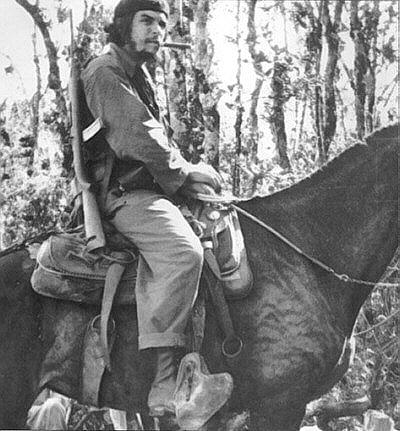
2. Guerrilla Strategy

3. Guerrilla Tactics

4. Warfare on Favorable Ground

5. Warfare on Unfavorable Ground

6. Suburban Warfare

1. Essence of Guerrilla Warfare

The armed victory of the Cuban people over the Batista dictatorship was not only the triumph of heroism as reported by the newspapers of the world; it also forced a change in the old dogmas concerning the conduct of the popular masses of Latin America. It showed plainly the capacity of the people to free themselves by means of guerrilla warfare from a government that oppresses them.
We consider that the Cuban Revolution contributed three fundamental lessons to the conduct of revolutionary movements in America. They are:
   1. Popular forces can win a war against the army.
   2. It is not necessary to wait until all conditions for making revolution exist; the insurrection can create them.
  3. In underdeveloped America the countryside is the basic area for armed fighting.
Of these three propositions the first two contradict the defeatist attitude of revolutionaries or pseudo-revolutionaries who remain inactive and take refuge in the pretext that against a professional army nothing can be done, who sit down to wait until in some mechanical way all necessary objective and subjective conditions are given without working to accelerate them. As these problems were formerly a subject of discussion in Cuba, until facts settled the question, they are probably still much discussed in America.
Naturally, it is not to be thought that all conditions for revolution are going to be created through the impulse given to them by guerrilla activity. It must always be kept in mind that there is a necessary minimum without which the establishment and consolidation of the first center is not practicable. People must see clearly the futility of maintaining the fight for social goals within the framework of civil debate. When the forces of oppression come to maintain themselves in power against established law, peace is considered already broken.
In these conditions popular discontent expresses itself in more active forms. An attitude of resistance finally crystallizes in an outbreak of fighting, provoked initially by the conduct of the authorities.
Where a government has come into power through some form of popular vote, fraudulent or not, and maintains at least an appearance of constitutional legality, the guerrilla outbreak cannot be promoted, since the possibilities of peaceful struggle have not yet been exhausted.
The third proposition is a fundamental of strategy. It ought to be noted by those who maintain dogmatically that the struggle of the masses is centered in city movements, entirely forgetting the immense participation of the country people in the life of all the underdeveloped parts of America. Of course, the struggles of the city masses of organized workers should not be underrated; but their real possibilities of engaging in armed struggle must be carefully analyzed where the guarantees which customarily adorn our constitutions are suspended or ignored. In these conditions the illegal workers’ movements face enormous dangers. They must function secretly without arms. The situation in the open country is not so difficult. There, in places beyond the reach of the repressive forces, the inhabitants can be supported by the armed guerrillas.
We will later make a careful analysis of these three conclusions that stand out in the Cuban revolutionary experience. We emphasize them now at the beginning of this work as our fundamental contribution.
Guerrilla warfare, the basis of the struggle of a people to redeem itself, has diverse characteristics, different facets, even though the essential will for liberation remains the same. It is obvious-and writers on the theme have said it many times-that war responds to a certain series of scientific laws; whoever ignores them will go down to defeat. Guerrilla warfare as a phase of war must be ruled by all of these; but besides, because of its special aspects, a series of corollary laws must also be recognized in order to carry it forward. Though geographical and social conditions in each country determine the mode and particular forms that guerrilla warfare will take, there are general laws that hold for all fighting of this type.
Our task at the moment is to find the basic principles of this kind of fighting and the rules to be followed by peoples seeking liberation; to develop theory from facts; to generalize and give structure to our experience for the profit of others.
Let us first consider the question: Who are the combatants in guerrilla warfare? On one side we have a group composed of the oppressor and his agents, the professional army, well armed and disciplined, in many cases receiving foreign help as well as the help of the bureaucracy in the employ of the oppressor. On the other side are the people of the nation or region involved. It is important to emphasize that guerrilla warfare is a war of the masses, a war of the people. The guerrilla band is an armed nucleus, the fighting vanguard of the people. It draws its great force from the mass of the people themselves. The guerrilla band is not to be considered inferior to the army against which it fights simply because it is inferior in firepower. Guerrilla warfare is used by the side which is supported by a majority but which possesses a much smaller number of arms for use in defense against oppression.
The guerrilla fighter needs full help from the people of the area. This is an indispensable condition. This is clearly seen by considering the case of bandit gangs that operate in a region. They have all the characteristics of a guerrilla army: homogeneity, respect for the leader, valor, knowledge of the ground, and, often, even good understanding of the tactics to be employed. The only thing missing is support of the people; and, inevitably, these gangs are captured and exterminated by the public force.
Analyzing the mode of operation of the guerrilla band, seeing its form of struggle, and understanding its base in the masses, we can answer the question: Why does the guerrilla fighter fight? We must come to the inevitable conclusion that the guerrilla fighter is a social reformer, that he takes up arms responding to the angry protest of the people against their oppressors, and that he fights in order to change the social system that keeps all his unarmed brothers in ignominy and misery. He launches himself against the conditions of the reigning institutions at a particular moment and dedicates himself with all the vigor that circumstances permit to breaking the mold of these institutions.
When we analyze more fully the tactic of guerrilla warfare, we will see that the guerrilla fighter needs to have a good knowledge of the surrounding countryside, the paths of entry and escape, the possibilities of speedy maneuver, good hiding places; naturally, also, he must count on the support of the people. All this indicates that the guerrilla fighter will carry out his action in wild places of small population. Since in these places the struggle of the people for reforms is aimed primarily and almost exclusively at changing the social form of land ownership, the guerrilla fighter is above all an agrarian revolutionary. He interprets the desires of the great peasant mass to be owners of land, owners of their means of production, of their animals, of all that which they have long yearned to call their own, of that which constitutes their life and will also serve as their cemetery.
It should be noted that in current interpretations there are two different types of guerrilla warfare, one of which-a struggle complementing great regular armies such as was the case of the Ukrainian fighters in the Soviet Union-does not enter into this analysis. We are interested in the other type, the case of an armed group engaged in struggle against the constituted power, whether colonial or not, which establishes itself as the only base and which builds itself up in rural areas. In all such cases, whatever the ideological aims that may inspire the fight, the economic aim is determined by the aspiration toward ownership of land.
The China of Mao begins as an outbreak of worker groups in the South, which is defeated and almost annihilated. It succeeds in establishing itself and begins its advance only when, after the long march from Yenan, it takes up its base in rural territories and makes agrarian reform its fundamental goal. The struggle of Ho Chi Minh is based in the rice-growing peasants, who are oppressed by the French colonial yoke; with this force it is going forward to the defeat of the colonialists. In both cases there is a framework of patriotic war against the Japanese invader, but the economic basis of a fight for the land has not disappeared. In the case of Algeria, the grand idea of Arab nationalism has its economic counterpart in the fact that nearly all of the arable land of Algeria is utilized by a million French settlers. In some countries, such as Puerto Rico, where the special conditions of the island have not permitted a guerrilla outbreak, the nationalist spirit, deeply wounded by the discrimination that is daily practiced, has as its basis the aspiration of the peasants (even though many of them are already a proletariat) to recover the land that the Yankee invader seized from them. This same central idea, though in different forms, inspired the small farmers, peasants, and slaves of the eastern estates of Cuba to close ranks and defend together the right to possess land during the thirty-year war of liberation.
Taking account of the possibilities of development of guerrilla warfare, which is transformed with the increase in the operating potential of the guerrilla band into a war of positions, this type of warfare, despite its special character, is to be considered as an embryo, a prelude, of the other. The possibilities of growth of the guerrilla band and of changes in the mode of fight, until conventional warfare is reached, are as great as the possibilities of defeating the enemy in each of the different battles, combats, or skirmishes that take place. Therefore, the fundamental principle is that no battle, combat, or skirmish is to be fought unless it will be won. There is a malevolent definition that says: «The guerrilla fighter is the Jesuit of warfare.» By this is indicated a quality of secretiveness, of treachery, of surprise that is obviously an essential element of guerrilla warfare. It is a special kind of Jesuitism, naturally prompted by circumstances, which necessitates acting at certain moments in ways different from the romantic and sporting conceptions with which we are taught to believe war is fought.
War is always a struggle in which each contender tries to annihilate the other. Besides using force, they will have recourse to all possible tricks and stratagems in order to achieve the goal. Military strategy and tactics are a representation by analysis of the objectives of the groups and of the means of achieving these objectives. These means contemplate taking advantage of all the weak points of the enemy. The fighting action of each individual platoon in a large army in a war of positions will present the same characteristics as those of the guerrilla band. It uses secretiveness, treachery, and surprise; and when these are not present, it is because vigilance on the other side prevents surprise. But since the guerrilla band is a division unto itself, and since there are large zones of territory not controlled by the enemy, it is always possible to carry out guerrilla attacks in such a way as to assure surprise; and it is the duty of the guerrilla fighter to do so.
«Hit and run,» some call this scornfully, and this is accurate. Hit and run, wait, lie in ambush, again hit and run, and thus repeatedly, without giving any rest to the enemy. There is in all this, it would appear, a negative quality, an attitude of retreat, of avoiding frontal fights. However, this is consequent upon the general strategy of guerrilla warfare, which is the same in its ultimate end as is any warfare: to win, to annihilate the enemy.
Thus, it is clear that guerrilla warfare is a phase that does not afford in itself opportunities to arrive at complete victory. It is one of the initial phases of warfare and will develop continuously until the guerrilla army in its steady growth acquires the characteristics of a regular army. At that moment it will be ready to deal final blows to the enemy and to achieve victory. Triumph will always be the product of a regular army, even though its origins are in a guerrilla army.
Just as the general of a division in a modern war does not have to die in front of his soldiers, the guerrilla fighter, who is general of himself, need not die in every battle. He is ready to give his life, but the positive quality of this guerrilla warfare is precisely that each one of the guerrilla fighters is ready to die, not to defend an ideal, but rather to convert it into reality. This is the basis, the essence of guerrilla fighting. Miraculously, a small band of men, the armed vanguard of the great popular force that supports them, goes beyond the immediate tactical objective, goes on decisively to achieve an ideal, to establish a new society, to break the old molds of the outdated, and to achieve, finally, the social justice for which they fight.
Considered thus, all these disparaged qualities acquire a true nobility, the nobility of the end at which they aim; and it becomes clear that we are not speaking of distorted means of reaching an end. This fighting attitude, this attitude of not being dismayed at any time, this inflexibility when confronting the great problems in the final objective is also the nobility of the guerrilla fighter.

2. Guerrilla Strategy

    In guerrilla terminology, strategy is understood as the analysis of the objectives to be achieved in light of the total military situation and the overall ways of reaching these objectives.
To have a correct strategic appreciation from the point of view of the guerrilla band, it is necessary to analyze fundamentally what will be the enemy’s mode of action. If the final objective is always the complete destruction of the opposite force, the enemy is confronted in the case of a civil war of this kind with the standard task: he will have to achieve the total destruction of each one of the components of the guerrilla band. The guerrilla fighter, on the other hand, must analyze the resources which the enemy has for trying to achieve that outcome: the means in men, in mobility, in popular support, in armaments, in capacity of leadership on which he can count. We must make our own strategy adequate on the basis of these studies, keeping in mind always the final objective of defeating the enemy army.
There are fundamental aspects to be studied: the armament, for example, and the manner of using this armament. The value of a tank, of an airplane, in a fight of this type must be weighed. The arms of the enemy, his ammunition, his habits must be considered; because the principal source of provision for the guerrilla force is precisely in enemy armaments. If there is a possibility of choice, we should prefer the same type as that used by the enemy, since the greatest problem of the guerrilla band is the lack of ammunition, which the opponent must provide.
After the objectives have been fixed and analyzed, it is necessary to study the order of the steps leading to the achievement of the final objective. This should be planned in advance, even though it will be modified and adjusted as the fighting develops and unforeseen circumstances arise.
At the outset, the essential task of the guerrilla fighter is to keep himself from being destroyed. Little by little it will be easier for the members of the guerrilla band or bands to adapt themselves to their form of life and to make flight and escape from the forces that are on the offensive an easy task, because it is performed daily. When this condition is reached, the guerrilla, having taken up inaccessible positions out of reach of the enemy, or having assembled forces that deter the enemy from attacking, ought to proceed to the gradual weakening of the enemy. This will be carried out at first at those points nearest to the points of active warfare against the guerrilla band and later will be taken deeper into enemy territory, attacking his communications, later attacking or harassing his bases of operations and his central bases, tormenting him on all sides to the full extent of the capabilities of the guerrilla forces.
The blows should be continuous. The enemy soldier in a zone of operations ought not to be allowed to sleep; his outposts ought to be attacked and liquidated systematically. At every moment the impression ought to be created that he is surrounded by a complete circle. In wooded and broken areas this effort should be maintained both day and night; in open zones that are easily penetrated by enemy patrols, at night only. In order to do all this the absolute cooperation of the people and a perfect knowledge of the ground are necessary. These two necessities affect every minute of the life of the guerrilla fighter. Therefore, along with centers for study of present and future zones of operations, intensive popular work must be undertaken to explain the motives of the revolution, its ends, and to spread the incontrovertible truth that victory of the enemy against the people is finally impossible. Whoever does not feel this undoubted truth cannot be a guerrilla fighter.
This popular work should at first be aimed at securing secrecy; that is, each peasant, each member of the society in which action is taking place, will be asked not to mention what he sees and hears; later, help will be sought from inhabitants whose loyalty to the revolution offers greater guarantees; still later, use will be made of these persons in missions of contact, for transporting goods or arms, as guides in the zones familiar to them; still later, it is possible to arrive at organized mass action in the centers of work, of which the final result will be the general strike.
The strike is a most important factor in civil war, but in order to reach it a series of complementary conditions are necessary which do not always exist and which very rarely come to exist spontaneously. It is necessary to create these essential conditions, basically by explaining the purposes of the revolution and by demonstrating the forces of the people and their possibilities.
It is also possible to have recourse to certain very homogeneous groups, which must have shown their efficacy previously in less dangerous tasks, in order to make use of another of the terrible arms of the guerrilla band, sabotage. It is possible to paralyze entire armies, to suspend the industrial life of a zone, leaving the inhabitants of a city without factories, without light, without water, without communications of any kind, without being able to risk travel by highway except at certain hours. If all this is achieved, the morale of the enemy falls, the morale of his combatant units weakens, and the fruit ripens for plucking at a precise moment.
All this presupposes an increase in the territory included within the guerrilla action, but an excessive increase of this territory is to be avoided. It is essential always to preserve a strong base of operations and to continue strengthening it during the course of the war. Within this territory, measures of indoctrination of the inhabitants of the zone should be utilized; measures of quarantine should be taken against the irreconcilable enemies of the revolution; all the purely defensive measures, such as trenches, mines, and communications, should be perfected.
When the guerrilla band has reached a respectable power in arms and in number of combatants, it ought to proceed to the formation of new columns. This is an act similar to that of the beehive when at a given moment it releases a new queen, who goes to another region with a part of the swarm. The mother hive with the most notable guerrilla chief will stay in the less dangerous places, while the new columns will penetrate other enemy territories following the cycle already described.
A moment will arrive in which the territory occupied by the columns is too small for them; and in the advance toward regions solidly defended by the enemy, it will be necessary to confront powerful forces. At that instant the columns join, they offer a compact fighting front, and a war of positions is reached, a war carried on by regular armies. However, the former guerrilla army cannot cut itself off from its base, and it should create new guerrilla bands behind the enemy acting in the same way as the original bands operated earlier, proceeding thus to penetrate enemy territory until it is dominated.
It is thus that guerrillas reach the stage of attack, of the encirclement of fortified bases, of the defeat of reinforcements, of mass action, ever more ardent, in the whole national territory, arriving finally at the objective of the war: victory.