
Κατηγορία: Ιστορικοί λόγοι
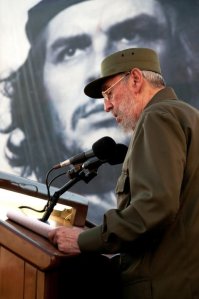

Πρωτομαγιάτικος λόγος του Τσε
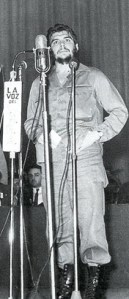 Ο παρακάτω λόγος εκφωνήθηκε από τον Τσε στο Θέατρο Γκαρθία Λόρκα της Αβάνας, στις 30 Απριλίου 1963. Η εκδήλωση έγινε παραμονή της εργατικής Πρωτομαγιάς και διοργανώθηκε από την Κουβανική Επαναστατική Συνομοσπονδία Εργατών (CTC-R) και το Υπουργείο Βιομηχανίας του οποίου ο Γκεβάρα ηγείτο.
Σύντροφοι,
συναντιόμαστε άλλη μια φορά, την παραμονή της Διεθνούς Εργατικής Γιορτής για να τιμήσουμε τους συντρόφους εκείνους που ξεχώρισαν με τις προσπάθειές τους στις παραγωγικές υπηρεσίες της χώρας μας, στις υπηρεσίες του ευγενούς σκοπού της οικοδόμησης του σοσιαλισμού, σαν πρωτοπόροι εργάτες σε κάθε μια απ’ τις επιχειρήσεις στις οποίες μοιράζεται το υπουργείο μας. Κατά τη διάρκεια των δώδεκα προηγούμενων μηνών, είχαμε περιοδικές συζητήσεις με τους συντρόφους εκείνους που, μήνα με το μήνα με την αφοσίωσή τους στην εργασία, ξεχώρισαν ανάμεσα στους εργάτες των επιχειρήσεών μας.
Έχουμε επαναλάβει ξανά και ξανά ότι, στην περίπτωση των πρωτοπόρων εργατών, η υπερβολική μετριοφροσύνη δεν είναι αρετή αλλά μειονέκτημα, ότι ο πρωτοπόρος εργάτης πρέπει με να δίνει παράδειγμα, πρέπει να το κάνει κατανοητό, να μεταδώσει τον ενθουσιασμό του, και να δει ότι η δική του ατομική προσπάθεια μετατράπηκε σε μια προσπάθεια συλλογική όλων των εργατών και των εργοστασίων της χώρας, ότι οι δυνάμεις των εργοστασίων πρώτης γραμμής, όλων των κέντρων παραγωγής, ότι μπορεί να αυξήσει την παραγωγικότητα της δουλειάς και τη συνείδηση των ανθρώπων, για να κατακτηθεί η υλική επάρκεια που χρειάζεται για το χτίσιμο του σοσιαλισμού και τη δημιουργία ισχυρής συνείδησης στους απογόνους του, πράγμα που χρειάζεται για τη διατήρηση του σοσιαλισμού.
Ολόκληρο το χρόνο αυτά τα δύο έργα εκπληρώθηκαν. Όχι τέλεια, όχι χωρίς σοβαρές παραλείψεις, όχι χωρίς λάθη, καυγάδες, βήματα προς τα πίσω, αλλά με πολύ ενθουσιασμό και πλήρη αφοσίωση στο έργο μας, καταφέραμε το 1962 να δημιουργήσουμε μια ισχυρή κοινωνική βάση. Συνεισφέραμε και εμείς στην ανάπτυξη της επαναστατικής συνείδησης ολόκληρου του κόσμου όταν, μπροστά στην αμερικάνικη πυρηνική απειλή, ο λαός μας ξεσηκώθηκε και έδωσε μια απάντηση που αναμφίβολα θα μείνει στην ιστορία. Ήταν παράδειγμα του πώς μια επανάσταση μπορεί να αντιμετωπίσει μεγάλο κίνδυνο, ακόμα και τον κίνδυνο της πυρηνικής καταστροφής – μια απειλή άγνωστη σε άλλες κοινωνίες στην παγκόσμια ιστορία – και πώς με επαναστατική συνείδηση, θέληση για τη νίκη και τη συμπαράσταση ολόκληρου του σοσιαλιστικού στρατοπέδου και όλων των ελευθέρων ανθρώπων τους κόσμου, ένας μικρός λαός, που ζει δίπλα στην πιο μεγάλη ιμπεριαλιστική δύναμη της γης, μπορεί να θριαμβεύσει, να διατηρήσει την αυτονομία του και, το πιο σημαντικό, να συνεχίσει το χτίσιμο της κοινωνίας του.
Το κύριο έργο που μας ανατέθηκε, σύντροφοι, σ’ αυτό που θα ονομαζόταν οχυρώματα της οικονομίας, είναι ατέρμονη κατασκευή, άσχετα με τις δυσκολίες και τους κινδύνους που πρέπει να ξεπεραστούν. Και ανταποκρινόμαστε σ’ αυτό το έργο. Κάθε χρόνο τα καταφέρνουμε και καλύτερα. Κάθε χρόνο μαθαίνουμε από τα λάθη μας και τις εμπειρίες των άλλων. Δημιουργούμε τη βάση για μια ισχυρή, αυτόνομη και αυτοδύναμη οικονομία που θα στηρίζεσαι στη γεωργία, που με τη σειρά της θα στηρίζεται στο γόνιμο έδαφος, το ευνοϊκό κλίμα και τη μικρή πληθυσμιακή πυκνότητα. Αλλά ο αναλφαβητισμός δε σημαίνει έλλειψη πολιτισμού καθώς η ανάγνωση και η γραφή είναι μοναχά το πρώτο βήμα του πολιτισμού.
Οι καινούργιες διαδικασίες προχωρούν με γιγάντια βήματα. Πολύ γρήγορα το να είσαι τεχνικός σ’ αυτή τη χώρα θα προϋποθέτει τη γνώση δύο ή περισσότερων ξένων γλωσσών. Ο τεχνικός πρέπει να είναι ικανός να η ανάγνωση βιβλία στο αντικείμενο σε ξένες γλώσσες. Πρέπει να μάθει να διαβάζει γιατί οι καπιταλιστές έχουν προχωρήσει πολύ στον τεχνολογικό τομέα και πρέπει να μάθουμε να εκμεταλλευόμαστε τις γνώσεις τους. Η αύξηση των προσόντων είναι βασική αποστολή για την κυβέρνηση και όλους τους ανθρώπους και δεν πρέπει να παραμεληθεί. Άντρες και γυναίκες, όταν θα είναι κουρασμένοι μετά απ’ τη δουλειά, πρέπει να κάνουν το απαραίτητο διάβασμα και να συνεχίσουν έτσι να αυξάνουν τις γνώσεις τους.
Δεν είναι σημαντικό το ότι σε λίγες βδομάδες ή μήνες η απόσταση που καλύφθηκε φαίνεται μικρή. Αυτό είναι έργο χρόνων και ένα έργο δεν πρέπει ποτέ να τελειώνει. Το έργο αυτό είναι υπερβολικά δύσκολο για τον πρωτάρη, για τον εργάτη κάποιας ηλικίας που δεν έχει μάθει γραφή και ανάγνωση. Αλλά στο βαθμό που θα αποκτείται γνώση, θα ανάγεται η επιμόρφωση σε επαναστατικό καθήκον, κάτι λιγότερο ή περισσότερο επίπονο θα γίνει γι αυτό, και τελικά θα γίνει ανάγκη όλων. Τότε θα σταματήσει η προσπάθεια αυτή. Σ’ αυτό το σκοπό έχουν γίνει φοβερές προσπάθειες αλλά έχει καταναλωθεί και θα συνεχίσει να καταναλώνεται και ένα μεγάλο ποσό κοινωνικών αγαθών. Πιστεύουμε ότι η μόρφωση και η δημόσια υγεία είναι υπηρεσίες που στις οποίες ποτέ δεν μπορούμε να πούμε ότι ξοδεύουμε αρκετά για το λαό μας. Και όσο περισσότερα δίνουμε, τόσο καλύτερα θα είναι για όλους. Και έτσι θα συνεχίσουμε να δίνουμε όσο το δυνατόν περισσότερα.
Αλλά να θυμάστε, οι καθηγητές που διδάσκουν τους μαθητές-εργάτες κρατιούνται εκτός παραγωγής και καταναλώνουν, συνεπώς, κρατικά χρήματα που πρέπει να ανταποδοθούν στην κοινωνία εις διπλούν. Πρέπει να απασχοληθούμε με άλλο ένα σημαντικό πρόβλημα, τη νέα μισθολογική κλίμακα και τις νόρμες εργασίας, δύο στενά συνδεδεμένα θέματα που συζητούμε πάνω από ένα χρόνο. Θυμάμαι ότι πέρσι την παραμονή της Πρωτομαγιάς σ αυτή την αίθουσα είχα ζητήσει συγγνώμη που δεν είχα τελειώσει με αυτό το πρόβλημα. Φέτος ξαναζητώ συγγνώμη, αλλά το θέμα της νέας μισθολογικής κλίμακας και των νορμών εργασίας έχει προχωρήσει πολύ. Και τον επόμενο μήνα θα αρχίσουν δοκιμασίες σε διάφορες βιομηχανίες, όχι μόνο στο υπουργείο μας, αλλά σε όλους τους κλάδους της οικονομίας. Τότε, θα έχουμε τελειοποιήσει το σύστημα δίνοντας ένα μισθό σε όλη τη χώρα και πιο δίκαια αποζημίωση. Αλλά πρέπει να υπάρξει αυστηρότητα σε κάτι που δεν έχει ξεκαθαριστεί ακόμη. Το νέο μισθολογικό σύστημα, με τις τρέχουσες νόρμες εργασίας, δεν σημαίνει μισθολογική αύξηση. Κάθε άλλο. Εξηγήσαμε ότι ο πρώτος κλάδος στον οποίο εφαρμόστηκε αυτό, ο μεταλλευτικός -και μόνο σε μερικά ορυχεία – εξαιτίας της σχετικά χαμηλής πληρωμής, οι νέες νόρμες εργασίας και το νέο μισθολογικό σύστημα σήμαιναν μεγάλες μισθολογικές αυξήσεις για τους συντρόφους εκεί. Αλλά δε θα είναι το ίδιο σε όλους τους κλάδους.
Είναι κάποιοι εργάτες που προς το παρόν πληρώνονται ανάλογα με τον μέσο όρο, και άλλοι εργάτες που παίρνουν περισσότερα απ’ το μέσο όρο. Ξεκαθαρίσαμε επίσης ότι όλοι εκείνοι οι εργάτες των οποίων η αμοιβή είναι μεγαλύτερη απ’ όση καθορίζει το νέο μισθολογικό σύστημα θα συνεχίσουν να παίρνουν κανονικό μισθό, αλλά χωρισμένο σε δύο μέρη: ένα που ανταποκρίνεται στην πραγματική του εργασία και ένα επίδομα έτσι ώστε να μην διαταραχθούν τα οικονομικά των συντρόφων εκείνων που έπαιρναν υψηλότερο μισθό τόσα χρόνια και κάτω από διαφορετικές συνθήκες, την περίοδο ανάπτυξης του καπιταλισμού με τις άναρχες παραγωγικές σχέσεις. Ωστόσο, όλοι όσοι μπαίνουν στην παραγωγή θα πληρώνονται σύμφωνα με το νέο μισθολογικό σύστημα, και ένα απ’ τα κύρια σημεία απ’ τα οποία θα εξαρτάται η μισθολογική αύξηση θα είναι οι ικανότητες του εργάτη. Αυτό σημαίνει ότι οι εργάτες που ικανοποιητικά εκπληρώνουν τα στάνταρ της ποσότητας και της ποιότητας για ορισμένο χρόνο, αλλά που δεν μπορούν να ανέβουν αυτόματα στη βαθμολογική κλίμακα γιατί ανήκουν σε διαφορετική μισθολογική τάξη, θα έχουν τη δυνατότητα να ανεβάσουν το μισθό τους. Έτσι, οι ατομικές ικανότητες θα λαμβάνονται υπ’ όψιν στον υπολογισμό του μισθού. Όλα αυτά ας τα εξηγήσει ο Υπουργός Εργασίας. Θα υπάρξουν συζητήσεις και μια ολόκληρη διαδικασία αποσαφήνισης, αφού είναι ένα τόσο δύσκολο έργο στο οποίο στηρίζεται ολόκληρη η εθνική οικονομία.
Σε μερικές περιπτώσεις, θα σημαίνει αύξηση για να διορθώσει μερικές πολύ χαμηλές αμοιβές. Σε άλλες, οι αμοιβές θα παραμείνουν σταθερές, ανάλογα με τα μέτρα που θα υιοθετηθούν απ’ τις μελέτες. Σε άλλες περιπτώσεις, θα μειωθούν οι μισθοί, αλλά αυτοί οι σύντροφοι θα έχουν μοιρασμένο μισθό και έτσι δε θα πληγεί το εισόδημά τους.
Απλά, ένα μέρος του μισθού του, του ανήκει, παραδείγματος χάριν, για ιστορικούς λόγους. Όταν αυτός ο εργάτης φύγει απ’ τη δουλειά του, ο μισθός γι αυτό το πόστο γίνεται κανονικός, ο σταθερός κανονικός μισθός, και δεν είναι πια ο πραγματικός μισθός που έπαιρνε ο υποθετικός αυτός εργάτης. Για να τελειώσω αυτό το λόγο – λίγο μεγάλος, λίγο βαρετός – θέλω να σας υπενθυμίσω, σύντροφοι, την ευθύνη που όλοι ανεξαιρέτως έχουμε. Σήμερα βρισκόμαστε εδώ για να τιμήσουμε τους καλύτερούς μας εργάτες, τους εργάτες πρώτης γραμμής. Και τιμούμε επίσης τις εργατικές αντιπροσωπείες που ήρθαν να μας επισκεφτούν απ’ όλο τον κόσμο
Είμαστε μια βιτρίνα, ένας καθρέφτης στον οποίο οι Αμερικάνοι μπορούν να δουν, και πρέπει να δουλεύουν για να αυξάνουμε τις ικανότητές μας κάθε μέρα σε βάρος των αδυναμιών μας. Δεν πρέπει να εφαρμόσουμε την τακτική του κρυψίματος των αδυναμιών μας. Κάτι τέτοιο δε θα ήταν ούτε τίμιο ούτε επαναστατικό. Θα διδαχθούν απ’ τα λάθη μας, απ’ τις παραλείψεις μας, οι σύντροφοι της Αμερικής αλλά και της Ασίας, και της Αφρικής, και όλων των χωρών που σήμερα πολεμούν για ανεξαρτησία. Δεν πρέπει να διστάζουμε να δείχνουμε κάποιο από τα λάθη του παρελθόντος, κάτι κακό στο παρελθόν που δεν μπορέσαμε να διορθώσουμε, ούτε ένα λάθος της σοσιαλιστικής παρουσίας μας.
Πρέπει να είμαστε ανοιχτοί, αυτό είναι το υψηλό καθήκον μας. Και καθένας από μας είναι υπεύθυνος απέναντι στους ανθρώπους σε όλο τον κόσμο γι αυτά που κάνε ή θα κάνει Κουβανική επανάσταση. Ο δρόμος μας δεν είναι εύκολος, αλλά γεμάτος κινδύνους και εμπόδια. Ο ιμπεριαλισμός κρύβεται σε κάθε γωνιά του δρόμου, ελπίζοντας σε ένα στραβοπάτημά μας, έτοιμος να μας επιτεθεί. Οι αντιδραστικοί όλης της Αμερικής περιμένουν ν’ ακούσουν με χαρά την επίσημη αναγνώριση των λαθών μας. Βασικά, προσπαθούν να δείξουν στην Αμερική και σ’ ολόκληρο τον κόσμο ότι αν ένα μικρό κράτος σαν εμάς, χωρίς βιομηχανία, χωρίς τεχνολογική ανάπτυξη προσπαθήσει να κάνει επανάσταση, θα αποτύχει. Και χρησιμοποιούν πλάγιες μεθόδους και σαμποτέρ για να σταματήσουν την ανάπτυξή μας.
Δεν μπορούμε να επιτρέψουμε στους εαυτούς μας ούτε μια στιγμή αδυναμίας. Όχι τώρα που είμαστε κάτω απ’ τα βλέμματα των προσκεκλημένων μας, ούτε ποτέ. Ολόκληρη η Αμερική παρατηρεί κάθε λεπτό της ζωής στη χώρα μας και βλέπουν σ’ εμάς μια ελπίδα σωτηρίας, μια ελπίδα ν’ απελευθερωθούν απ’ τα δεσμά τους.
Ας τους δείξουμε τις αλήθειες του δρόμου που πήραμε, σύντροφοι! Ας τους δείξουμε ότι όχι μόνο είμαστε ικανοί όχι μόνο να αντιμετωπίσουμε σχεδόν άοπλοι, τις πάνοπλες δυνάμεις της ολιγαρχίας. Όχι μόνο μπορούμε και εξοπλίζουμε το λαϊκό στρατό παίρνοντας όπλα απ’ τον εχθρό, αντιμετωπίζοντάς τους στο πεδίο της μάχης, αλλά και διαμορφώνουμε τις συνειδήσεις των λαών της Αμερικής μετατρέποντάς τους σε πολεμιστές εναντίον της δικτατορίας! Ας δείξουμε ότι δεν είμαστε μόνο ικανοί να κάνουμε τους ανθρώπους μας ένα, να βγάλουμε την πολεμική μας κραυγή, την προκλητική μας κραυγή. Ας τους δείξουμε, σύντροφοι, ότι μπορούμε να νικήσουμε σ’ αυτό τον μακρύ και δύσκολο αγώνα στον οποίο υποχρεωνόμαστε χτίζοντας το σοσιαλισμό δίπλα σε μια καπιταλιστική υπερδύναμη.
Σε όλους τους κινδύνους, τις απειλές, τους εμπορικούς αποκλεισμούς, τα σαμποτάζ και τους διχασμούς, σε όλες τις δυνάμεις που προσπαθούν να μας εμποδίσουν, πρέπει να δείξουμε την ικανότητα του λαού μας να γράφει ιστορία. Πρέπει να όλοι ενωμένοι, ίσως όχι περισσότερο από σήμερα, να βαδίσουμε με τα μάτια στραμμένα στο μέλλον, με τα πόδια στο έδαφος, προσέχοντας κάθε μας βήμα και βεβαιώνοντας ότι κανένα βήμα μας δε θα παραδώσει ούτε πόντο απ’ αυτά που κερδίσαμε, απ’ αυτά που χτίσαμε, απ’ αυτό που είναι δικό μας: το σοσιαλισμό!
Patria O Muerte! Venceremos! (Πατρίδα ή θάνατος! Θα νικήσουμε!)
Che’s ideas are absolutely relevant today: A speech by Fidel Castro (Part Two)
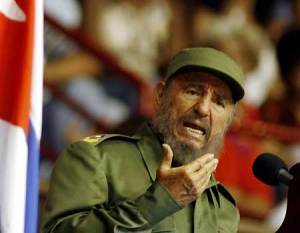 Thus, I remember that during the days of Batista’s final offensive in the Sierra Maestra mountains against our militant but small forces, the most experienced cadres were not in the front lines; they were assigned strategic leadership assignments and save for our devastating counterattack. It would have been pointless to put Che, Camilo [Cienfuegos], and other compañeros who had participated in many battles at the head of a squad. We held them back so that they could subsequently lead columns that would undertake risky missions of great importance, it was then that we did send them in enemy territory with full responsibility and awareness of the risks as in the case of the invasion of Las Villas led by Camilo and Che, an extraordinarily difficult assignment that required men of great experience and authority as column commanders, men capable of reaching the goal.
In line with this reasoning, and considering the objectives, perhaps it would have been better if this principle had been observed and Che had joined at a later stage. It really was no so critical for him to handle everything right from the start. But he was impatient, very impatient really. Some Argentine comrades had been killed in the initial efforts he had made years before, including Ricardo Massetti, the founder of Presna Latina. He remembered that often and was really impatient to start to participate personally in the work.
As always, we respected our commitments and his views, for our relationship was always based on absolute trust, absolute brotherhood, regardless of our ideas about what would be the right time for him to join in. And so we gave him all the help and the facilities possible to start the struggle. The news came of the first clashes, and contact was completely lost. The enemy detected the initial stage of organization of the guerrilla movement, and that marked the start of a period lasting many months in which almost the only news we received was what came via international news dispatches, and we had to know how to interpret them. But that’s something our revolution had become very experienced at: determining when a report is reliable or when it is made up, false.
I remember, for example, when a dispatch came with the news of the death of Joaquín’s grip (his real name was Vilo Acuña.* When we analyzed it, I immediately concluded that it was true, this was because of the way they described how the group had been eliminated while crossing a river. Because of our own guerrilla experience, because of what we had lived through, we knew how a small guerrilla group can be done away with. We knew the few, exceptional ways such a group can be destroyed,
When it was reported that a peasant had made contact with the army and provided detailed information on the location and plans of the group, which was looking for a way to cross the river; how the army set up an ambush on the other bank at a spot on the route the same peasant had told the guerrilla fighters to use; the way the army opened fire in midstream; there was no doubt as to the truth of the explanation. If the writers of false reports, which came in often, tried to do it again, it was impossible to admit that they, who were always so clumsy in their lies, would have had enough intelligence and experience to make up the exact and only circumstances in which the group could be eliminated. That’s why we conclude the report was true. Long years of revolutionary experience had taught us to decipher dispatches and tell the difference between the truth and the falsehood of each development; although, of course, there are other things to keep in mind when making a judgment. But that was the type of information we had about the situation until the news of Che’s death arrived.
As we have explained, we had hopes that even with only twenty men left, even in a very difficult situation, the guerrillas still had a chance. They were headed toward an area where sectors of the peasants were organized, where some good Bolivian cadres had influence, and until that moment, until almost the very end, there was chance that the movement could consolidate and could develop. But the circumstances in which my relationship with Che were so unique — the almost unreal history of the brief but intense saga of the first year of the revolution when we were used to making the impossible possible — that is, as I explained to that journalist, one had the permanent impression that Che had not died, that he was still alive. Sine his was such an exemplary personality, so unforgettable, so familiar, it was difficult to resign oneself to the idea of his death.
Sometimes I would dream — all of us dream of things related to our lives and struggles — that I saw Che, that he returned, that we was alive. How often this happened! I told the journalist that these are feelings you seldom talk about, but they give an idea of the impact of Che’s personality and also of the extraordinary degree to which he really lives on, almost as if his was a physical presence, with his ideas and deeds, with his example and all the things he created, with his continued relevance and the respect for him not only in Latin America but in Europe and all over the world. As we predicted on October 18, twenty years ago, he became a symbol for all the oppressed, for all the exploited, for all the patriotic and democratic forces, for all the revolutionaries. He became a permanent and invincible symbol.
We feel Che’s presence for all these reasons, because of the real force that he still has today which, even though twenty years have gone by, exists in the spirit of all of us, when we hear the poem, when we hear the anthem, or the bugle is sounded before a moment’s silence, when we open our newspapers and see photographs of Che during different stages of his life, his image, so well known throughout the world — because it has to be said that Che not only had the virtues and all the human moral qualities to be a symbol, he also had the appearance of a symbol, the image of a symbol: his look, the frankness and strength of his look; his face, which reflects character irrepressibly determined for action, at the same time showing great intelligence and great purity — when we look at the poems that have been written, the episodes that are recounted, and the stories that are repeated, we feel the reality of Che’s relevance, of his presence.
It’s not strange if one feels Che’s presence not only in everyday life, but even in dreams if one imagines that he is alive, that Che is in action and that he never died. In the end we must reach the conclusion that for all intents and purposes in the life of our revolution, Che never died, and the light that of what has been done, he is more alive than ever, has more influence than ever, and is a more powerful opponent of imperialism than ever. Those who disposed of his body so that he would not become a symbol; those who, under the guidance of the methods of their imperial masters, did not want any trace to remain, have discovered that although his tomb is unmarked, there are no remains, and there is no body, nevertheless a frightening opponent of imperialism, a symbol, a force, a presence that can never be destroyed, does exist.
When they hid Che’s body, they showed their weakness and their cowardice, because they also showed their fear of the example and the symbol. They did not want the exploited peasants, the workers, the students, the intellectuals, the democrats, the progressives or the patriots of this hemisphere to have a place to go to pay tribute to Che’s remains. And in the world today, in which there is no specific place to go to pay tribute to Che’s remains, tribute is paid to everywhere.
Today tribute is not paid to Che once a year, not once ever five, ten, fifteen, or twenty years; today homage is paid to Che every year every month, every day, everywhere, in a factory, in a school, in a military barracks, in a home, among children, among Pioneers. Who can count how many millions of times in these twenty years, the Pioneers have said: “Pioneers for communism, we will be like Che”!
Really, there can be no superior symbol, there can be no better image, when searching for a model revolutionary man, when searching for the model communist. I say this because I have the deepest conviction — I always have had and I still have today, just the same or more so when I spoke that October 18 and I asked how we wanted our fighters, our revolutionaries, our party members, our children to be, and I said we wanted them to be like Che. Because Che is the personification, Che is the image of that new man, the image of that human being if we want to talk about a communist society; if our real objective is to build, not just socialism but the higher stages of socialism, if humanity is not going to renounce the lofty and extraordinary idea of living in a communist society one day.
If we need a paradigm, a model, an example to follow, then men like Che are essential, as are men and women who imitate him, who are like him, who think like, who act like him; men and women whose conduct resembles his when it comes to doing their duty, in every little thing, every detail, every activity; in his attitude toward work, his habit of teaching and educating by setting an example; his attitude of wanting to be first at everything, the first to volunteer for the most difficult tasks, the hardest ones, the most self-sacrificing ones; the individual who gives his body and soul to others, the person who displays true solidarity, the individual who never lets down a compañero; the simple man; the man without a flaw, who doesn’t live any contradiction between what he says and what he does, between what he practices and what he preaches; a man of thought and a man of action — all of which Che symbolizes.
For our country, it is a great honor and privilege to have had Che as a son of our people even though he wasn’t born in this land. He was a son because he earned the right consider himself and to be considered a son of our country, and it is an honor and a privilege for our people, for our country, for our country’s history, for our revolution to have had among its ranks a truly exceptional man such as Che.
That’s not to say that exceptional people are rare; that’s not to say that amid the masses there are not hundreds, thousands, even millions of exceptional men and women. I said it once during the bitter days after Camilo disappeared. When I recounted the history of how Camilo became the man he was, I said: “Among our people there are many Camilos.” I could say: “Among our peoples, among the peoples of Latin America and peoples of the world, there are many Ches.” But, why do we call them exceptional? Because in actual fact, in the world in which they lived, in the circumstances in which they lived, they had the chance and the opportunity to demonstrate all that man, with his generosity and solidarity, is capable of being. And, indeed, seldom do ideal circumstances exist in which man has the opportunity to express himself and to show everything he has inside as was the case with Che.
Of course, it’s clear that there are countless men and women among the masses who, partly as a result of other people’s examples and certain new values, are capable of heroism, including a kind of heroism I greatly admire: silent heroism, anonymous heroism, silent virtue, anonymous virtue, But given that its so unusual, so rare for all the necessary circumstances to exist to produce a figure like Che — who today has become a symbol for world, a symbol that will grow — it is a great honor and privilege that this figure was born during our revolution.
And as proof of what I said earlier about Che’s presence and force today, I could ask: Is there a better date, a better anniversary than this one to remember Che with all our conviction and deep feelings of appreciation and gratitude? Is there a better moment than this particular anniversary, when we are in the middle of the rectification process?
What are we rectifying? We are rectifying all those things — and there are many — that strayed from the revolutionary spirit, from revolutionary work, revolutionary virtue, revolutionary effort, revolutionary responsibility; all those things that strayed from the spirit of solidarity among people. We’re rectifying all the shoddiness and mediocrity that is precisely the negation of Che’s ideas, his revolutionary thought, his style, his spirit and his example. I really believe, and I say it with great satisfaction, that if Che were sitting in this chair, he would feel jubilant. He would be happy about what we are doing these days, just like he would have felt very unhappy during that unstable period, that disgraceful period of building socialism in which there began to prevail a series of ideas, of mechanisms, of bad habits, which would have caused Che to feel profound and terrible bitterness.
Speech at the U.N. General Assembly (1964)
 Mr. President;
Distinguished delegates:
The delegation of Cuba to this Assembly, first of all, is pleased to fulfill the agreeable duty of welcoming the addition of three new nations to the important number of those that discuss the problems of the world here. We therefore greet, in the persons of their presidents and prime ministers, the peoples of Zambia, Malawi and Malta, and express the hope that from the outset these countries will be added to the group of Nonaligned countries that struggle against imperialism, colonialism and neocolonialism.
We also wish to convey our congratulations to the president of this Assembly [Alex Quaison-Sackey of Ghana], whose elevation to so high a post is of special significance since it reflects this new historic stage of resounding triumphs for the peoples of Africa, who up until recently were subject to the colonial system of imperialism. Today, in their immense majority these peoples have become sovereign states through the legitimate exercise of their self-determination. The final hour of colonialism has struck, and millions of inhabitants of Africa, Asia and Latin America rise to meet a new life and demand their unrestricted right to self-determination and to the independent development of their nations.
We wish you, Mr. President, the greatest success in the tasks entrusted to you by the member states.
Cuba comes here to state its position on the most important points of controversy and will do so with the full sense of responsibility that the use of this rostrum implies, while at the same time fulfilling the unavoidable duty of speaking clearly and frankly.
We would like to see this Assembly shake itself out of complacency and move forward. We would like to see the committees begin their work and not stop at the first confrontation. Imperialism wants to turn this meeting into a pointless oratorical tournament, instead of solving the serious problems of the world. We must prevent it from doing so. This session of the Assembly should not be remembered in the future solely by the number 19 that identifies it. Our efforts are directed to that end.
We feel that we have the right and the obligation to do so, because our country is one of the most constant points of friction. It is one of the places where the principles upholding the right of small countries to sovereignty are put to the test day by day, minute by minute. At the same time our country is one of the trenches of freedom in the world, situated a few steps away from U.S. imperialism, showing by its actions, its daily example, that in the present conditions of humanity the peoples can liberate themselves and can keep themselves free.
Of course, there now exists a socialist camp that becomes stronger day by day and has more powerful weapons of struggle. But additional conditions are required for survival: the maintenance of internal unity, faith in one’s own destiny, and the irrevocable decision to fight to the death for the defense of one’s country and revolution. These conditions, distinguished delegates, exist in Cuba.
Of all the burning problems to be dealt with by this Assembly, one of special significance for us, and one whose solution we feel must be found first — so as to leave no doubt in the minds of anyone — is that of peaceful coexistence among states with different economic and social systems. Much progress has been made in the world in this field. But imperialism, particularly U.S. imperialism, has attempted to make the world believe that peaceful coexistence is the exclusive right of the earth’s great powers. We say here what our president said in Cairo, and what later was expressed in the declaration of the Second Conference of Heads of State or Government of Nonaligned Countries: that peaceful coexistence cannot be limited to the powerful countries if we want to ensure world peace. Peaceful coexistence must be exercised among all states, regardless of size, regardless of the previous historical relations that linked them, and regardless of the problems that may arise among some of them at a given moment.
At present, the type of peaceful coexistence to which we aspire is often violated. Merely because the Kingdom of Cambodia maintained a neutral attitude and did not bow to the machinations of U.S. imperialism, it has been subjected to all kinds of treacherous and brutal attacks from the Yankee bases in South Vietnam.
Laos, a divided country, has also been the object of imperialist aggression of every kind. Its people have been massacred from the air. The conventions concluded at Geneva have been violated, and part of its territory is in constant danger of cowardly attacks by imperialist forces.
The Democratic Republic of Vietnam knows all these histories of aggression as do few nations on earth. It has once again seen its frontier violated, has seen enemy bombers and fighter planes attack its installations and U.S. warships, violating territorial waters, attack its naval posts. At this time, the threat hangs over the Democratic Republic of Vietnam that the U.S. war makers may openly extend into its territory the war that for many years they have been waging against the people of South Vietnam. The Soviet Union and the People’s Republic of China have given serious warnings to the United States. We are faced with a case in which world peace is in danger and, moreover, the lives of millions of human beings in this part of Asia are constantly threatened and subjected to the whim of the U.S. invader.
Peaceful coexistence has also been brutally put to the test in Cyprus, due to pressures from the Turkish Government and NATO, compelling the people and the government of Cyprus to make a heroic and firm stand in defense of their sovereignty.
In all these parts of the world, imperialism attempts to impose its version of what coexistence should be. It is the oppressed peoples in alliance with the socialist camp that must show them what true coexistence is, and it is the obligation of the United Nations to support them.
We must also state that it is not only in relations among sovereign states that the concept of peaceful coexistence needs to be precisely defined. As Marxists we have maintained that peaceful coexistence among nations does not encompass coexistence between the exploiters and the exploited, between the oppressors and the oppressed. Furthermore, the right to full independence from all forms of colonial oppression is a fundamental principle of this organization. That is why we express our solidarity with the colonial peoples of so-called Portuguese Guinea, Angola and Mozambique, who have been massacred for the crime of demanding their freedom. And we are prepared to help them to the extent of our ability in accordance with the Cairo declaration.
We express our solidarity with the people of Puerto Rico and their great leader, Pedro Albizu Campos, who, in another act of hypocrisy, has been set free at the age of 72, almost unable to speak, paralyzed, after spending a lifetime in jail. Albizu Campos is a symbol of the as yet unfree but indomitable Latin America. Years and years of prison, almost unbearable pressures in jail, mental torture, solitude, total isolation from his people and his family, the insolence of the conqueror and its lackeys in the land of his birth — nothing broke his will. The delegation of Cuba, on behalf of its people, pays a tribute of admiration and gratitude to a patriot who confers honor upon our America.
The United States for many years has tried to convert Puerto Rico into a model of hybrid culture: the Spanish language with English inflections, the Spanish language with hinges on its backbone — the better to bow down before the Yankee soldier. Puerto Rican soldiers have been used as cannon fodder in imperialist wars, as in Korea, and have even been made to fire at their own brothers, as in the massacre perpetrated by the U.S. Army a few months ago against the unarmed people of Panama — one of the most recent crimes carried out by Yankee imperialism. And yet, despite this assault on their will and their historical destiny, the people of Puerto Rico have preserved their culture, their Latin character, their national feelings, which in themselves give proof of the implacable desire for independence lying within the masses on that Latin American island. We must also warn that the principle of peaceful coexistence does not encompass the right to mock the will of the peoples, as is happening in the case of so-called British Guiana. There the government of Prime Minister Cheddi Jagan has been the victim of every kind of pressure and maneuver, and independence has been delayed to gain time to find ways to flout the people’s will and guarantee the docility of a new government, placed in power by covert means, in order to grant a castrated freedom to this country of the Americas. Whatever roads Guiana may be compelled to follow to obtain independence, the moral and militant support of Cuba goes to its people.
Furthermore, we must point out that the islands of Guadaloupe and Martinique have been fighting for a long time for self-government without obtaining it. This state of affairs must not continue. Once again we speak out to put the world on guard against what is happening in South Africa. The brutal policy of apartheid is applied before the eyes of the nations of the world. The peoples of Africa are compelled to endure the fact that on the African continent the superiority of one race over another remains official policy, and that in the name of this racial superiority murder is committed with impunity. Can the United Nations do nothing to stop this?
I would like to refer specifically to the painful case of the Congo, unique in the history of the modern world, which shows how, with absolute impunity, with the most insolent cynicism, the rights of peoples can be flouted. The direct reason for all this is the enormous wealth of the Congo, which the imperialist countries want to keep under their control. In the speech he made during his first visit to the United Nations, compañero Fidel Castro observed that the whole problem of coexistence among peoples boils down to the wrongful appropriation of other peoples’ wealth. He made the following statement: “End the philosophy of plunder and the philosophy of war will be ended as well.”
But the philosophy of plunder has not only not been ended, it is stronger than ever. And that is why those who used the name of the United Nations to commit the murder of Lumumba are today, in the name of the defense of the white race, murdering thousands of Congolese. How can we forget the betrayal of the hope that Patrice Lumumba placed in the United Nations? How can we forget the machinations and maneuvers that followed in the wake of the occupation of that country by UN troops, under whose auspices the assassins of this great African patriot acted with impunity? How can we forget, distinguished delegates, that the one who flouted the authority of the UN in the Congo — and not exactly for patriotic reasons, but rather by virtue of conflicts between imperialists — was Moise Tshombe, who initiated the secession of Katanga with Belgian support? And how can one justify, how can one explain, that at the end of all the United Nations’ activities there, Tshombe, dislodged from Katanga, should return as lord and master of the Congo? Who can deny the sad role that the imperialists compelled the United Nations to play?
To sum up: dramatic mobilizations were carried out to avoid the secession of Katanga, but today Tshombe is in power, the wealth of the Congo is in imperialist hands — and the expenses have to be paid by the honorable nations. The merchants of war certainly do good business! That is why the government of Cuba supports the just stance of the Soviet Union in refusing to pay the expenses for this crime.
And as if this were not enough, we now have flung in our faces these latest acts that have filled the world with indignation. Who are the perpetrators? Belgian paratroopers, carried by U.S. planes, who took off from British bases. We remember as if it were yesterday that we saw a small country in Europe, a civilized and industrious country, the Kingdom of Belgium, invaded by Hitler’s hordes. We were embittered by the knowledge that this small nation was massacred by German imperialism, and we felt affection for its people. But this other side of the imperialist coin was the one that many of us did not see. Perhaps the sons of Belgian patriots who died defending their country’s liberty are now murdering in cold blood thousands of Congolese in the name of the white race, just as they suffered under the German heel because their blood was not sufficiently Aryan. Our free eyes open now on new horizons and can see what yesterday, in our condition as colonial slaves, we could not observe: that “Western Civilization” disguises behind its showy facade a picture of hyenas and jackals. That is the only name that can be applied to those who have gone to fulfill such “humanitarian” tasks in the Congo. A carnivorous animal that feeds on unarmed peoples. That is what imperialism does to men. That is what distinguishes the imperial “white man.”
All free men of the world must be prepared to avenge the crime of the Congo. Perhaps many of those soldiers, who were turned into sub-humans by imperialist machinery, believe in good faith that they are defending the rights of a superior race. In this Assembly, however, those peoples whose skins are darkened by a different sun, colored by different pigments, constitute the majority. And they fully and clearly understand that the difference between men does not lie in the color of their skin, but in the forms of ownership of the means of production, in the relations of production. The Cuban delegation extends greetings to the peoples of Southern Rhodesia and South-West Africa, oppressed by white colonialist minorities; to the peoples of Basutoland, Bechuanaland, Swaziland, French Somaliland, the Arabs of Palestine, Aden and the Protectorates, Oman; and to all peoples in conflict with imperialism and colonialism. We reaffirm our support to them.
I express also the hope that there will be a just solution to the conflict facing our sister republic of Indonesia in its relations with Malaysia. Mr. President: One of the fundamental themes of this conference is general and complete disarmament. We express our support for general and complete disarmament. Furthermore, we advocate the complete destruction of all thermonuclear devices and we support the holding of a conference of all the nations of the world to make this aspiration of all people a reality. In his statement before this assembly, our prime minister warned that arms races have always led to war. There are new nuclear powers in the world, and the possibilities of a confrontation are growing. We believe that such a conference is necessary to obtain the total destruction of thermonuclear weapons and, as a first step, the total prohibition of tests. At the same time, we have to establish clearly the duty of all countries to respect the present borders of other states and to refrain from engaging in any aggression, even with conventional weapons.
In adding our voice to that of all the peoples of the world who ask for general and complete disarmament, the destruction of all nuclear arsenals, the complete halt to the building of new thermonuclear devices and of nuclear tests of any kind, we believe it necessary to also stress that the territorial integrity of nations must be respected and the armed hand of imperialism held back, for it is no less dangerous when it uses only conventional weapons. Those who murdered thousands of defenseless citizens of the Congo did not use the atomic bomb. They used conventional weapons. Conventional weapons have also been used by imperialism, causing so many deaths.
Even if the measures advocated here were to become effective and make it unnecessary to mention it, we must point out that we cannot adhere to any regional pact for denuclearization so long as the United States maintains aggressive bases on our own territory, in Puerto Rico, Panama and in other Latin American states where it feels it has the right to place both conventional and nuclear weapons without any restrictions. We feel that we must be able to provide for our own defense in the light of the recent resolution of the Organization of American States against Cuba, on the basis of which an attack may be carried out invoking the Rio Treaty.If the conference to which we have just referred were to achieve all these objectives — which, unfortunately, would be difficult — we believe it would be the most important one in the history of humanity. To ensure this it would be necessary for the People’s Republic of China to be represented, and that is why a conference of this type must be held. But it would be much simpler for the peoples of the world to recognize the undeniable truth of the existence of the People’s Republic of China, whose government is the sole representative of its people, and to give it the seat it deserves, which is, at present, usurped by the gang that controls the province of Taiwan, with U.S. support.
The problem of the representation of China in the United Nations cannot in any way be considered as a case of a new admission to the organization, but rather as the restoration of the legitimate rights of the People’s Republic of China.
We must repudiate energetically the “two Chinas” plot. The Chiang Kai-shek gang of Taiwan cannot remain in the United Nations. What we are dealing with, we repeat, is the expulsion of the usurper and the installation of the legitimate representative of the Chinese people.
We also warn against the U.S. Government’s insistence on presenting the problem of the legitimate representation of China in the UN as an “important question, in order to impose a requirement of a two-thirds majority of members present and voting. The admission of the People’s Republic of China to the United Nations is, in fact, an important question for the entire world, but not for the machinery of the United Nations, where it must constitute a mere question of procedure. In this way justice will be done. Almost as important as attaining justice, however, would be the demonstration, once and for all, that this august Assembly has eyes to see, ears to hear, tongues to speak with and sound criteria for making its decisions. The proliferation of nuclear weapons among the member states of NATO, and especially the possession of these devices of mass destruction by the Federal Republic of Germany, would make the possibility of an agreement on disarmament even more remote, and linked to such an agreement is the problem of the peaceful reunification of Germany. So long as there is no clear understanding, the existence of two Germanys must be recognized: that of the German Democratic Republic and the Federal Republic. The German problem can be solved only with the direct participation in negotiations of the German Democratic Republic with full rights. We shall only touch on the questions of economic development and international trade that are broadly represented in the agenda. In this very year of 1964 the Geneva conference was held at which a multitude of matters related to these aspects of international relations were dealt with. The warnings and forecasts of our delegation were fully confirmed, to the misfortune of the economically dependent countries.
We wish only to point out that insofar as Cuba is concerned, the United States of America has not implemented the explicit recommendations of that conference, and recently the U.S. Government also prohibited the sale of medicines to Cuba. By doing so it divested itself, once and for all, of the mask of humanitarianism with which it attempted to disguise the aggressive nature of its blockade against the people of Cuba.
Furthermore, we state once more that the scars left by colonialism that impede the development of the peoples are expressed not only in political relations. The so-called deterioration of the terms of trade is nothing but the result of the unequal exchange between countries producing raw materials and industrial countries, which dominate markets and impose the illusory justice of equal exchange of values.
So long as the economically dependent peoples do not free themselves from the capitalist markets and, in a firm bloc with the socialist countries, impose new relations between the exploited and the exploiters, there will be no solid economic development. In certain cases there will be retrogression, in which the weak countries will fall under the political domination of the imperialists and colonialists.
Finally, distinguished delegates, it must be made clear that in the area of the Caribbean, maneuvers and preparations for aggression against Cuba are taking place, on the coasts of Nicaragua above all, in Costa Rica aswell, in the Panama Canal Zone, on Vieques Island in Puerto Rico, in Florida and possibly in other parts of U.S. territory and perhaps also in Honduras. In these places Cuban mercenaries are training, as well as mercenaries of other nationalities, with a purpose that cannot be the most peaceful one. After a big scandal, the government of Costa Rica — it is said — has ordered the elimination of all training camps of Cuban exiles in that country.
No-one knows whether this position is sincere, or whether it is a simple alibi because the mercenaries training there were about to commit some misdeed. We hope that full cognizance will be taken of the real existence of bases for aggression, which we denounced long ago, and that the world will ponder the international responsibility of the government of a country that authorizes and facilitates the training of mercenaries to attack Cuba. We should note that news of the training of mercenaries in different parts in the Caribbean and the participation of the U.S. Government in such acts is presented as completely natural in the newspapers in the United States. We know of no Latin American voice that has officially protested this. This shows the cynicism with which the U.S. Government moves its pawns.
The sharp foreign ministers of the OAS had eyes to see Cuban emblems and to find “irrefutable” proof in the weapons that the Yankees exhibited in Venezuela, but they do not see the preparations for aggression in the United States, just as they did not hear the voice of President Kennedy, who explicitly declared himself the aggressor against Cuba at Playa Girón [Bay of Pigs invasion of April 1961]. In some cases, it is a blindness provoked by the hatred against our revolution by the ruling classes of the Latin American countries. In others — and these are sadder and more deplorable — it is the product of the dazzling glitter of mammon.
As is well known, after the tremendous commotion of the so-called Caribbean crisis, the United States undertook certain commitments with the Soviet Union. These culminated in the withdrawal of certain types of weapons that the continued acts of aggression of the United States — such as the mercenary attack at Playa Girón and threats of invasion against our homeland — had compelled us to install in Cuba as an act of legitimate and essential defense.
The United States, furthermore, tried to get the UN to inspect our territory. But we emphatically refuse, since Cuba does not recognize the right of the United States, or of anyone else in the world, to determine the type of weapons Cuba may have within its borders.
In this connection, we would abide only by multilateral agreements, with equal obligations for all the parties concerned. As Fidel Castro has said: “So long as the concept of sovereignty exists as the prerogative of nations and of independent peoples, as a right of all peoples, we will not accept the exclusion of our people from that right. So long as the world is governed by these principles, so long as the world is governed by those concepts that have universal validity because they are universally accepted and recognized by the peoples, we will not accept the attempt to deprive us of any of those rights, and we will renounce none of those rights.” The Secretary-General of the United Nations, U Thant, understood our reasons. Nevertheless, the United States attempted to establish a new prerogative, an arbitrary and illegal one: that of violating the airspace of a small country. Thus, we see flying over our country U-2 aircraft and other types of spy planes that, with complete impunity, fly over our airspace. We have made all the necessary warnings for the violations of our airspace to cease, as well as for a halt to the provocations of the U.S. Navy against our sentry posts in the zone of Guantánamo, the buzzing by aircraft of our ships or the ships of other nationalities in international waters, the pirate attacks against ships sailing under different flags, and the infiltration of spies, saboteurs and weapons onto our island.
We want to build socialism. We have declared that we are supporters of those who strive for peace. We have declared ourselves to be within the group of Nonaligned countries, although we are Marxist-Leninists, because the Nonaligned countries, like ourselves, fight imperialism. We want peace. We want to build a better life for our people. That is why we avoid, insofar as possible, falling into the provocations manufactured by the Yankees. But we know the mentality of those who govern them. They want to make us pay a very high price for that peace. We reply that the price cannot go beyond the bounds of dignity.
And Cuba reaffirms once again the right to maintain on its territory the weapons it deems appropriate, and its refusal to recognize the right of any power on earth — no matter how powerful — to violate our soil, our territorial waters, or our airspace.
If in any assembly Cuba assumes obligations of a collective nature, it will fulfill them to the letter. So long as this does not happen, Cuba maintains all its rights, just as any other nation. In the face of the demands of imperialism, our prime minister laid out the five points necessary for the existence of a secure peace in the Caribbean. They are:
1. A halt to the economic blockade and all economic and trade pressures by the United States, in all parts of the world, against our country.
2. A halt to all subversive activities, launching and landing of weap- ons and explosives by air and sea, organization of mercenary invasions, infiltration of spies and saboteurs, acts all carried out from the territory of the United States and some accomplice countries.
3. A halt to pirate attacks carried out from existing bases in the United States and Puerto Rico.
4. A halt to all the violations of our airspace and our territorial waters by U.S. aircraft and warships.
5. Withdrawal from the Guantánamo naval base and return of the Cuban territory occupied by the United States.
None of these elementary demands has been met, and our forces are still being provoked from the naval base at Guantánamo. That base has become a nest of thieves and a launching pad for them into our territory. We would tire this Assembly were we to give a detailed account of the large number of provocations of all kinds. Suffice it to say that including the first days of December, the number amounts to 1,323 in 1964 alone. The list covers minor provocations such as violation of the boundary line, launching of objects from the territory controlled by the United States, the commission of acts of sexual exhibitionism by U.S. personnel of both sexes, and verbal insults. It includes others that are more serious, such as shooting off small caliber weapons, aiming weapons at our territory, and offenses against our national flag. Extremely serious provocations include those of crossing the boundary line and starting fires in installations on the Cuban side, as well as rifle fire. There have been 78 rifle shots this year, with the sorrowful toll of one death: that of Ramón López Peña, a soldier, killed by two shots fired from the U.S. post three and a half kilometers from the coast on the northern boundary. This extremely grave provocation took place at 7:07 p.m. on July 19, 1964, and the prime minister of our government publicly stated on July 26 that if the event were to recur he would give orders for our troops to repel the aggression. At the same time orders were given for the withdrawal of the forward line of Cuban forces to positions farther away from the boundary line and construction of the necessary fortified positions. One thousand three hundred and twenty-three provocations in 340 days amount to approximately four per day. Only a perfectly disciplined army with a morale such as ours could resist so many hostile acts without losing its self-control.
Forty-seven countries meeting at the Second Conference of Heads of State or Government of Nonaligned Countries in Cairo unanimously agreed:
Noting with concern that foreign military bases are in practice a means of bringing pressure on nations and retarding their emancipation and development, based on their own ideological, political, economic and cultural ideas, the conference declares its unreserved support to the countries that are seeking to secure the elimination of foreign bases from their territory and calls upon all states maintaining troops and bases in other countries to remove them immediately. The conference considers that the maintenance at Guantánamo (Cuba) of a military base of the United States of America, in defiance of the will of the government and people of Cuba and in defiance of the provisions embodied in the declaration of the Belgrade conference, constitutes a violation of Cuba’s sovereignty and territorial integrity.
Noting that the Cuban Government expresses its readiness to settle its dispute over the base at Guantánamo with the United States of America on an equal footing, the conference urges the U.S. Government to open negotiations with the Cuban Government to evacuate their base. The government of the United States has not responded to this request of the Cairo conference and is attempting to maintain indefinitely by force its occupation of a piece of our territory, from which it carries out acts of aggression such as those detailed earlier.
The Organization of American States — which the people also call the U.S. Ministry of Colonies — condemned us “energetically,” even though it had just excluded us from its midst, ordering its members to break off diplomatic and trade relations with Cuba. The OAS authorized aggression against our country at any time and under any pretext, violating the most fundamental international laws, completely disregarding the United Nations. Uruguay, Bolivia, Chile and Mexico opposed that measure, and the government of the United States of Mexico refused to comply with the sanctions that had been approved. Since then we have had no relations with any Latin American countries except Mexico, and this fulfills one of the necessary conditions for direct aggression by imperialism.
We want to make clear once again that our concern for Latin America is based on the ties that unite us: the language we speak, the culture we maintain, and the common master we had. We have no other reason for desiring the liberation of Latin America from the U.S. colonial yoke. If any of the Latin American countries here decide to reestablish relations with Cuba, we would be willing to do so on the basis of equality, and without viewing that recognition of Cuba as a free country in the world to be a gift to our government. We won that recognition with our blood in the days of the liberation struggle. We acquired it with our blood in the defense of our shores against the Yankee invasion.
Although we reject any accusations against us of interference in the internal affairs of other countries, we cannot deny that we sympathize with those people who strive for their freedom. We must fulfill the obligation of our government and people to state clearly and categorically to the world that we morally support and stand in solidarity with peoples who struggle anywhere in the world to make a reality of the rights of full sovereignty proclaimed in the UN Charter.
It is the United States that intervenes. It has done so historically in Latin America. Since the end of the last century Cuba has experienced this truth; but it has been experienced, too, by Venezuela, Nicaragua, Central America in general, Mexico, Haiti and the Dominican Republic. In recent years, apart from our people, Panama has experienced direct aggression, where the marines in the Canal Zone opened fire in cold blood against the defenseless people; the Dominican Republic, whose coast was violated by the Yankee fleet to avoid an outbreak of the just fury of the people after the death of Trujillo; and Colombia, whose capital was taken by assault as a result of a rebellion provoked by the assassination of Gaitán.[18] Covert interventions are carried out through military missions that participate in internal repression, organizing forces designed for that purpose in many countries, and also in coups d’état, which have been repeated so frequently on the Latin American continent during recent years. Concretely, U.S. forces intervened in the repression of the peoples of Venezuela, Colombia and Guatemala, who fought with weapons for their freedom. In Venezuela, not only do U.S. forces advise the army and the police, but they also direct acts of genocide carried out from the air against the peasant population in vast insurgent areas. And the Yankee companies operating there exert pressures of every kind to increase direct interference. The imperialists are preparing to repress the peoples of the Americas and are establishing an International of Crime.
The United States intervenes in Latin America invoking the defense of free institutions. The time will come when this Assembly will acquire greater maturity and demand of the U.S. Government guarantees for the life of the blacks and Latin Americans who live in that country, most of them U.S. citizens by origin or adoption.
Those who kill their own children and discriminate daily against them because of the color of their skin; those who let the murderers of blacks remain free, protecting them, and furthermore punishing the black population because they demand their legitimate rights as free men — how can those who do this consider themselves guardians of freedom? We understand that today the Assembly is not in a position to ask for explanations of these acts. It must be clearly established, however, that the government of the United States is not the champion of freedom, but rather the perpetrator of exploitation and oppression against the peoples of the world and against a large part of its own population.
To the ambiguous language with which some delegates have described the case of Cuba and the OAS, we reply with clear-cut words and we proclaim that the peoples of Latin America will make those servile, sell-out governments pay for their treason.
Cuba, distinguished delegates, a free and sovereign state with no chains binding it to anyone, with no foreign investments on its territory, with no proconsuls directing its policy, can speak with its head held high in this Assembly and can demonstrate the justice of the phrase by which it has been baptized: “Free Territory of the Americas.” Our example will bear fruit in the continent, as it is already doing to a certain extent in Guatemala, Colombia and Venezuela.
There is no small enemy nor insignificant force, because no longer are there isolated peoples. As the Second Declaration of Havana states:
No nation in Latin America is weak — because each forms part of a family of 200 million brothers, who suffer the same miseries, who harbor the same sentiments, who have the same enemy, who dream about the same better future, and who count upon the solidarity of all honest men and women throughout the world…
This epic before us is going to be written by the hungry Indian masses, the peasants without land, the exploited workers. It is going to be written by the progressive masses, the honest and brilliant intellectuals, who so greatly abound in our suffering Latin American lands. Struggles of masses and ideas. An epic that will be carried forward by our peoples, mistreated and scorned by imperialism; our people, unreckoned with until today, who are now beginning to shake off their slumber. Imperialism considered us a weak and submissive flock; and now it begins to be terrified of that flock; a gigantic flock of 200 million Latin Americans in whom Yankee monopoly capitalism now sees its gravediggers…
But now from one end of the continent to the other they are signaling with clarity that the hour has come — the hour of their vindication. Now this anonymous mass, this America of color, somber, taciturn America, which all over the continent sings with the same sadness and disillusionment, now this mass is beginning to enter definitively into its own history, is beginning to write it with its own blood, is beginning to suffer and die for it.
Because now in the mountains and fields of America, on its flatlands and in its jungles, in the wilderness or in the traffic of cities, on the banks of its great oceans or rivers, this world is beginning to tremble. Anxious hands are stretched forth, ready to die for what is theirs, to win those rights that were laughed at by one and all for 500 years. Yes, now history will have to take the poor of America into account, the exploited and spurned of America, who have decided to begin writing their history for themselves for all time. Already they can be seen on the roads, on foot, day after day, in endless march of hundreds of kilometers to the governmental “eminences,” there to obtain their rights.
Already they can be seen armed with stones, sticks, machetes, in one direction and another, each day, occupying lands, sinking hooks into the land that belongs to them and defending it with their lives. They can be seen carrying signs, slogans, flags; letting them flap in the mountain or prairie winds. And the wave of anger, of demands for justice, of claims for rights trampled underfoot, which is beginning to sweep the lands of Latin America, will not stop. That wave will swell with every passing day. For that wave is composed of the greatest number, the majorities in every respect, those whose labor amasses the wealth and turns the wheels of history. Now they are awakening from the long, brutalizing sleep to which they had been subjected.
For this great mass of humanity has said, “Enough!” and has begun to march. And their march of giants will not be halted until they conquer true independence — for which they have vainly died more than once. Today, however, those who die will die like the Cubans at Playa Girón. They will die for their own true and never-to-be-surrendered independence.
All this, distinguished delegates, this new will of a whole continent, of Latin America, is made manifest in the cry proclaimed daily by our masses as the irrefutable expression of their decision to fight and to paralyze the armed hand of the invader. It is a cry that has the understanding and support of all the peoples of the world and especially of the socialist camp, headed by the Soviet Union.
That cry is: Patria o muerte! [Homeland or death]
(© 2005 Aleida March, Che Guevara Studies Center and Ocean Press. Reprinted with their permission. Not to be reproduced in any form without the written permission of Ocean Press).
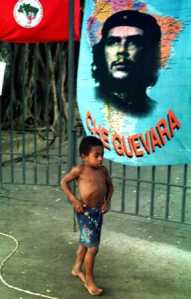
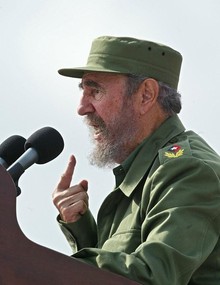
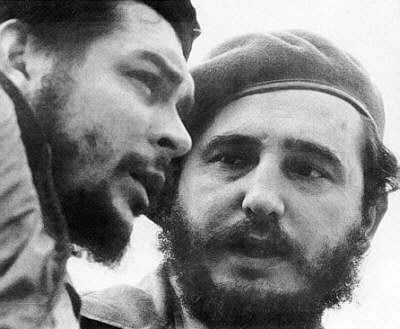 I simply ask that in a cultured country, in a cultured world, in a world where ideas are discussed, Che’s economic theories should be made known I especially ask that our students of economics, of whom we have many and who read all kinds of pamphlets, manuals, theories abut capitalist categories and capitalist laws, also begin to study Che’s economic thought, so as to enrich their knowledge. It would be a sign of ignorance to believe there is only way of doing things arising from the concrete experience of a specific time and specific historical circumstances. What I ask for, what I limit myself to asking for, is a little more knowledge, consisting of knowing about other points-of-view, points-of-view as respected, as deserving and as coherent as Che’s points-of-view.
 Η παρακάτω ιστορική ομιλία εκφωνήθηκε από τον Τσε σε κουβανούς φοιτητές της Ιατρικής, στις 20 Αυγούστου 1960.
  Ο ατομικισμός ως τέτοιος, ως η μεμονωμένη δράση ενός προσώπου στο κοινωνικό περιβάλλον, πρέπει να εκλείψει στην Κούβα. Αύριο ο ατομικισμός θα πρέπει να είναι η σωστή χρησιμοποίηση όλων των ατόμων προς όφελος της κοινότητας. Αλλά, αν και όλα αυτά, όλα όσα λέω, γίνονται κατανοητά σήμερα, αν και όλοι είναι πρόθυμοι να σκεφτούν λίγο το παρόν, το παρελθόν και το πώς θα πρέπει να είναι το μέλλον, η αλλαγή του τρόπου σκέψης απαιτεί βαθιές εσωτερικές αλλαγές και συμβολή στην πραγματοποίηση βαθιών εξωτερικών αλλαγών, κυρίως κοινωνικών. Αυτές οι εξωτερικές αλλαγές πραγματοποιούνται στην Κούβα καθημερινά. Ένας τρόπος να μάθετε γι’αυτή την επανάσταση, να γνωρίζετε τις δυνάμεις που κρύβουν μέσα τους οι άνθρωποι, δυνάμεις που ήταν λανθάνουσες για τόσο καιρό, είναι να επισκεφτείτε όλη την Κούβα, να επισκεφτείτε τις κολεκτίβες και όλους τους χώρους δουλειάς που δημιουργούνται. Κι ένας τρόπος για να φτάσετεστην καρδιά του ιατρικού ζητήματος είναι όχι μόνο να γνωρίσετε, όχι μόνο να επισκεφτείτε αυτά ταμέρη, αλλά να γνωρίσετε και τους ανθρώπους που συνθέτουν αυτές τις κολεκτίβες και τα κέντρα εργασίας. Πηγαίνετε εκεί και μάθετε τι αρρώστιες έχουν, από τι πάσχουν, από πόση φτώχεια υπέφεραν σ’ όλη τους τη ζωή, φτώχεια που κληρονόμησαν από αιώνες καταπίεσης και απόλυτης υποταγής. Ο γιατρός, ο νοσοκόμος, θα φτάσουν τότε στην καρδιά της νέας δουλειάς τους, δηλαδή ως άτομα μέσα στις μάζες, άτομα μέσα στην κοινότητα. Ό,τι κι αν συμβαίνει στον κόσμο, μένοντας πάντα κοντά στον άρρωστο, γνωρίζοντας καλά την ψυχολογία του, εκπροσωπώντας εκείνους που έρχονται κοντά στον πόνο και τον ανακουφίζουν, ο γιατρός έχει πάντα πολύ σημαντικό έργο, ένα έργο μεγάλης ευθύνης στην κοινωνική ζωή. Πριν από λίγο καιρό, λίγους μήνες, συνέβη εδώ στην Αβάνα μια ομάδα φοιτητών που μόλις είχανπάρει το πτυχίο της ιατρικής να μη θέλουν να πάνε στην ύπαιθρο και ζητούσαν επιπλέον πληρωμή για να το κάνουν. Από την οπτική γωνία του παρελθόντος είναι περισσότερο από λογικό να συμβαίνειαυτό- έτσι τουλάχιστον μου φαίνεται και το καταλαβαίνω. Θυμάμαι πως έτσι ήταν τα πράγματα, έτσι σκέφτονταν οι άνθρωποι πριν από μερικά χρόνια. Για ακόμα μια φορά είναι ο μονομάχος στην επανάσταση, ο μοναχικός πολεμιστης αυτός που θέλει να εξασφαλίσει ένα καλύτερο μέλλον, καλύτερες συνθήκες, και να κερδίσει την αναγνώριση για αυτό που κάνει. Τι θα συνέβαινε όμως αν δεν ήταν αυτά τα άτομα – οι οικογένειες των οποίων στην πλειονότητα τους μπορούσαν να πληρώσουν για τις σπουδές τους – εκείνα που ολοκλήρωσαν τα μαθήματα τους και αρχίζουν τώρα να ασκούν το επάγγελμα τους; Τι θα συνέβαινε αν στη θέση τους ήταν διακόσιοι, τριακόσιοι χωρικοί αυτοί που θα ξεπρόβαλλαν – σαν από θαύμα, ας πούμε – από τις αίθουσες διαλέξεων του πανεπιστημίου; Αυτό που απλώς θα συνέβαινε είναι ότι αυτοί οι χωρικοί θα έτρεχαν αμέσως και με μεγάλο ενθουσιασμό να φροντίσουν τα αδέρφια τους. Θα ζητούσαν τις θέσεις με τη μεγαλύτερη ευθύνη και την περισσότερη δουλειά, για να δείξουν ότι τα χρόνια σπουδών δε σπαταλήθηκαν άσκοπα. Αυτό θα συμβεί σε έξι εφτά χρόνια, όταν οι νέοι φοιτητές, παιδιά της εργατικής τάξης και της αγροτιάς, θα πάρουν τα πτυχία τους. Δεν πρέπει όμως να βλέπουμε το μέλλον μοιρολατρικά και να χωρίζουμε τους ανθρώπους σε παιδιά της εργατικής τάξης ή της αγροτιάς και σε αντεπαναστάτες. Αυτό είναι απλουστευτικό, δεν είναι αλήθεια, και τίποτα δε διαπαιδαγωγεί περισσότερο έναν έντιμο άνθρωπο από το να βιώσει τηνεπανάσταση.Κανένας από εμάς, απ’ όσους φτάσαμε πρώτοι με το Granma, εγκατασταθήκαμε στη Σιέρα Μαέστρα και μάθαμε να σεβόμαστε τον αγρότη και τον εργάτη, ζώντας μαζί τους, κανένας από εμάς δεν ήτανεργάτης ή αγρότης στο παρελθόν. Φυσικά, υπήρχαν εκείνοι που είχε χρειαστεί να δουλέψουν, πουείχαν γνωρίσει ορισμένες ανάγκες σαν παιδιά.
 Ελληνικό Αρχείο Τσε Γκεβάρα © Guevaristas