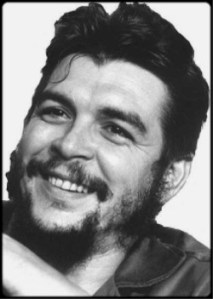
Forty years since the death of Che Guevara (Part One)

9 October 2007.

By Alan Woods*.

Ernesto (“Che”) Guevara was executed by Bolivian troops near the town of La Higuera on 9 October 1967, following an ambush. The operation was planned by the CIA and organized by US Special Forces. On the 40th anniversary of his death it is appropriate that we make a balance sheet of this outstanding revolutionary and martyr. Alan Woods in a two-part article looks at the evolution of Che Guevara from his early days to the day he was killed.

Che – an icon?

 Lenin wrote in State and Revolution: «What is now happening to Marx’s theory has, in the course of history, happened repeatedly to the theories of revolutionary thinkers and leaders of oppressed classes fighting for emancipation. During the lifetime of great revolutionaries, the oppressing classes constantly hounded them, received their theories with the most savage malice, the most furious hatred and the most unscrupulous campaigns of lies and slander. After their death, attempts are made to convert them into harmless icons, to canonize them, so to say, and to hallow their names to a certain extent for the ‘consolation’ of the oppressed classes and with the object of duping the latter, while at the same time robbing the revolutionary theory of its substance, blunting its revolutionary edge and vulgarizing it.»

After his death, Guevara became an icon of socialist revolutionary movements and a key figure of modern pop culture worldwide. The Alberto Korda photo of Che has become famous, appearing on t-shirts and protest banners all over the world. Thus, Che has become an icon of our times. After the death of Lenin, the leading clique of Stalin and Zinoviev created a cult around his figure. Against Krupskaya’s wishes, his body was embalmed and placed on public display in the mausoleum in Red Square. Later Krupskaya stated: «All his life Vladimir Ilyich was against icons, and now they have turned him into an icon.»

In November 2005, the German magazine Der Spiegel wrote about Europe’s «peaceful revolutionaries» whom it describes as the heirs of Gandhi and Guevara [!]. This is a complete travesty. We should form a «Society for the Protection of Che Guevara» against the people who have nothing to with Marxism, the class struggle or socialist revolution, and who wish to paint an entirely false picture of Che as a kind of revolutionary saint, a romantic petty bourgeois, an anarchist, a Gandhian pacifist or some other nonsense of the sort.

Our attitude to this outstanding revolutionary is similar to the attitude of Lenin towards Rosa Luxemburg. While not concealing his criticisms of the mistakes of Rosa Luxemburg, Lenin held Rosa Luxemburg in high regard as a revolutionary and internationalist. Here is what he wrote about Rosa, defending her memory against the reformists and Mensheviks:

«We shall reply to this by quoting two lines from a Russian fable, ‘Eagles may at times fly lower than hens but hens can never rise to the height of eagles’. [Rosa ] in spite of her mistakes […] was and remains for us an eagle. And not only will Communists all over the world cherish her memory, but her biography and her complete works will serve as useful manuals for training many generations of communists all over the world. ‘Since August 4, 1914, German social-democracy has become a stinking corpse’ ‑ this statement will make Rosa Luxemburg’s name famous in the history of the international working class movement. And, of course, in the backyard of the working class movement, among the dung heaps, hens like Paul Levi, Scheidemann, Kautsky and all their fraternity will cackle over the mistakes committed by the great Communist». (Lenin Collected Works, Vol. 33, p. 210, Notes of a Publicist, Vol. 33).

Early life

Ernesto Guevara de la Serna (14th June 1928 – 9th October, 1967), generally known as Che Guevara was a Marxist revolutionary – Argentinean by birth but an internationalist to the marrow of his bones. His ancestry, like that of most people in Latin America, was very mixed. Guevara is a Castilianized form of the Basque Gebara, signifying «from the Basque province of Araba (Alava)». One of his family names, Lynch, was Irish (the Lynch family was one of the 14 Tribes of Galway). The mixture of Basque and Irish blood is somewhat explosive!

Born into a middle class family, he did not suffer poverty and hunger like so many other children in Latin America. But he suffered from ill health. His naturally adventurous and rebellious spirit was connected with the fact that from an early age he had a serious asthmatic condition. He spent all his life trying to overcome this problem by deliberately driving himself to the limit. His steely determination to overcome all difficulties may also be traced back to this.

His humanitarian instincts first inclined him to the field of medicine. He obtained a medical degree. His specialty was dermatology and he was particularly interested in leprosy. At this time his horizons were no wider than those of most other middle class young men: to work hard, get a degree in medicine, get a good job, maybe do original research into medical science and advance human knowledge by some amazing discovery. About this period in his life he wrote:

«When I began to study medicine most of the concepts I now have as a revolutionary were then absent from my warehouse of ideals. I wanted to be successful, as everyone does. I used to dream of being a famous researcher, of working tirelessly to achieve something that could, decidedly, be placed at the service of mankind, but which was at that time all about personal triumph. I was, as we all are, a product of my environment.»

Like most young people, Ernesto loved to travel. He was seized by what the Germans call «Wanderlust». He wrote: «I now know by an unbelievable coincidence of fate that I am destined to travel.» Just how far he was to travel, and in what direction he would go, was as yet a sealed book to him. No doubt he would have made a conscientious physician, but the Wanderlust got the better of him. He took to the road, and did not to return to Argentina for many years. His adventurous nature induced him to set out on a long journey travelling rough throughout South America on a motorbike.

The link between medicine and his political ideals emerged in a speech that he delivered in the San Pablo leprosarium in Peru on the occasion of his 24th birthday. He said:

«Although we’re too insignificant to be spokesmen for such a noble cause, we believe, and this journey has only served to confirm this belief, that the division of America into unstable and illusory nations is a complete fiction. We are one single mestizo race with remarkable ethnographical similarities, from Mexico down to the Magellan Straits. And so, in an attempt to break free from all narrow-minded provincialism, I propose a toast to Peru and to a United America.»(Motorcycle Diaries, p.135).

Early awakenings

This journey was the beginning of a long odyssey that slowly opened his eyes to the reality of the world in which he lived. For the first time in his life he was brought into direct contact with the impoverished and oppressed masses of the continent. He witnessed at first hand the appalling conditions in which the majority of people lived. That such dreadful poverty should exist amidst all the natural wealth and beauty of this wonderful continent made a deep impression on his young mind.

These contradictions moved his passionate and sensitive nature and caused him to mediate on their causes. Che always had an eager and inquiring mind. That same intellectual fervour that he showed in his study of medicine was now turned to the study of society. The experiences and observations he had during these trips left a lasting mark on his consciousness.

Suddenly all his earlier ambitions for personal advancement seemed petty and uninteresting. After all, a doctor can cure individual patients. But who can cure the terrible disease of poverty, illiteracy, homelessness and oppression? One cannot cure cancer with an aspirin, and one cannot cure the underlying ills of society with palliatives and half-measures.

Slowly in the mind of this young man a revolutionary idea was maturing and developing. He did not immediately become a Marxist. Who does? He thought long and hard, and read widely: a habit that never left him to the end of his life. He began to study Marxism. Gradually, imperceptibly, but with a steely inevitability, he became convinced that the problems of the masses could only be remedied by revolutionary means.

Guatemala

His conversion to conscious Marxism received a decisive impetus when he went to Guatemala to learn about the reforms being implemented there by President Jacobo Arbenz Guzmán. In December 1953 Che arrived in Guatemala where Guzmán headed a reformist government, which was attempting to carry out a land reform and demolish the latifundia system.

Even before arriving in Guatemala Guevara was a committed revolutionary, although his views were still in a formative stage. This is shown by a letter written in Costa Rica on 10 December 1953, in which he says: «En Guatemala me perfeccionaré y lograré lo que me falta para ser un revolucionario auténtico.» («In Guatemala I will perfect myself and gain everything I still lack to be a real revolutionary»: Guevara Lynch, Ernesto. Aquí va un soldado de América. Barcelona: Plaza y Janés Editores, S.A., 2000, p. 26.).

But the United Fruit Company and the CIA had other ideas. They organized a coup attempt led by Carlos Castillo Armas, with US air support. Guevara immediately joined an armed militia organized by the Communist Youth; but was frustrated with the group’s inaction. After the coup, the arrests began and Che had to seek refuge in the Argentine consulate where he remained until he received a safe-conduct pass. He then decided to make his way to Mexico.

His experience of the US-sponsored coup against Arbenz confirmed him in his views and led him to draw certain conclusions. It concentrated Che Guevara’s mind on the role of the United States in Latin America. Here was an imperialist power that was a bulwark of all the reactionary forces throughout the continent. Any government that tried to change society would inevitably face the implacable opposition of a powerful and ruthless enemy.

After the victory of the CIA-inspired coup, Che was forced to flee to Mexico where, in 1956, he joined Fidel Castro’s revolutionary 26th of July Movement, which was engaged in a ferocious struggle against the dictatorship of General Fulgencio Batista in Cuba. The two men seemed to strike up an immediate rapport. Castro needed reliable men and Che needed an organization and a cause for which to fight.

Che had seen with his own eyes the fatal weakness of reformism and this confirmed in him the belief that socialism could only be achieved through armed struggle. He arrived in Mexico City in early September 1954, and entered into contact with Cuban exiles whom he had met in Guatemala. In June 1955 he met first Raúl Castro, and then his brother Fidel, who had been amnestied from prison in Cuba, where he had been confined after the failure of the assault on the Moncada Barracks.

Che immediately joined the 26th of July Movement that was planning to overthrow the dictatorship of Fulgencio Batista. At first Che was supposed to play a medical role. His poor health (he suffered from asthma all his life) did not suggest a warrior’s constitution. Nevertheless, he participated in military training side by side with the other members of the Movement, and proved his worth.

Granma

On November 25th, 1956, the cabin cruiser Granma set out from Tuxpan, Veracruz heading for Cuba, loaded with revolutionaries. It was an old ship and it was carrying many more people than it was designed for. It nearly sank in the heavy weather that reduced many of the passengers to severe seasickness. This was only the beginning of their problems.

The expedition was almost destroyed right at the outset. They landed in the wrong place and were caught in the swamps. They were attacked by government troops soon after landing, and about half of the rebels were killed or executed after being captured. Only 15-20 survived. This battered and depleted force somehow managed to re-group and escape into the Sierra Maestra Mountains from where they waged a guerrilla war against the Batista dictatorship.

Despite the initial setback, the rebels had struck a courageous blow, which resonated in the hearts and minds of the masses and especially the youth. New recruits filled up their depleted ranks. The guerrilla war spread throughout eastern Cuba. Che had been taken on as a medic, but in the heat of battle he had to make up his mind whether he could serve the cause best as a doctor or a fighter. He decided:

«Perhaps this was the first time I was confronted with the real-life dilemma of having to choose between my devotion to medicine and my duty as a revolutionary soldier. Lying at my feet were a knapsack full of medicine and a box of ammunition. They were too heavy for me to carry both of them. I grabbed the box of ammunition, leaving the medicine behind « (Quizás esa fue la primera vez que tuve planteado prácticamente ante mí el dilema de mi dedicación a la medicina o a mi deber de soldado revolucionario. Tenía delante de mí una mochila llena de medicamentos y una caja de balas, las dos eran mucho peso para transportarlas juntas; tomé la caja de balas, dejando la mochila ….»)

The main strength of the rebellion lay in the chronic weakness of the old regime, which was internally rotted with corruption and decay. Despite the support, money and arms of US imperialism, Batista was unable to check the advance of the revolution. His soldiers were unwilling to risk their lives to defend a diseased regime. Weakened and demoralized by a series of ambushes in the heights of the Sierra Maestra, at Guisa and Cauto Plains, the army was already thoroughly demoralized when the final offensive was launched.

In this campaign Che became a Comandante, gaining a reputation for courage, bravery and military skill. He was now second only to Fidel Castro himself. In the final days of December 1958, Comandante Guevara and his column of fighters headed west for the final push towards Havana. This column undertook the most dangerous tasks in the decisive attack on Santa Clara. In a speech given in Palma Soriano on December 27, 1983), Castro pointed out the importance of this offensive:

«We established our defensive line on the Cautillo River. We had Mapos surrounded, but there was still Palma. There were approximately 300 enemy soldiers. We had to take Palma. We were also anxious to take the arms that were to be found in Palma, because when we left La Plata, in the Sierra Maestra, because of the latest offensive, we left with 25 armed soldiers and 1,000 unarmed recruits. We armed those troops along the way. We armed them during the fighting, but we really finished fully arming them in Palma.»

The final orders to the rebel army were issued from Palma on January 1, 1959. But the final blow that finished off the dictatorship was the general strike of the workers of Havana. The whole edifice was collapsing like a house of cards. Batista’s generals were attempting to negotiate a separate peace with the rebels. When he learned of this, the dictator realized that the game was up and fled to the Dominican Republic on New Year’s Day, 1959.

In power

The old bourgeois state had been smashed and a new power was formed, or rather improvised, on the basis of the guerrilla army. Power now passed into the hands of the guerrilla army. Marxists all over the world rejoiced at the victory of the Cuban Revolution. This was a heavy blow stuck at imperialism, capitalism and landlordism on the doorstep of the most powerful imperialist state in history. It gave hope to the oppressed masses everywhere. Yet the way in which it took place was different to the Russian Revolution of October 1917. There were no soviets and the working class, although it had ensured the final victory of the Revolution through a general strike, did not play a leading role.

There are some who argue that this is irrelevant, that every revolution is different, that there cannot be a model that is applicable to all cases, and so on. To some extent this is true. Every revolution has its own concrete features and characteristics that correspond to the different concrete conditions, class balance of forces, history and traditions of different countries. But this observation by no means exhausts the question.

«The dictatorship of the proletariat»

Marx explained that the workers cannot simply lay hold of the old state apparatus and use it to change society. He developed his theory of workers’ power in The Civil War in France: Address of the General Council of the International Working Men’s’ Association, 1871. What is the essence of this theory? Marx explained that the old state could not serve as an instrument to change society. It had to be destroyed and replaced with a new state power – a workers’ state – that would be completely different to the old state machine, «the centralized state power, with its ubiquitous organs of standing army, police, bureaucracy, clergy, and judicature». It would be a semi-state, to use Marx’s expression, dedicated to its own disappearance:

«The Commune was formed of the municipal councillors, chosen by universal suffrage in the various wards of the town, responsible and revocable at short terms. The majority of its members was naturally working men, or acknowledged representatives of the working class. The Commune was to be a working, not a parliamentary body, executive and legislative at the same time.

«Instead of continuing to be the agent of the Central Government, the police was at once stripped of its political attributes, and turned into the responsible, and at all times revocable, agent of the Commune. So were the officials of all other branches of the administration. From the members of the Commune downwards, the public service had to be done at workman’s wage. The vested interests and the representation allowances of the high dignitaries of state disappeared along with the high dignitaries themselves. Public functions ceased to be the private property of the tools of the Central Government. Not only municipal administration, but the whole initiative hitherto exercised by the state was laid into the hands of the Commune.

«Having once got rid of the standing army and the police – the physical force elements of the old government – the Commune was anxious to break the spiritual force of repression, the «parson-power», by the disestablishment and disendowment of all churches as proprietary bodies. The priests were sent back to the recesses of private life, there to feed upon the alms of the faithful in imitation of their predecessors, the apostles.» (Marx, The Civil War in France, The Third Address, May, 1871 [The Paris Commune])

This bears absolutely no relation to the bureaucratic totalitarian regime of Stalinist Russia where the state was a monstrous repressive power standing above society. Even the word «dictatorship» in Marx’s day had an entirely different connotation to that which we attach to it today. After the experience of Stalin, Hitler, Mussolini, Franco and Pinochet the word dictatorship signifies concentration camps, the Gestapo and the KGB. But Marx actually had in mind the dictatorship of the Roman Republic, whereby in a state of emergency (usually war) the usual mechanisms of democracy were temporarily suspended and a dictator ruled for a temporary period with exceptional powers.

Far from a totalitarian monster, the Paris Commune was a very democratic form of popular government. It was a state so constructed that it was intended to disappear – a semi-state, to use Engels’ expression. Lenin and the Bolsheviks modelled the Soviet state on the same lines after the October Revolution. The workers took power through the soviets, which were the most democratic organs of popular representation ever invented.

Despite the conditions of terrible backwardness in Russia the working class enjoyed democratic rights. The 1919 Party programme specified that, «all the working masses without exception must be induced to take part in the work of state administration». Direction of the planned economy was to be mainly in the hands of the trade unions. This document was immediately translated into all the main languages of the world and widely distributed. However, by the time of the Purges in 1936 it was already regarded as a dangerous document and all copies of it were quietly removed from all libraries and bookshops in the USSR.

In any revolution where the leading role is not played by the working class but other forces, certain things will inevitably flow. There is always a tendency for the state to rise above the rest of society and even the most dedicated people can be corrupted or lose contact with the masses under certain circumstances. That is why Lenin devised his famous four conditions for workers’ power:

i) Free and democratic elections with right of recall of all officials.

ii) No official to receive a higher wage than a skilled worker.

iii) No standing army but the armed people.

iv) Gradually, all the tasks of running society to be done by everybody in turn (when everybody is a bureaucrat nobody is a bureaucrat).

These conditions were not a caprice or an arbitrary idea of Lenin. In a nationalized planned economy it is absolutely necessary to ensure the maximum of participation of the masses in the running of industry, society and the state. Without that, there will inevitably be a tendency towards bureaucratism, corruption and mismanagement, which can ultimately undermine and destroy the planned economy from within. That is just what happened to the USSR. The points raised by Lenin have an important bearing on the events in Cuba and on Che’s own evolution.

Revolutionary minister

Che occupied various posts in the revolutionary administration. He worked at the National Institute of Agrarian Reform, and was President of the National Bank of Cuba, when he signed banknotes with his nickname, «Che». All this time, Guevara refused his official salaries of office, drawing only his lowly wage as an army comandante.

This little detail tells us a lot about the man. He maintained that he did this in order to set a «revolutionary example». In fact, he was following to the letter the principle laid down by Lenin in State and Revolution that no official in the Soviet state should receive a salary higher than a skilled worker. This was an anti-bureaucratic measure. Lenin, like Marx, was well aware of the danger of the state raising itself above society and that this danger also existed in a workers’ state.

Taking as his point of departure Marx and Engels’ analysis of the Paris Commune, Lenin put forward four key points to fight bureaucracy in a workers’ state in 1917 to which we have already referred to above.

«We shall reduce the role of state officials,» wrote Lenin, «to that of simply carrying out our instructions as responsible, revocable, modest paid ‘foremen and accountants’ (of course, with the aid of technicians of all sorts, types and degrees). This is our proletarian task, this is what we can and must start with in accomplishing the proletarian revolution.» (LCW, Vol. 25, p. 431.).

During the first months of Soviet rule the salary of a People’s Commissar (including Lenin himself) was only twice the minimum subsistence wage for an ordinary citizen. Over the next years, prices and the value of the ruble often changed very rapidly and wages altered accordingly. At times the figures were quite astonishing – hundreds of thousands and millions of rubles. But even under these conditions Lenin made sure that the ratio between lowest and highest salaries in state organizations did not exceed the fixed limit – during his lifetime the differential apparently was never greater than 1:5.

Of course, under conditions of backwardness, many exceptions had to be made which represented a retreat from the principles of the Paris Commune. In order to persuade the «bourgeois specialists» (spetsy) to work for the Soviet state, it was necessary to pay them very large salaries. Such measures were necessary until the working class could create its own intelligentsia. In addition, special «shock worker» rates were paid for certain categories of factory and office workers, and so on.

However, such compromises did not apply to Communists. They were strictly forbidden to receive more than a skilled worker. Any income they received in excess of that figure had to be paid over to the Party. The chair of the Council of People’s Deputies received 500 rubles, comparable to the earnings of a skilled worker. When the office manager of the Council of People’s Deputies, V. D. Bonch-Bruevich paid Lenin too much in May 1918, he was given «a severe reprimand» by Lenin, who described the rise as «illegal».

Due to the isolation of the revolution, and the need to employ bourgeois specialists and technicians the differential was increased for these workers – they could earn a wage 50 per cent more than that received by the members of the government. Lenin was to denounce this as a «bourgeois concession», which should be reduced as rapidly as possible.

Not only in theory but in practice, Che adhered to similar revolutionary principles.

Che versus Stalinism

Che Guevara was an instinctive revolutionary. He was personally incorruptible and detested bureaucracy, careerism and privileges. His was the stern and puritan morality of the revolutionary fighter. Therefore, he was repelled by the manifestations of bureaucracy and flunkeyism that he observed after the victory of the Revolution.

Che often expressed opinions in opposition of the official positions of the Communist Party of the Soviet Union under Nikita Khrushchev. He was opposed to the «theory» of peaceful coexistence. He did not like the slavish attitude of some Cubans towards Moscow and its ideology. Above all, bureaucracy, careerism and privilege repelled him. His visits to Russia and Eastern Europe shocked him and deepened his sense of disillusionment with Stalinism. The bureaucracy, privileges and suffocating conformism repelled him to the depths of his soul.

He became increasingly critical of the Soviet Union and its leaders. That is why he initially inclined to China in the Sino-Soviet dispute. But to portray Che as a Maoist is to do him an injustice. There is no reason to believe that he would have felt any more at home in Mao’s China than in Khrushchev’s Russia. The reason he appeared to lean to China was that the Chinese criticized Moscow’s decision to remove the Soviet missiles from Cuba, an act that Che looked on as a betrayal.

It is impossible to arrive at a neat classification of Che Guevara. He was a complex character with a fertile brain that was always seeking after truth. The dogmas of Stalinism were the absolute antithesis of his way of thinking. He was repelled by bureaucratic servility and conformism and detested privilege of any sort. This made him an object of suspicion to visiting «Communist» dignitaries from Europe and the Soviet Bloc. The Stalinist leaders of the French Communist Party were particularly hostile to him and even launched a campaign of calumnies against Che, describing him as a «petty bourgeois adventurer».

Minister of Industries

Guevara later served as Minister of Industries, in which post he grappled with the problems of building a socialist planned economy in the difficult conditions that confronted the Cuban Revolution. My good friend and comrade Leon Ferrera, the veteran Cuban Trotskyist, worked with Che in the Ministry and had many discussions with him about Trotsky and Trotskyism. He gave him Trotsky’s books to read and he showed some interest in them. But there was one point he could not grasp: «Trotsky writes a lot about the bureaucracy, but what does this mean». Leon explained as best he could, and after a while Che said: «Yes, I think I understand what you mean.»

The next day Che and Leon were together cutting sugar cane in the fields. In the middle of this backbreaking work, Leon saw a big black car slowly advancing across the field. He turned to Che: «Comandante, it looks like you have a visitor,» he said. Che looked up, surprised and saw the limousine. Then his face lit up with a smile and he said to Leon: «Now just you watch this!»

The car came to a halt and a sweating official with a suit and tie stepped out and began to walk towards Che. Before he could open his mouth, Che shouted at him: «What are you doing here? Get out! We don’t want any bureaucrats here!» The shamefaced functionary turned back and headed for the car and Che turned to Leon: «You see!» he said with a triumphant grin.

When the Cuban Trotskyists were arrested Che personally intervened to secure their release. (He later said that this had been a mistake.) He also proposed a study of the writings of Leon Trotsky, who he regarded as one of the unorthodox Marxists. This attitude is very different to the position of the followers of Mao Tse Tung who described Trotsky as a counterrevolutionary and enemy of socialism.

These ideas are expressed in the letter of Che Guevara to Armando Hart Dávalos, which was published in Cuba in September, 1997 in Contracorriente, N°9. The letter was written in Dar-es-Salaam, Tanzania on 4 December 1965, during Che’s African expedition. In it he expresses himself in very critical terms on Soviet philosophy and the servile tail-endism of some Cubans:

«In this long period of holidays [sic!] I have stuck my nose into philosophy, which is something I have been meaning to do for a long time. I met my first difficulties in Cuba [where] there is nothing published except the unreadable Soviet tomes [literally «Soviet bricks» los ladrillos soviéticos] which have the drawback that they do not allow you to think, since the Party has done it for you and you just have to swallow it. As a method, this is completely anti-Marxist, and furthermore they are mostly very bad.»

«If you take a look at the publications [in Cuba] you will see a profusion of Soviet and French authors [He is referring to the French hard-line Stalinists like Garaudy]. This is due to the ease with which translations are obtained and also to ideological tail-endism [seguidismo ideológico]. This is not the way to give Marxist culture to the people. In the best case it is Marxist propaganda [divulgación marxista], which is necessary, if it is of good quality (which is not the case), but insufficient.»

He proposes an extensive plan of political education including the study of the collected works of Marx, Engels, Lenin and Stalin «and other great Marxists. Nobody has read anything of Rosa Luxemburg, for example, who made mistakes in her criticism of Marx, but who died, assassinated, and the instinct of imperialism is superior to ours in cases like this. Also missing are Marxists who later went off the rails, like Kautsky and Hilfering (it is not written like that) [Che was thinking of the Austrian Marxist Rudolf Hilferding] who made some contributions, and many contemporary Marxists, who are not totally scholastic».

He adds playfully: «and your friend Trotsky, who existed and wrote, so it seems, should be included.» His interest in Trotsky’s ideas increased in the same degree that he became disillusioned with the bureaucratic regimes of Russia and Eastern Europe. Che Guevara was an avid reader and he took many books with him on his last campaign in Bolivia. Among these, significantly, were books by Trotsky – the Permanent Revolution and the History of the Russian Revolution.

Given the extremely difficult conditions of guerrilla war in the mountains and jungles, a fighter will only take what he regards as absolutely necessary. This tells us a lot of how Che was thinking at this time. We have no doubt that had he lived he would have moved towards Trotskyism and in fact he was already doing so before his life was cut short.

(Ο Alan Woods είναι Τροτσκιστής πολιτικός επιστήμων. Είναι ηγετικό στέλεχος της International Marxist Tendency και πολιτικός συντάκτης της ιστοσελίδας «In Defence of Marxism».)

Οι απόψεις που εκφράζονται στο άρθρο δεν υιοθετούνται απ’ το Ελληνικό Αρχείο Τσε Γκεβάρα.

Χιλή 1952: Η ασθματική γερόντισσα της «Τζιοκόντα»

Ο ΤΣΕ (ΑΡΙΣΤΕΡΑ) ΜΕ ΤΟΝ ΑΛΜΠΕΡΤΟ ΓΚΡΑΝΑΔΟ ΤΟ 1951.

Κατά τη διάρκεια της πολύμηνης περιπλάνησης τους στη Νότια Αμερική, ο Ερνέστο Γκεβάρα και ο Αλμπέρτο Γκρανάδο βρέθηκαν στο Βαλπαραϊσο (Valparaíso) της Χιλής. Μια γραφική, παραθαλάσσια πόλη, «χτισμένη στην άκρη της παραλίας με θέα σε ένα μεγάλο κόλπο» όπως αναφέρει ο Τσε στα απομνημονεύματα του στα Ημερολόγια Μοτοσικλέτας.  Οι δύο νεαροί αργεντίνοι κατέλησαν για να ξεκουραστούν προσωρινά στην «Τζιοκόντα», ενός ρεστοράν που ανήκε σε συμπατριώτη τους.

Μάρτιος 1952. Ο Τσε διηγείται στο ημερολόγιο του τις προσπάθειες να βρουν εργασία στο τοπικό νοσοκομείο (σ.σ: ο Τσε ήταν ακόμη φοιτητής Ιατρικής) και αναφέρει, με λόγια που σαν πρόκες καρφώνονται στη μνήμη, ίσως μια από τις συγκλονιστικότερες στιγμές του μεγάλου ταξιδιού του:

«Προσπαθούσαμε να έρθουμε σε απευθείας επαφή με τους γιατρούς του Πετροουέ, αλλά αυτοί μόλις γύριζαν από τις δραστηριότητες τους και, μην έχοντας καιρό για χάσιμο, δε μας παραχωρούσαν ούτε μία τυπική συνάντηση-ωστόσο τους είχαμε εντοπίσει και εκείνο το απόγευμα χωριστήκαμε: ο Αλμπέρτο τους ακολούθησε και εγώ πήγα να δω μια ασθματική γερόντισσα, πελάτισσα της «Τζοκόντα». Τη λυπόσουν την καψερή, το δωμάτιο της βρομούσε ιδρωτίλα, ποδαρίλα και σκόνη από δυο τρεις πολυθρόνες, τα μοναδικά είδη πολυτελείας στο σπίτι της. Εκτός από το άσθμα, υπέφερε και από καρδιακή ανεπάρκεια. Ήταν μία από τις περιπτώσεις που ένας γιατρός, συνειδητοποιώντας ότι είναι ανίσχυρος μπροστά στην κατάσταση, νιώθει την επιθυμία μιας ριζικής αλλαγής, που να εξαλείψει την αδικία η οποία ανάγκασε τη γριά γυναίκα να δουλεύει σαν υπηρέτρια μέχρι τον προηγούμενο μήνα για να βγάλει το ψωμί της, ασθμαίνοντας, υποφέροντας, μα κρατώντας ψηλά το κεφάλι στη ζωή. Το ζήτημα είναι πως στις φτωχές οικογένειες το μέλος που αδυνατεί να κερδίσει τα προς το ζην περιβάλλεται από μια ατμόσφαιρα δυσαρέσκειας, που κρύβεται με το ζόρι. Από εκείνη τη στιγμή παύει να είναι πατέρας, μητέρα, αδερφός· γίνεται ένας αρνητικός παράγοντας στον αγώνα για επιβίωση και, ως τέτοιος, στόχος μνησικακίας της υγιούς κοινότητας, που θεωρεί την αναπηρία του σαν προσωπική προσβολή γι’ αυτούς που πρέπει να τον συντηρήσουν. Εκεί, στις τελευταίες ώρες για τους ανθρώπους των οποίων ο ορίζοντας δεν εκτείνεται πέρα από το αύριο, εκεί επικεντρώνεται η τραγωδία της ζωής του προλεταριάτου όλου του κόσμου. Στα μάτια των ετοιμοθάνατων βλέπεις μια καρτερική έκκληση συγνώμης και, συχνά, μια απελπισμένη έκκληση παρηγοριάς που χάνεται στο κενό, όπως θα χαθεί γρήγορα και το σώμα μέσα στην απεραντοσύνη του μυστηρίου που μας περιβάλλει. Ως πότε θα συνεχιστεί αυτή η τάξη πραγμάτων που βασίζεται σε μια παράλογη διαίρεση, στις κοινωνικές τάξεις; Είναι κάτι στο οποίο δεν μπορώ να απαντήσω εγώ, αλλά είναι καιρός οι κυβερνώντες να αφιερώσουν λιγότερο χρόνο στην προπαγάνδα της ποιότητας των καθεστώτων τους και περισσότερα χρήματα, πολύ περισσότερα, για έργα κοινωνικής ωφέλειας. Δεν μπορώ να κάνω πολλά για την άρρωστη· της γράφω απλώς μια κατάλληλη δίαιτα, ένα διουρητικό και αντιασθματικά διαλύματα. Μου έχουν μείνει μερικές δραμαμίνες και της τις χαρίζω. Όταν βγαίνω, με ακολουθούν τα στοργικά λόγια της γερόντισσας και οι αδιάφορες ματιές των συγγενών».

[Το χαμόγελο της «Τζοκόντα», Ημερολόγια Μοτοσικλέτας].

Η εμπειρία αυτή του νεαρού Γκεβάρα, φοιτητή της Ιατρικής τότε, αποτέλεσε ίσως το ξεκίνημα μιάς σειράς γεγονότων που σταδιακά «έπλασαν» την κοινωνική και πολιτική του συνείδηση. Από τα γραπτά του, όπως αποτυπώνονται στα Ημερολόγια Μοτοσικλέτας, μπορεί κανείς να συμπεράνει το έναυσμα της πολιτικής του συνειδητοποίησης και τις αγωνιώδεις σκέψεις του γιά την ύπαρξη της παράλογης τάξης πραγμάτων που διαιρεί τους ανθρώπους σε κοινωνικές τάξεις και την «τραγωδία της ζωής του προλεταριάτου», η οποία αντικατοπτρίζονταν στο βλέμμα της ετοιμοθάνατης ασθματικής γερόντισσας.

Τσε Γκεβάρα και Φιντέλ Κάστρο / Che Guevara and Fidel Castro

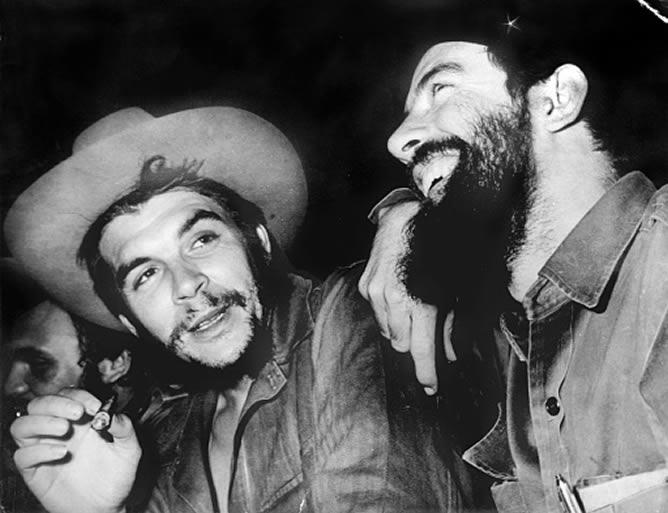
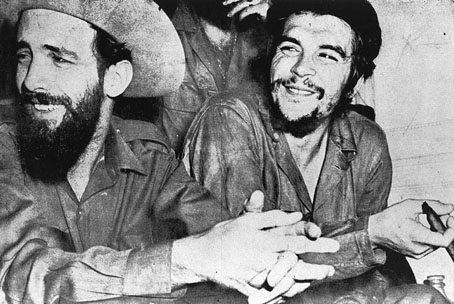
Ο Τσε και ο Φιντέλ σε διάφορες στιγμές της Κουβανικής επανάστασης. Σύντροφοι, συνεργάτες και φίλοι.

Che’s ideas are absolutely relevant today: A speech by Fidel Castro (Part Two)

Thus, I remember that during the days of Batista’s final offensive in the Sierra Maestra mountains against our militant but small forces, the most experienced cadres were not in the front lines; they were assigned strategic leadership assignments and save for our devastating counterattack. It would have been pointless to put Che, Camilo [Cienfuegos], and other compañeros who had participated in many battles at the head of a squad. We held them back so that they could subsequently lead columns that would undertake risky missions of great importance, it was then that we did send them in enemy territory with full responsibility and awareness of the risks as in the case of the invasion of Las Villas led by Camilo and Che, an extraordinarily difficult assignment that required men of great experience and authority as column commanders, men capable of reaching the goal.

In line with this reasoning, and considering the objectives, perhaps it would have been better if this principle had been observed and Che had joined at a later stage. It really was no so critical for him to handle everything right from the start. But he was impatient, very impatient really. Some Argentine comrades had been killed in the initial efforts he had made years before, including Ricardo Massetti, the founder of Presna Latina. He remembered that often and was really impatient to start to participate personally in the work.

As always, we respected our commitments and his views, for our relationship was always based on absolute trust, absolute brotherhood, regardless of our ideas about what would be the right time for him to join in. And so we gave him all the help and the facilities possible to start the struggle. The news came of the first clashes, and contact was completely lost. The enemy detected the initial stage of organization of the guerrilla movement, and that marked the start of a period lasting many months in which almost the only news we received was what came via international news dispatches, and we had to know how to interpret them. But that’s something our revolution had become very experienced at: determining when a report is reliable or when it is made up, false.

I remember, for example, when a dispatch came with the news of the death of Joaquín’s grip (his real name was Vilo Acuña.* When we analyzed it, I immediately concluded that it was true, this was because of the way they described how the group had been eliminated while crossing a river. Because of our own guerrilla experience, because of what we had lived through, we knew how a small guerrilla group can be done away with. We knew the few, exceptional ways such a group can be destroyed,

When it was reported that a peasant had made contact with the army and provided detailed information on the location and plans of the group, which was looking for a way to cross the river; how the army set up an ambush on the other bank at a spot on the route the same peasant had told the guerrilla fighters to use; the way the army opened fire in midstream; there was no doubt as to the truth of the explanation. If the writers of false reports, which came in often, tried to do it again, it was impossible to admit that they, who were always so clumsy in their lies, would have had enough intelligence and experience to make up the exact and only circumstances in which the group could be eliminated. That’s why we conclude the report was true. Long years of revolutionary experience had taught us to decipher dispatches and tell the difference between the truth and the falsehood of each development; although, of course, there are other things to keep in mind when making a judgment. But that was the type of information we had about the situation until the news of Che’s death arrived.

As we have explained, we had hopes that even with only twenty men left, even in a very difficult situation, the guerrillas still had a chance. They were headed toward an area where sectors of the peasants were organized, where some good Bolivian cadres had influence, and until that moment, until almost the very end, there was chance that the movement could consolidate and could develop. But the circumstances in which my relationship with Che were so unique — the almost unreal history of the brief but intense saga of the first year of the revolution when we were used to making the impossible possible — that is, as I explained to that journalist, one had the permanent impression that Che had not died, that he was still alive. Sine his was such an exemplary personality, so unforgettable, so familiar, it was difficult to resign oneself to the idea of his death.

Sometimes I would dream — all of us dream of things related to our lives and struggles — that I saw Che, that he returned, that we was alive. How often this happened! I told the journalist that these are feelings you seldom talk about, but they give an idea of the impact of Che’s personality and also of the extraordinary degree to which he really lives on, almost as if his was a physical presence, with his ideas and deeds, with his example and all the things he created, with his continued relevance and the respect for him not only in Latin America but in Europe and all over the world. As we predicted on October 18, twenty years ago, he became a symbol for all the oppressed, for all the exploited, for all the patriotic and democratic forces, for all the revolutionaries. He became a permanent and invincible symbol.

We feel Che’s presence for all these reasons, because of the real force that he still has today which, even though twenty years have gone by, exists in the spirit of all of us, when we hear the poem, when we hear the anthem, or the bugle is sounded before a moment’s silence, when we open our newspapers and see photographs of Che during different stages of his life, his image, so well known throughout the world — because it has to be said that Che not only had the virtues and all the human moral qualities to be a symbol, he also had the appearance of a symbol, the image of a symbol: his look, the frankness and strength of his look; his face, which reflects character irrepressibly determined for action, at the same time showing great intelligence and great purity — when we look at the poems that have been written, the episodes that are recounted, and the stories that are repeated, we feel the reality of Che’s relevance, of his presence.

It’s not strange if one feels Che’s presence not only in everyday life, but even in dreams if one imagines that he is alive, that Che is in action and that he never died. In the end we must reach the conclusion that for all intents and purposes in the life of our revolution, Che never died, and the light that of what has been done, he is more alive than ever, has more influence than ever, and is a more powerful opponent of imperialism than ever. Those who disposed of his body so that he would not become a symbol; those who, under the guidance of the methods of their imperial masters, did not want any trace to remain, have discovered that although his tomb is unmarked, there are no remains, and there is no body, nevertheless a frightening opponent of imperialism, a symbol, a force, a presence that can never be destroyed, does exist.

When they hid Che’s body, they showed their weakness and their cowardice, because they also showed their fear of the example and the symbol. They did not want the exploited peasants, the workers, the students, the intellectuals, the democrats, the progressives or the patriots of this hemisphere to have a place to go to pay tribute to Che’s remains. And in the world today, in which there is no specific place to go to pay tribute to Che’s remains, tribute is paid to everywhere.

Today tribute is not paid to Che once a year, not once ever five, ten, fifteen, or twenty years; today homage is paid to Che every year every month, every day, everywhere, in a factory, in a school, in a military barracks, in a home, among children, among Pioneers. Who can count how many millions of times in these twenty years, the Pioneers have said: “Pioneers for communism, we will be like Che”!

Really, there can be no superior symbol, there can be no better image, when searching for a model revolutionary man, when searching for the model communist. I say this because I have the deepest conviction — I always have had and I still have today, just the same or more so when I spoke that October 18 and I asked how we wanted our fighters, our revolutionaries, our party members, our children to be, and I said we wanted them to be like Che. Because Che is the personification, Che is the image of that new man, the image of that human being if we want to talk about a communist society; if our real objective is to build, not just socialism but the higher stages of socialism, if humanity is not going to renounce the lofty and extraordinary idea of living in a communist society one day.

If we need a paradigm, a model, an example to follow, then men like Che are essential, as are men and women who imitate him, who are like him, who think like, who act like him; men and women whose conduct resembles his when it comes to doing their duty, in every little thing, every detail, every activity; in his attitude toward work, his habit of teaching and educating by setting an example; his attitude of wanting to be first at everything, the first to volunteer for the most difficult tasks, the hardest ones, the most self-sacrificing ones; the individual who gives his body and soul to others, the person who displays true solidarity, the individual who never lets down a compañero; the simple man; the man without a flaw, who doesn’t live any contradiction between what he says and what he does, between what he practices and what he preaches; a man of thought and a man of action — all of which Che symbolizes.

For our country, it is a great honor and privilege to have had Che as a son of our people even though he wasn’t born in this land. He was a son because he earned the right consider himself and to be considered a son of our country, and it is an honor and a privilege for our people, for our country, for our country’s history, for our revolution to have had among its ranks a truly exceptional man such as Che.
That’s not to say that exceptional people are rare; that’s not to say that amid the masses there are not hundreds, thousands, even millions of exceptional men and women. I said it once during the bitter days after Camilo disappeared. When I recounted the history of how Camilo became the man he was, I said: “Among our people there are many Camilos.” I could say: “Among our peoples, among the peoples of Latin America and peoples of the world, there are many Ches.” But, why do we call them exceptional? Because in actual fact, in the world in which they lived, in the circumstances in which they lived, they had the chance and the opportunity to demonstrate all that man, with his generosity and solidarity, is capable of being. And, indeed, seldom do ideal circumstances exist in which man has the opportunity to express himself and to show everything he has inside as was the case with Che.
Of course, it’s clear that there are countless men and women among the masses who, partly as a result of other people’s examples and certain new values, are capable of heroism, including a kind of heroism I greatly admire: silent heroism, anonymous heroism, silent virtue, anonymous virtue, But given that its so unusual, so rare for all the necessary circumstances to exist to produce a figure like Che — who today has become a symbol for world, a symbol that will grow — it is a great honor and privilege that this figure was born during our revolution.
And as proof of what I said earlier about Che’s presence and force today, I could ask: Is there a better date, a better anniversary than this one to remember Che with all our conviction and deep feelings of appreciation and gratitude? Is there a better moment than this particular anniversary, when we are in the middle of the rectification process?

What are we rectifying? We are rectifying all those things — and there are many — that strayed from the revolutionary spirit, from revolutionary work, revolutionary virtue, revolutionary effort, revolutionary responsibility; all those things that strayed from the spirit of solidarity among people. We’re rectifying all the shoddiness and mediocrity that is precisely the negation of Che’s ideas, his revolutionary thought, his style, his spirit and his example. I really believe, and I say it with great satisfaction, that if Che were sitting in this chair, he would feel jubilant. He would be happy about what we are doing these days, just like he would have felt very unhappy during that unstable period, that disgraceful period of building socialism in which there began to prevail a series of ideas, of mechanisms, of bad habits, which would have caused Che to feel profound and terrible bitterness.

Γκρεμίζει σύνορα και σήμερα

Του Πάνου Τριγάζη.

Το να θυμόμαστε και να τιμούμε τον Τσε Γκεβάρα έχει ιδιαίτερη αξία σήμερα: για τους δύσκολους αγώνες που καλούμαστε να δώσουμε, αλλά και για τις σχέσεις μέσα στην ίδια την αριστερά της χώρας μας, που έχουν υποστεί οδυνηρούς αυτοτραυματισμούς τον τελευταίο καιρό. Η βαθιά κρίση, που ζει όλος ο κόσμος, αναδεικνύει όσο ποτέ πριν την σημασία του διεθνισμού της αριστεράς, του οποίου ο Τσε αποτελεί το απόλυτο σύμβολο. Την ίδια ώρα χρειαζόμαστε τον Τσε ως ηθικό πρότυπο και πηγή έμπνευσης για ένα μεγάλο κίνημα αξιών, καθώς η κρίση είναι πολυδιάστατη και δεν αφορά μόνο τις «κορυφές» του καπιταλιστικού συστήματος αλλά λειτουργεί διαβρωτικά μέσα στις ίδιες τις κοινωνίες, παράγοντας ποικίλες βαρβαρότητες.

Αν λέγαμε ότι ο «Τσε Γκεβάρα ζει», 43 χρόνια μετά τη δολοφονία του, θα ήταν κάτι κοινότυπο για τον «αιώνιο επαναστάτη», που η παγκοσμιότητα της παρουσίας του δεν έχει προηγούμενο. Ο Τσε γκρεμίζει σύνορα και σήμερα. Η μορφή του υπάρχει παντού όπου υπάρχει εξέγερση, σε κάθε διαδήλωση, στα πανεπιστήμια, στις μεγάλες ροκ συναυλίες, αλλά και σε άλλους χώρους όπου συγκεντρώνονται νέοι άνθρωποι. Ο Τσε έγινε ποίηση, τραγούδι, μυθιστόρημα, ήρωας πολλών ταινιών, «γκράφιτι» στους τοίχους στις γειτονιές όλου του κόσμου. Ακόμα και η καταναλωτική εκμετάλλευση του μύθου του, που προσβάλλει τη μνήμη του, δείχνει την τεράστια απήχηση του στην παγκόσμια νεολαία.

Ο Τσε δεν χωράει σε κανένα επαναστατικό «καλούπι». Δεν μπορεί κανένα ρεύμα της αριστεράς να τον οικειοποιηθεί. Αναφέρονται σ’ αυτόν όλες οι αντισυστημικές δυνάμεις, από τους κομμουνιστές και την νέα αριστερά, ως τους αντιεξουσιαστές, ακόμα και σοσιαλδημοκράτες. Η μνήμη του αποτελεί ένα είδος βάλσαμου για τον βαρύτατα πληγωμένο επαναστατικό ρομαντισμό μας από σοσιαλιστικά εγχειρήματα που οδηγήθηκαν στον εκφυλισμό. «Ίσως για μας καλύτερα που δεν γέρασες/ που έμεινες για πάντα νέος Ερνέστο/ όπως η Επανάσταση στη χαραυγή της», λέει χαρακτηριστικά σ’ ένα ποίημά του ο Τίτος Πατρίκιος.

«Ο Τσε έπεσε υπερασπιζόμενος την υπόθεση των φτωχών και των ταπεινών αυτής της γης», είπε ο Φιντέλ Κάστρο στον επικήδειο που εκφώνησε στην Πλατεία της Επανάστασης στην Αβάνα (18-10-1967), προσθέτοντας ότι «ξεχώρισε ως άνθρωπος ανυπέρβλητης δράσης, αλλά ήταν και άνθρωπος βαθυστόχαστος, με διορατική ευφυΐα και βαθιά μόρφωση». «Ο μαρξισμός μου έχει βαθιές ρίζες και έχει εξαγνιστεί», έγραφε στο τελευταίο γράμμα προς τους γονείς του, το 1965, αλλά άρχιζε το ίδιο γράμμα με τη φράση: «νοιώθω και πάλι κάτω από τις φτέρνες μου το ανεβοκατέβασμα των πλευρών του Ροσινάντε», δηλαδή έβλεπε τον εαυτό του σαν ένα είδος Δον Κιχώτη. Όμως, η παγκόσμια ακτινοβολία του Τσε δεν εξηγείται με στενά πολιτικούς και ιδεολογικούς όρους, με κριτήριο ότι εκπροσωπεί τη σωστή «συνταγή» για την επανάσταση, αλλά διότι συνεγείρει συνειδήσεις ως κορυφαίο ηθικό πρότυπο ενός ασυμβίβαστου αγωνιστή, που ενώνει την πολιτική και την ηθική.

Ο Τσε ήταν ένας μεγάλος διεθνιστής και αντιιμπεριαλιστής, στη θεωρία και στην πράξη. Αν κάναμε μια δημοσκόπηση, ρωτώντας ποια είναι η εθνικότητά, του δύσκολα θα παίρναμε σωστή απάντηση. Γεννήθηκε στην Αργεντινή, αλλά είναι ήρωας όλης της Λατινικής Αμερικής και σύμβολο της ενότητάς της. Υπήρξε από τους πρωτεργάτες της Κουβανικής Επανάστασης, δίπλα στον Φιντέλ Κάστρο, με τον οποίο συμπορεύτηκε από το 1955 ως το 1965, όταν εγκατέλειψε τη θέση του υπουργού που κατείχε στην Κούβα, για να πολεμήσει στο πλευρό εθνικοαπελευθερωτικών κινημάτων. Θεωρούσε ότι «το βασικό πεδίο εκμετάλλευσης του ιμπεριαλισμού περιλαμβάνει τις τρεις καθυστερημένες ηπείρους, Λατινική Αμερική, Ασία και Αφρική», και έβλεπε το μέλλον φωτεινό «αν δύο, τρία, πολλά Βιετνάμ, άνθιζαν στην επιφάνεια της γης». Με βάση αυτή την ανάλυση και όχι ως «απελπισμένη ανταρσία», επέλεξε να φύγει το 1965 για το Κογκό και να καταλήξει, το 1966, στη Βολιβία. Εκεί προσπάθησε να οργανώσει αντάρτικο κίνημα, αλλά βρήκε μεγάλες δυσκολίες και τελικά έπεσε σε ενέδρα μαζί με τους 17 συμμαχητές που του είχαν απομείνει. Αιχμαλωτίστηκε από τον βολιβιανό στρατό, με τη βοήθεια της CIA, στις 8 Οκτωβρίου 1967, και την επομένη ημέρα δολοφονήθηκε.

«Για τα παιδιά του κόσμου σκοτώθηκες/ Τσε Γκεβάρα», λέει σ’ ένα ποίημά του ο Τάσος Λειβαδίτης, που μελοποίησε ο Μίκης Θεοδωράκης (Λειτουργία Νο 2), ενώ με τον δικό του μοναδικό τρόπο θρήνησε τη δολοφονία του Τσε ο ποιητής Νίκος Καββαδίας:

Ποιος το ‘λεγε ποιος το ‘λπιζε και ποιος να το βαστάξει.

Αλάργα φεύγουν τα πουλιά και χάσαν τη λαλιά τους.

Θερίζουν του προσώπου σου το εβένινο μετάξι

νεράιδες, και το υφαίνουνε να δέσουν τα μαλλιά τους.

Το πώς δέχθηκαν οι Έλληνες αριστεροί την είδηση της δολοφονίας του Τσε μέσα στη μαύρη νύχτα της χούντας, αποδόθηκε από τον Μάνο Λοΐζο με ένα τραγούδι που λέει:

Μια φωτογραφία σου ήρθε και σε μένα/ μια φωτογραφία σου απ’ τα ξένα/ Απ’ αυτές που κρατάν οι φοιτητές/ απ’ αυτές που ξεσκίζει ο χαφιές/ απ’ αυτές που κρεμάν οι φοιτητές/ στην καρδιά τους.

Διανύοντας τον 21ο αιώνα, ο μύθος του Τσε όχι μόνο δεν έχει φθαρεί αλλά συνεχώς ενισχύεται και παγκοσμιοποιείται, ιδιαίτερα ανάμεσα στους νέους και τις νέες του πλανήτη μας. Κι αυτό συμβαίνει γιατί η κρίση του συστήματος είναι βαθειά και πολυδιάστατη και ο κόσμος πρέπει να αλλάξει ριζικά, να βγει από τις «συμπληγάδες» των ανισοτήτων, που συνθλίβουν τις κοινωνίες και ακινητοποιούν τις δημιουργικές ικανότητες των ανθρώπων. Γιατί η ίδια η ζωή στη γη απειλείται από την ραγδαία περιβαλλοντική υποβάθμιση, που οφείλεται στο κυρίαρχο μοντέλο ανάπτυξης.

Ο Τσε είναι πιο ζωντανός σήμερα. Ζει στις νίκες των συνασπισμένων αριστερών και προοδευτικών δυνάμεων στη Λ. Αμερική, στον αγώνα για την άρση του αμερικανικού εμπάργκο εις βάρος της Κούβας. Προτείνει την αριστερά ως στάση και τρόπο ζωής. Μιλάει στην καρδιά και στη συνείδησή μας με τα ίδια λόγια που μίλησε στα παιδιά του με το τελευταίο γράμμα του: «Πάνω απ΄ όλα να είστε πάντα ικανοί να νοιώθετε βαθιά μέσα σας οποιαδήποτε αδικία διαπράττεται ενάντια σε οποιονδήποτε, σε οποιαδήποτε γωνιά του κόσμου. Είναι η πιο όμορφη ιδιότητα ενός επαναστάτη».

Σημ: όλα τα αποσπάσματα σε εισαγωγικά είναι από το βιβλίο «Ερνέστο Τσε Γκεβάρα – κείμενα», Σύγχρονη Εποχή, Αθήνα 1988, με την εξαίρεση της αναφοράς σε «απελπισμένη ανταρσία» που είναι από το βιβλίο του Γερ. Λυκιαρδόπουλου «Η έσχατη στράτευση», εκδόσεις Ύψιλον 1985.

*Ο Πάνος Τριγάζης είναι μέλος της ΚΠΕ του Συνασπισμού. Το παρόν άρθρο δημοσιεύθηκε στην εφημερίδα «Η Αυγή», 17.10.2010.

Με την Αλεϊδα Μαρτς

Ο γάμος του Ερνέστο Γκεβάρα με την Αλεϊδα Μαρτς στην Αβάνα το 1959. Η τελετή έλαβε χώρα σε αίθουσα των φυλακών της Λα Καμπάνια.

Ερνέστο και Αλεϊδα.

Ο Τσε και η Αλεϊδα μετά το γάμο τους.

Τα χρόνια της Επανάστασης.

Speech at the U.N. General Assembly (1964)

Mr. President;
Distinguished delegates:

The delegation of Cuba to this Assembly, first of all, is pleased to fulfill the agreeable duty of welcoming the addition of three new nations to the important number of those that discuss the problems of the world here. We therefore greet, in the persons of their presidents and prime ministers, the peoples of Zambia, Malawi and Malta, and express the hope that from the outset these countries will be added to the group of Nonaligned countries that struggle against imperialism, colonialism and neocolonialism.

We also wish to convey our congratulations to the president of this Assembly [Alex Quaison-Sackey of Ghana], whose elevation to so high a post is of special significance since it reflects this new historic stage of resounding triumphs for the peoples of Africa, who up until recently were subject to the colonial system of imperialism. Today, in their immense majority these peoples have become sovereign states through the legitimate exercise of their self-determination. The final hour of colonialism has struck, and millions of inhabitants of Africa, Asia and Latin America rise to meet a new life and demand their unrestricted right to self-determination and to the independent development of their nations.

We wish you, Mr. President, the greatest success in the tasks entrusted to you by the member states.

Cuba comes here to state its position on the most important points of controversy and will do so with the full sense of responsibility that the use of this rostrum implies, while at the same time fulfilling the unavoidable duty of speaking clearly and frankly.

We would like to see this Assembly shake itself out of complacency and move forward. We would like to see the committees begin their work and not stop at the first confrontation. Imperialism wants to turn this meeting into a pointless oratorical tournament, instead of solving the serious problems of the world. We must prevent it from doing so. This session of the Assembly should not be remembered in the future solely by the number 19 that identifies it. Our efforts are directed to that end.

We feel that we have the right and the obligation to do so, because our country is one of the most constant points of friction. It is one of the places where the principles upholding the right of small countries to sovereignty are put to the test day by day, minute by minute. At the same time our country is one of the trenches of freedom in the world, situated a few steps away from U.S. imperialism, showing by its actions, its daily example, that in the present conditions of humanity the peoples can liberate themselves and can keep themselves free.

Of course, there now exists a socialist camp that becomes stronger day by day and has more powerful weapons of struggle. But additional conditions are required for survival: the maintenance of internal unity, faith in one’s own destiny, and the irrevocable decision to fight to the death for the defense of one’s country and revolution. These conditions, distinguished delegates, exist in Cuba.

Of all the burning problems to be dealt with by this Assembly, one of special significance for us, and one whose solution we feel must be found first — so as to leave no doubt in the minds of anyone — is that of peaceful coexistence among states with different economic and social systems. Much progress has been made in the world in this field. But imperialism, particularly U.S. imperialism, has attempted to make the world believe that peaceful coexistence is the exclusive right of the earth’s great powers. We say here what our president said in Cairo, and what later was expressed in the declaration of the Second Conference of Heads of State or Government of Nonaligned Countries: that peaceful coexistence cannot be limited to the powerful countries if we want to ensure world peace. Peaceful coexistence must be exercised among all states, regardless of size, regardless of the previous historical relations that linked them, and regardless of the problems that may arise among some of them at a given moment.

At present, the type of peaceful coexistence to which we aspire is often violated. Merely because the Kingdom of Cambodia maintained a neutral attitude and did not bow to the machinations of U.S. imperialism, it has been subjected to all kinds of treacherous and brutal attacks from the Yankee bases in South Vietnam.

Laos, a divided country, has also been the object of imperialist aggression of every kind. Its people have been massacred from the air. The conventions concluded at Geneva have been violated, and part of its territory is in constant danger of cowardly attacks by imperialist forces.

The Democratic Republic of Vietnam knows all these histories of aggression as do few nations on earth. It has once again seen its frontier violated, has seen enemy bombers and fighter planes attack its installations and U.S. warships, violating territorial waters, attack its naval posts. At this time, the threat hangs over the Democratic Republic of Vietnam that the U.S. war makers may openly extend into its territory the war that for many years they have been waging against the people of South Vietnam. The Soviet Union and the People’s Republic of China have given serious warnings to the United States. We are faced with a case in which world peace is in danger and, moreover, the lives of millions of human beings in this part of Asia are constantly threatened and subjected to the whim of the U.S. invader.

Peaceful coexistence has also been brutally put to the test in Cyprus, due to pressures from the Turkish Government and NATO, compelling the people and the government of Cyprus to make a heroic and firm stand in defense of their sovereignty.

In all these parts of the world, imperialism attempts to impose its version of what coexistence should be. It is the oppressed peoples in alliance with the socialist camp that must show them what true coexistence is, and it is the obligation of the United Nations to support them.

We must also state that it is not only in relations among sovereign states that the concept of peaceful coexistence needs to be precisely defined. As Marxists we have maintained that peaceful coexistence among nations does not encompass coexistence between the exploiters and the exploited, between the oppressors and the oppressed. Furthermore, the right to full independence from all forms of colonial oppression is a fundamental principle of this organization. That is why we express our solidarity with the colonial peoples of so-called Portuguese Guinea, Angola and Mozambique, who have been massacred for the crime of demanding their freedom. And we are prepared to help them to the extent of our ability in accordance with the Cairo declaration.

We express our solidarity with the people of Puerto Rico and their great leader, Pedro Albizu Campos, who, in another act of hypocrisy, has been set free at the age of 72, almost unable to speak, paralyzed, after spending a lifetime in jail. Albizu Campos is a symbol of the as yet unfree but indomitable Latin America. Years and years of prison, almost unbearable pressures in jail, mental torture, solitude, total isolation from his people and his family, the insolence of the conqueror and its lackeys in the land of his birth — nothing broke his will. The delegation of Cuba, on behalf of its people, pays a tribute of admiration and gratitude to a patriot who confers honor upon our America.

The United States for many years has tried to convert Puerto Rico into a model of hybrid culture: the Spanish language with English inflections, the Spanish language with hinges on its backbone — the better to bow down before the Yankee soldier. Puerto Rican soldiers have been used as cannon fodder in imperialist wars, as in Korea, and have even been made to fire at their own brothers, as in the massacre perpetrated by the U.S. Army a few months ago against the unarmed people of Panama — one of the most recent crimes carried out by Yankee imperialism. And yet, despite this assault on their will and their historical destiny, the people of Puerto Rico have preserved their culture, their Latin character, their national feelings, which in themselves give proof of the implacable desire for independence lying within the masses on that Latin American island. We must also warn that the principle of peaceful coexistence does not encompass the right to mock the will of the peoples, as is happening in the case of so-called British Guiana. There the government of Prime Minister Cheddi Jagan has been the victim of every kind of pressure and maneuver, and independence has been delayed to gain time to find ways to flout the people’s will and guarantee the docility of a new government, placed in power by covert means, in order to grant a castrated freedom to this country of the Americas. Whatever roads Guiana may be compelled to follow to obtain independence, the moral and militant support of Cuba goes to its people.

Furthermore, we must point out that the islands of Guadaloupe and Martinique have been fighting for a long time for self-government without obtaining it. This state of affairs must not continue. Once again we speak out to put the world on guard against what is happening in South Africa. The brutal policy of apartheid is applied before the eyes of the nations of the world. The peoples of Africa are compelled to endure the fact that on the African continent the superiority of one race over another remains official policy, and that in the name of this racial superiority murder is committed with impunity. Can the United Nations do nothing to stop this?

I would like to refer specifically to the painful case of the Congo, unique in the history of the modern world, which shows how, with absolute impunity, with the most insolent cynicism, the rights of peoples can be flouted. The direct reason for all this is the enormous wealth of the Congo, which the imperialist countries want to keep under their control. In the speech he made during his first visit to the United Nations, compañero Fidel Castro observed that the whole problem of coexistence among peoples boils down to the wrongful appropriation of other peoples’ wealth. He made the following statement: “End the philosophy of plunder and the philosophy of war will be ended as well.”

But the philosophy of plunder has not only not been ended, it is stronger than ever. And that is why those who used the name of the United Nations to commit the murder of Lumumba are today, in the name of the defense of the white race, murdering thousands of Congolese. How can we forget the betrayal of the hope that Patrice Lumumba placed in the United Nations? How can we forget the machinations and maneuvers that followed in the wake of the occupation of that country by UN troops, under whose auspices the assassins of this great African patriot acted with impunity? How can we forget, distinguished delegates, that the one who flouted the authority of the UN in the Congo — and not exactly for patriotic reasons, but rather by virtue of conflicts between imperialists — was Moise Tshombe, who initiated the secession of Katanga with Belgian support? And how can one justify, how can one explain, that at the end of all the United Nations’ activities there, Tshombe, dislodged from Katanga, should return as lord and master of the Congo? Who can deny the sad role that the imperialists compelled the United Nations to play?

To sum up: dramatic mobilizations were carried out to avoid the secession of Katanga, but today Tshombe is in power, the wealth of the Congo is in imperialist hands — and the expenses have to be paid by the honorable nations. The merchants of war certainly do good business! That is why the government of Cuba supports the just stance of the Soviet Union in refusing to pay the expenses for this crime.

And as if this were not enough, we now have flung in our faces these latest acts that have filled the world with indignation. Who are the perpetrators? Belgian paratroopers, carried by U.S. planes, who took off from British bases. We remember as if it were yesterday that we saw a small country in Europe, a civilized and industrious country, the Kingdom of Belgium, invaded by Hitler’s hordes. We were embittered by the knowledge that this small nation was massacred by German imperialism, and we felt affection for its people. But this other side of the imperialist coin was the one that many of us did not see. Perhaps the sons of Belgian patriots who died defending their country’s liberty are now murdering in cold blood thousands of Congolese in the name of the white race, just as they suffered under the German heel because their blood was not sufficiently Aryan. Our free eyes open now on new horizons and can see what yesterday, in our condition as colonial slaves, we could not observe: that “Western Civilization” disguises behind its showy facade a picture of hyenas and jackals. That is the only name that can be applied to those who have gone to fulfill such “humanitarian” tasks in the Congo. A carnivorous animal that feeds on unarmed peoples. That is what imperialism does to men. That is what distinguishes the imperial “white man.”

All free men of the world must be prepared to avenge the crime of the Congo. Perhaps many of those soldiers, who were turned into sub-humans by imperialist machinery, believe in good faith that they are defending the rights of a superior race. In this Assembly, however, those peoples whose skins are darkened by a different sun, colored by different pigments, constitute the majority. And they fully and clearly understand that the difference between men does not lie in the color of their skin, but in the forms of ownership of the means of production, in the relations of production. The Cuban delegation extends greetings to the peoples of Southern Rhodesia and South-West Africa, oppressed by white colonialist minorities; to the peoples of Basutoland, Bechuanaland, Swaziland, French Somaliland, the Arabs of Palestine, Aden and the Protectorates, Oman; and to all peoples in conflict with imperialism and colonialism. We reaffirm our support to them.

I express also the hope that there will be a just solution to the conflict facing our sister republic of Indonesia in its relations with Malaysia. Mr. President: One of the fundamental themes of this conference is general and complete disarmament. We express our support for general and complete disarmament. Furthermore, we advocate the complete destruction of all thermonuclear devices and we support the holding of a conference of all the nations of the world to make this aspiration of all people a reality. In his statement before this assembly, our prime minister warned that arms races have always led to war. There are new nuclear powers in the world, and the possibilities of a confrontation are growing. We believe that such a conference is necessary to obtain the total destruction of thermonuclear weapons and, as a first step, the total prohibition of tests. At the same time, we have to establish clearly the duty of all countries to respect the present borders of other states and to refrain from engaging in any aggression, even with conventional weapons.

In adding our voice to that of all the peoples of the world who ask for general and complete disarmament, the destruction of all nuclear arsenals, the complete halt to the building of new thermonuclear devices and of nuclear tests of any kind, we believe it necessary to also stress that the territorial integrity of nations must be respected and the armed hand of imperialism held back, for it is no less dangerous when it uses only conventional weapons. Those who murdered thousands of defenseless citizens of the Congo did not use the atomic bomb. They used conventional weapons. Conventional weapons have also been used by imperialism, causing so many deaths.

Even if the measures advocated here were to become effective and make it unnecessary to mention it, we must point out that we cannot adhere to any regional pact for denuclearization so long as the United States maintains aggressive bases on our own territory, in Puerto Rico, Panama and in other Latin American states where it feels it has the right to place both conventional and nuclear weapons without any restrictions. We feel that we must be able to provide for our own defense in the light of the recent resolution of the Organization of American States against Cuba, on the basis of which an attack may be carried out invoking the Rio Treaty.If the conference to which we have just referred were to achieve all these objectives — which, unfortunately, would be difficult — we believe it would be the most important one in the history of humanity. To ensure this it would be necessary for the People’s Republic of China to be represented, and that is why a conference of this type must be held. But it would be much simpler for the peoples of the world to recognize the undeniable truth of the existence of the People’s Republic of China, whose government is the sole representative of its people, and to give it the seat it deserves, which is, at present, usurped by the gang that controls the province of Taiwan, with U.S. support.

The problem of the representation of China in the United Nations cannot in any way be considered as a case of a new admission to the organization, but rather as the restoration of the legitimate rights of the People’s Republic of China.

We must repudiate energetically the “two Chinas” plot. The Chiang Kai-shek gang of Taiwan cannot remain in the United Nations. What we are dealing with, we repeat, is the expulsion of the usurper and the installation of the legitimate representative of the Chinese people.

We also warn against the U.S. Government’s insistence on presenting the problem of the legitimate representation of China in the UN as an “important question, in order to impose a requirement of a two-thirds majority of members present and voting. The admission of the People’s Republic of China to the United Nations is, in fact, an important question for the entire world, but not for the machinery of the United Nations, where it must constitute a mere question of procedure. In this way justice will be done. Almost as important as attaining justice, however, would be the demonstration, once and for all, that this august Assembly has eyes to see, ears to hear, tongues to speak with and sound criteria for making its decisions. The proliferation of nuclear weapons among the member states of NATO, and especially the possession of these devices of mass destruction by the Federal Republic of Germany, would make the possibility of an agreement on disarmament even more remote, and linked to such an agreement is the problem of the peaceful reunification of Germany. So long as there is no clear understanding, the existence of two Germanys must be recognized: that of the German Democratic Republic and the Federal Republic. The German problem can be solved only with the direct participation in negotiations of the German Democratic Republic with full rights. We shall only touch on the questions of economic development and international trade that are broadly represented in the agenda. In this very year of 1964 the Geneva conference was held at which a multitude of matters related to these aspects of international relations were dealt with. The warnings and forecasts of our delegation were fully confirmed, to the misfortune of the economically dependent countries.

We wish only to point out that insofar as Cuba is concerned, the United States of America has not implemented the explicit recommendations of that conference, and recently the U.S. Government also prohibited the sale of medicines to Cuba. By doing so it divested itself, once and for all, of the mask of humanitarianism with which it attempted to disguise the aggressive nature of its blockade against the people of Cuba.

Furthermore, we state once more that the scars left by colonialism that impede the development of the peoples are expressed not only in political relations. The so-called deterioration of the terms of trade is nothing but the result of the unequal exchange between countries producing raw materials and industrial countries, which dominate markets and impose the illusory justice of equal exchange of values.

So long as the economically dependent peoples do not free themselves from the capitalist markets and, in a firm bloc with the socialist countries, impose new relations between the exploited and the exploiters, there will be no solid economic development. In certain cases there will be retrogression, in which the weak countries will fall under the political domination of the imperialists and colonialists.

Finally, distinguished delegates, it must be made clear that in the area of the Caribbean, maneuvers and preparations for aggression against Cuba are taking place, on the coasts of Nicaragua above all, in Costa Rica aswell, in the Panama Canal Zone, on Vieques Island in Puerto Rico, in Florida and possibly in other parts of U.S. territory and perhaps also in Honduras. In these places Cuban mercenaries are training, as well as mercenaries of other nationalities, with a purpose that cannot be the most peaceful one. After a big scandal, the government of Costa Rica — it is said — has ordered the elimination of all training camps of Cuban exiles in that country.

No-one knows whether this position is sincere, or whether it is a simple alibi because the mercenaries training there were about to commit some misdeed. We hope that full cognizance will be taken of the real existence of bases for aggression, which we denounced long ago, and that the world will ponder the international responsibility of the government of a country that authorizes and facilitates the training of mercenaries to attack Cuba. We should note that news of the training of mercenaries in different parts in the Caribbean and the participation of the U.S. Government in such acts is presented as completely natural in the newspapers in the United States. We know of no Latin American voice that has officially protested this. This shows the cynicism with which the U.S. Government moves its pawns.

The sharp foreign ministers of the OAS had eyes to see Cuban emblems and to find “irrefutable” proof in the weapons that the Yankees exhibited in Venezuela, but they do not see the preparations for aggression in the United States, just as they did not hear the voice of President Kennedy, who explicitly declared himself the aggressor against Cuba at Playa Girón [Bay of Pigs invasion of April 1961]. In some cases, it is a blindness provoked by the hatred against our revolution by the ruling classes of the Latin American countries. In others — and these are sadder and more deplorable — it is the product of the dazzling glitter of mammon.

As is well known, after the tremendous commotion of the so-called Caribbean crisis, the United States undertook certain commitments with the Soviet Union. These culminated in the withdrawal of certain types of weapons that the continued acts of aggression of the United States — such as the mercenary attack at Playa Girón and threats of invasion against our homeland — had compelled us to install in Cuba as an act of legitimate and essential defense.

The United States, furthermore, tried to get the UN to inspect our territory. But we emphatically refuse, since Cuba does not recognize the right of the United States, or of anyone else in the world, to determine the type of weapons Cuba may have within its borders.

In this connection, we would abide only by multilateral agreements, with equal obligations for all the parties concerned. As Fidel Castro has said: “So long as the concept of sovereignty exists as the prerogative of nations and of independent peoples, as a right of all peoples, we will not accept the exclusion of our people from that right. So long as the world is governed by these principles, so long as the world is governed by those concepts that have universal validity because they are universally accepted and recognized by the peoples, we will not accept the attempt to deprive us of any of those rights, and we will renounce none of those rights.” The Secretary-General of the United Nations, U Thant, understood our reasons. Nevertheless, the United States attempted to establish a new prerogative, an arbitrary and illegal one: that of violating the airspace of a small country. Thus, we see flying over our country U-2 aircraft and other types of spy planes that, with complete impunity, fly over our airspace. We have made all the necessary warnings for the violations of our airspace to cease, as well as for a halt to the provocations of the U.S. Navy against our sentry posts in the zone of Guantánamo, the buzzing by aircraft of our ships or the ships of other nationalities in international waters, the pirate attacks against ships sailing under different flags, and the infiltration of spies, saboteurs and weapons onto our island.

We want to build socialism. We have declared that we are supporters of those who strive for peace. We have declared ourselves to be within the group of Nonaligned countries, although we are Marxist-Leninists, because the Nonaligned countries, like ourselves, fight imperialism. We want peace. We want to build a better life for our people. That is why we avoid, insofar as possible, falling into the provocations manufactured by the Yankees. But we know the mentality of those who govern them. They want to make us pay a very high price for that peace. We reply that the price cannot go beyond the bounds of dignity.

And Cuba reaffirms once again the right to maintain on its territory the weapons it deems appropriate, and its refusal to recognize the right of any power on earth — no matter how powerful — to violate our soil, our territorial waters, or our airspace.

If in any assembly Cuba assumes obligations of a collective nature, it will fulfill them to the letter. So long as this does not happen, Cuba maintains all its rights, just as any other nation. In the face of the demands of imperialism, our prime minister laid out the five points necessary for the existence of a secure peace in the Caribbean. They are:

1. A halt to the economic blockade and all economic and trade pressures by the United States, in all parts of the world, against our country.

2. A halt to all subversive activities, launching and landing of weap- ons and explosives by air and sea, organization of mercenary invasions, infiltration of spies and saboteurs, acts all carried out from the territory of the United States and some accomplice countries.

3. A halt to pirate attacks carried out from existing bases in the United States and Puerto Rico.

4. A halt to all the violations of our airspace and our territorial waters by U.S. aircraft and warships.

5. Withdrawal from the Guantánamo naval base and return of the Cuban territory occupied by the United States.

None of these elementary demands has been met, and our forces are still being provoked from the naval base at Guantánamo. That base has become a nest of thieves and a launching pad for them into our territory. We would tire this Assembly were we to give a detailed account of the large number of provocations of all kinds. Suffice it to say that including the first days of December, the number amounts to 1,323 in 1964 alone. The list covers minor provocations such as violation of the boundary line, launching of objects from the territory controlled by the United States, the commission of acts of sexual exhibitionism by U.S. personnel of both sexes, and verbal insults. It includes others that are more serious, such as shooting off small caliber weapons, aiming weapons at our territory, and offenses against our national flag. Extremely serious provocations include those of crossing the boundary line and starting fires in installations on the Cuban side, as well as rifle fire. There have been 78 rifle shots this year, with the sorrowful toll of one death: that of Ramón López Peña, a soldier, killed by two shots fired from the U.S. post three and a half kilometers from the coast on the northern boundary. This extremely grave provocation took place at 7:07 p.m. on July 19, 1964, and the prime minister of our government publicly stated on July 26 that if the event were to recur he would give orders for our troops to repel the aggression. At the same time orders were given for the withdrawal of the forward line of Cuban forces to positions farther away from the boundary line and construction of the necessary fortified positions. One thousand three hundred and twenty-three provocations in 340 days amount to approximately four per day. Only a perfectly disciplined army with a morale such as ours could resist so many hostile acts without losing its self-control.

Forty-seven countries meeting at the Second Conference of Heads of State or Government of Nonaligned Countries in Cairo unanimously agreed:

Noting with concern that foreign military bases are in practice a means of bringing pressure on nations and retarding their emancipation and development, based on their own ideological, political, economic and cultural ideas, the conference declares its unreserved support to the countries that are seeking to secure the elimination of foreign bases from their territory and calls upon all states maintaining troops and bases in other countries to remove them immediately. The conference considers that the maintenance at Guantánamo (Cuba) of a military base of the United States of America, in defiance of the will of the government and people of Cuba and in defiance of the provisions embodied in the declaration of the Belgrade conference, constitutes a violation of Cuba’s sovereignty and territorial integrity.

Noting that the Cuban Government expresses its readiness to settle its dispute over the base at Guantánamo with the United States of America on an equal footing, the conference urges the U.S. Government to open negotiations with the Cuban Government to evacuate their base. The government of the United States has not responded to this request of the Cairo conference and is attempting to maintain indefinitely by force its occupation of a piece of our territory, from which it carries out acts of aggression such as those detailed earlier.

The Organization of American States — which the people also call the U.S. Ministry of Colonies — condemned us “energetically,” even though it had just excluded us from its midst, ordering its members to break off diplomatic and trade relations with Cuba. The OAS authorized aggression against our country at any time and under any pretext, violating the most fundamental international laws, completely disregarding the United Nations. Uruguay, Bolivia, Chile and Mexico opposed that measure, and the government of the United States of Mexico refused to comply with the sanctions that had been approved. Since then we have had no relations with any Latin American countries except Mexico, and this fulfills one of the necessary conditions for direct aggression by imperialism.

We want to make clear once again that our concern for Latin America is based on the ties that unite us: the language we speak, the culture we maintain, and the common master we had. We have no other reason for desiring the liberation of Latin America from the U.S. colonial yoke. If any of the Latin American countries here decide to reestablish relations with Cuba, we would be willing to do so on the basis of equality, and without viewing that recognition of Cuba as a free country in the world to be a gift to our government. We won that recognition with our blood in the days of the liberation struggle. We acquired it with our blood in the defense of our shores against the Yankee invasion.

Although we reject any accusations against us of interference in the internal affairs of other countries, we cannot deny that we sympathize with those people who strive for their freedom. We must fulfill the obligation of our government and people to state clearly and categorically to the world that we morally support and stand in solidarity with peoples who struggle anywhere in the world to make a reality of the rights of full sovereignty proclaimed in the UN Charter.

It is the United States that intervenes. It has done so historically in Latin America. Since the end of the last century Cuba has experienced this truth; but it has been experienced, too, by Venezuela, Nicaragua, Central America in general, Mexico, Haiti and the Dominican Republic. In recent years, apart from our people, Panama has experienced direct aggression, where the marines in the Canal Zone opened fire in cold blood against the defenseless people; the Dominican Republic, whose coast was violated by the Yankee fleet to avoid an outbreak of the just fury of the people after the death of Trujillo; and Colombia, whose capital was taken by assault as a result of a rebellion provoked by the assassination of Gaitán.[18] Covert interventions are carried out through military missions that participate in internal repression, organizing forces designed for that purpose in many countries, and also in coups d’état, which have been repeated so frequently on the Latin American continent during recent years. Concretely, U.S. forces intervened in the repression of the peoples of Venezuela, Colombia and Guatemala, who fought with weapons for their freedom. In Venezuela, not only do U.S. forces advise the army and the police, but they also direct acts of genocide carried out from the air against the peasant population in vast insurgent areas. And the Yankee companies operating there exert pressures of every kind to increase direct interference. The imperialists are preparing to repress the peoples of the Americas and are establishing an International of Crime.

The United States intervenes in Latin America invoking the defense of free institutions. The time will come when this Assembly will acquire greater maturity and demand of the U.S. Government guarantees for the life of the blacks and Latin Americans who live in that country, most of them U.S. citizens by origin or adoption.

Those who kill their own children and discriminate daily against them because of the color of their skin; those who let the murderers of blacks remain free, protecting them, and furthermore punishing the black population because they demand their legitimate rights as free men — how can those who do this consider themselves guardians of freedom? We understand that today the Assembly is not in a position to ask for explanations of these acts. It must be clearly established, however, that the government of the United States is not the champion of freedom, but rather the perpetrator of exploitation and oppression against the peoples of the world and against a large part of its own population.

To the ambiguous language with which some delegates have described the case of Cuba and the OAS, we reply with clear-cut words and we proclaim that the peoples of Latin America will make those servile, sell-out governments pay for their treason.

Cuba, distinguished delegates, a free and sovereign state with no chains binding it to anyone, with no foreign investments on its territory, with no proconsuls directing its policy, can speak with its head held high in this Assembly and can demonstrate the justice of the phrase by which it has been baptized: “Free Territory of the Americas.” Our example will bear fruit in the continent, as it is already doing to a certain extent in Guatemala, Colombia and Venezuela.

There is no small enemy nor insignificant force, because no longer are there isolated peoples. As the Second Declaration of Havana states:

No nation in Latin America is weak — because each forms part of a family of 200 million brothers, who suffer the same miseries, who harbor the same sentiments, who have the same enemy, who dream about the same better future, and who count upon the solidarity of all honest men and women throughout the world…

This epic before us is going to be written by the hungry Indian masses, the peasants without land, the exploited workers. It is going to be written by the progressive masses, the honest and brilliant intellectuals, who so greatly abound in our suffering Latin American lands. Struggles of masses and ideas. An epic that will be carried forward by our peoples, mistreated and scorned by imperialism; our people, unreckoned with until today, who are now beginning to shake off their slumber. Imperialism considered us a weak and submissive flock; and now it begins to be terrified of that flock; a gigantic flock of 200 million Latin Americans in whom Yankee monopoly capitalism now sees its gravediggers…

But now from one end of the continent to the other they are signaling with clarity that the hour has come — the hour of their vindication. Now this anonymous mass, this America of color, somber, taciturn America, which all over the continent sings with the same sadness and disillusionment, now this mass is beginning to enter definitively into its own history, is beginning to write it with its own blood, is beginning to suffer and die for it.

Because now in the mountains and fields of America, on its flatlands and in its jungles, in the wilderness or in the traffic of cities, on the banks of its great oceans or rivers, this world is beginning to tremble. Anxious hands are stretched forth, ready to die for what is theirs, to win those rights that were laughed at by one and all for 500 years. Yes, now history will have to take the poor of America into account, the exploited and spurned of America, who have decided to begin writing their history for themselves for all time. Already they can be seen on the roads, on foot, day after day, in endless march of hundreds of kilometers to the governmental “eminences,” there to obtain their rights.

Already they can be seen armed with stones, sticks, machetes, in one direction and another, each day, occupying lands, sinking hooks into the land that belongs to them and defending it with their lives. They can be seen carrying signs, slogans, flags; letting them flap in the mountain or prairie winds. And the wave of anger, of demands for justice, of claims for rights trampled underfoot, which is beginning to sweep the lands of Latin America, will not stop. That wave will swell with every passing day. For that wave is composed of the greatest number, the majorities in every respect, those whose labor amasses the wealth and turns the wheels of history. Now they are awakening from the long, brutalizing sleep to which they had been subjected.

For this great mass of humanity has said, “Enough!” and has begun to march. And their march of giants will not be halted until they conquer true independence — for which they have vainly died more than once. Today, however, those who die will die like the Cubans at Playa Girón. They will die for their own true and never-to-be-surrendered independence.

All this, distinguished delegates, this new will of a whole continent, of Latin America, is made manifest in the cry proclaimed daily by our masses as the irrefutable expression of their decision to fight and to paralyze the armed hand of the invader. It is a cry that has the understanding and support of all the peoples of the world and especially of the socialist camp, headed by the Soviet Union.

That cry is: Patria o muerte! [Homeland or death]

(© 2005 Aleida March, Che Guevara Studies Center and Ocean Press. Reprinted with their permission. Not to be reproduced in any form without the written permission of Ocean Press).